




What businesses can do to reduce ERP system friction
Your enterprise resource planning system holds essential business data, including financial records, inventory levels, customer information and operational metrics.
Despite its importance, your ERP can cause more friction than flow. For example, complex interfaces force users to find workarounds. Likewise, custom modifications can streamline projects, but they often come with high costs and long timelines.
When an ERP doesn’t centralize data, teams can struggle to communicate effectively. Roughly 70% of organizations report data silos in more than half of their business.
The solution may not be replacing your ERP, but instead extending it. As this guide from Winfosoft explains, Microsoft’s Power Platform lets you build custom applications, automate workflows and visualize data without the cost and disruption of a full replacement. These low-code tools connect directly to your existing ERP, empowering your teams to work smarter.
Why Extend Your ERP Instead of Replacing It?
Modernizing your business systems doesn’t require a complete overhaul. Here’s why a targeted ERP extension that preserves your existing technology may make more sense than a full replacement.
- Delivers value quickly: Traditional ERP rollouts often take 12 to 18 months before users see meaningful benefits. By using low-code tools, your team can solve specific, high-priority problems in weeks rather than years. This approach connects your systems, directly addressing data silos.
- Prevents high replacement costs: A “rip-and-replace” project is a massive undertaking for any organization. On average, ERP implementation costs about $150,000 for a midsized company, but it can run into the millions. ERP extension offers a more cost-effective path that builds on what you have rather than starting from scratch.
- Empowers teams without complex training: You can design simple, intuitive interfaces tailored to specific tasks, such as field data entry or expense submission. With custom applications, non-financial users can interact with ERP data without needing a full ERP license or extensive training.
What Is the Microsoft Power Platform?
Microsoft Power Platform is a suite of low-code tools for analyzing data, building solutions and automating processes. It connects seamlessly to Microsoft Dynamics 365 and other systems, enabling you to add new capabilities without disrupting your core operations.
The platform consists of three primary components that transform how your teams interact with business data.
1. Build Custom Low-Code Applications
ERP Power Apps allow teams to build custom applications with minimal coding experience. These applications provide a simple, user-friendly front end for complex ERP processes. Power Apps make it easier for employees across departments to access and update critical information.
For developers looking to accelerate their work, Microsoft offers many resources to improve the user experience. For example, the Creator Kit streamlines app development with prebuilt components and design patterns.
2. Automate Repetitive Workflows
Power Automate connects different applications and services to simplify workflows across your organization. This capability removes manual work from your employees’ plates. For instance, your team can automate multilevel approvals, synchronize data across systems and send automatic notifications that keep stakeholders informed.
3. Secure Real-Time Data Insights
Power BI is a business analytics tool that provides interactive visualizations. It connects directly to your ERP data with real-time dashboards and simple, user-friendly reports, giving your leaders the operational intelligence they need to make informed decisions.
4 Practical Examples of ERP Extension in Action
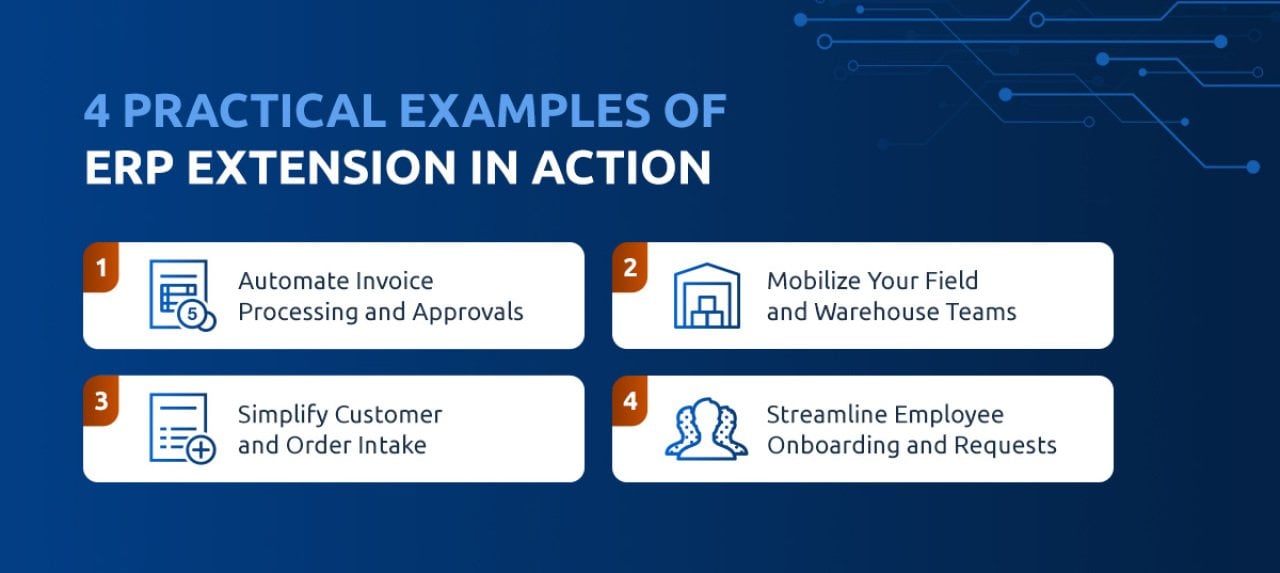


Power Platform business applications bring value in practical, real-world scenarios. Leading national companies like T-Mobile have successfully deployed these tools to improve their processes and customer interactions.
1. Automate Invoice Processing and Approvals
Many finance teams rely on labor-intensive invoice workflows. They receive invoices via email, print them, manually key them into the ERP and physically route them for approval. This process can take days and introduce errors at multiple points.
Power Platform ERP extension transforms this process. A Power Automate flow monitors an inbox, uses AI to extract invoice data, creates a draft record and routes an approval request via Microsoft Teams or email.
SLB, a global technology company, used Power Apps to streamline project life cycle management. With AI-powered discovery, SLB helped users quickly identify similar projects for consolidation.
2. Mobilize Your Field and Warehouse Teams
Teams often struggle with outdated data entry methods. For example, field technicians may use disconnected spreadsheets that need manual reentry back at the office.
Microsoft Power Apps ERP solutions allow for real-time, on-the-go data capture. Warehouse employees can use a simple Power App on a tablet for inventory counts. Similarly, field technicians can use a mobile Power App to enter service data, capture photos and get customer approval.
For example, the Singapore Civil Defence Force developed an Interactive Troubleshooting App to support field efficiency. This application helps officers perform self-help vehicle maintenance through step-by-step guides, improving resolution times and operational readiness.
3. Simplify Customer and Order Intake
Sales teams often use emails or spreadsheets to record complex orders or customer information. The back-office team must then manually reenter and validate this data, causing errors and delays that affect customer satisfaction.
A guided Power App supports data quality at the source. These applications have built-in business rules and can validate sales information before your team submits it to the ERP.
Concentrix turned its time-consuming manual invoice process into an efficient, fully automated solution. Their team achieved 96% extraction accuracy with Power Automate, Power Apps and AI Builder.
4. Streamline Employee Onboarding and Requests
HR departments manage several manual processes for new hire setups and employee requests. These often involve filling out PDFs and emailing different departments, with no visibility into completion status.
Power Platform Dynamics 365 integration streamlines these workflows. An employee will submit a request through a single Power App, and it will simultaneously route tasks to the IT, HR and finance teams. Then, your team can automatically complete and track all necessary steps.
For instance, Epiq’s Launchpad initiative seamlessly integrated with existing systems. Their team effectively eliminated manual tasks, reduced onboarding time and enabled rapid scaling for short-term projects.
A Framework for Successful Implementation
While ERP tools are powerful, a strategic approach is essential for success. These principles ensure your investment delivers measurable returns.
- Start with a strategic business problem: Identify a high-impact challenge to solve, rather than building an application for the sake of doing so. Focus on processes that consume significant time, create bottlenecks or cause frequent errors.
- Define your success metrics: Secure buy-in from all relevant departments before development begins. Define what a win looks like in measurable terms. That could be reducing invoice processing time by 50% or eliminating manual data reentry. Clear metrics support accountability and long-term value.
- Choose a reliable implementation partner: Experience is vital for avoiding pitfalls. A trustworthy partner brings technical expertise and a proven process to ensure your project delivers real business value. They must understand how to integrate Power Platform with your specific ERP environment and guide you through transitional challenges.
This story was produced by Winfosoft and reviewed and distributed by Stacker.


(0) comments
Welcome to the discussion.
Log In
Keep it Clean. Please avoid obscene, vulgar, lewd, racist or sexually-oriented language.
PLEASE TURN OFF YOUR CAPS LOCK.
Don't Threaten. Threats of harming another person will not be tolerated.
Be Truthful. Don't knowingly lie about anyone or anything.
Be Nice. No racism, sexism or any sort of -ism that is degrading to another person.
Be Proactive. Use the 'Report' link on each comment to let us know of abusive posts.
Share with Us. We'd love to hear eyewitness accounts, the history behind an article.