



(Sarah Peterson/ US NRL via SWNS)
By Dean Murray
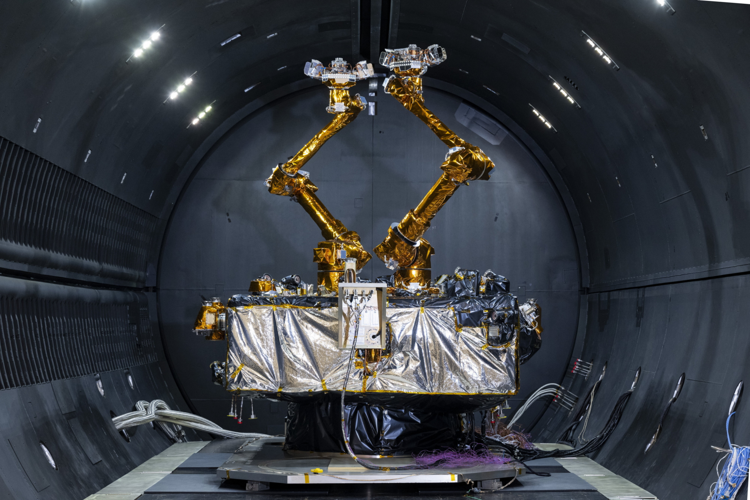
A U.S. spacecraft with two robotic arms designed to service satellites — and with potential to destroy enemy assets — has been launched.
The Robotic Servicing of Geosynchronous Satellites (RSGS) payload, flying aboard the Mission Robotic Vehicle (MRV), is designed to extend the life of satellites in orbit.
The mission launched from Cape Canaveral U.S. Space Force Station on Tuesday, July 21.
Military website TWZ reports that, in response to a question about whether offensive versions of the spacecraft could be used to disable adversary satellites, MRV developer Northrop Grumman's CEO Kathy Warden said Tuesday, "I will leave it up to the U.S. government to decide how that capability might fulfill mission objectives that they have in that regard.
"Certainly, it’s our objective to offer our clients options for technology deployment and for them to determine policy for when and how they might deploy that technology."
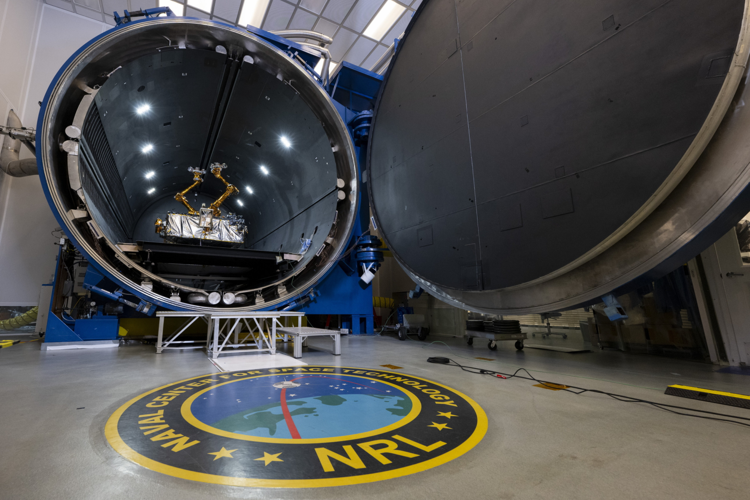
Funded by DARPA, the U.S. Department of War's research agency, the RSGS payload is designed and developed by the U.S. Naval Research Laboratory (NRL).


(Sarah Peterson/ US NRL via SWNS)
DARPA said hundreds of military, government and commercial satellites reside today in geosynchronous Earth orbit (GEO), approximately 22,000 miles (36,000 kilometers) above the Earth.
They explain, "This position is ideal for providing communications, meteorology and national security services. Yet the distance prevents inspection and diagnosis of malfunctioning components, let alone upgrades or repairs."
Once in orbit, the RSGS payload can inspect and service satellites, refuel them, remove debris or tow them into different orbits.
NRL Commanding Officer Capt. Randy Cruz said, "The successful launch of the RSGS payload provides the Department of War with a critical capability to maintain and sustain vital space infrastructure at operational scale.
"Extending the lifespan of our orbital assets ensures continuous mission readiness and enhances the overall resilience of U.S. space infrastructure."
Acting Director of NRL Naval Center of Space Technology Bernard Kelm said, "By combining NRL's decades of space robotics research with commercial spacecraft and launch capabilities, we have created a rapid, scalable pathway to field next-generation space logistics for both national security and civil space missions."
The launch follows President Donald Trump's announcement last year of the $175 billion "Golden Dome" missile defense system, a space- and ground-based shield intended to intercept missiles fired at the United States from anywhere in the world.


(0) comments
Welcome to the discussion.
Log In
Keep it Clean. Please avoid obscene, vulgar, lewd, racist or sexually-oriented language.
PLEASE TURN OFF YOUR CAPS LOCK.
Don't Threaten. Threats of harming another person will not be tolerated.
Be Truthful. Don't knowingly lie about anyone or anything.
Be Nice. No racism, sexism or any sort of -ism that is degrading to another person.
Be Proactive. Use the 'Report' link on each comment to let us know of abusive posts.
Share with Us. We'd love to hear eyewitness accounts, the history behind an article.