


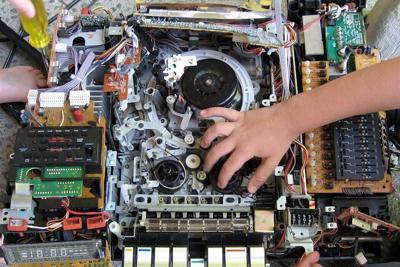
If you have ever tried to repair something, realized that it was beyond your financial or technical means, and ended up buying a new one, you are not alone. Repairing electronics and household appliances has not been a real option in the United States for decades now, particularly for items that have proprietary software in them.
Absurd situations have proliferated. It can cost about the same to buy a new printer as it does to replace the ink cartridge. The U.S. Department of Defense cannot repair the weapons systems it purchases because the intellectual property rights remain with the manufacturer. John Deere, the farming equipment company, doesn’t allow farmers to access the software needed to repair their own combines and tractors because, while the purchase covers the physical machinery, it does not cover the software.
One consequence, in addition to cost and frustration for consumers, is environmental harm. The U.S. is the world’s second producer of electronic waste after China, to the tune of about 43 lbs (19.5 kg) of electronic waste annually per person. Only 25% of this e-waste is recycled.
The right-to-repair movement emerged in response, calling for people to be able to repair what they purchase, or have third parties do the repair work, without unnecessary financial, legal or technical barriers. Right to repair seems to be a rare area of bipartisanship in Congress. The Warrior Right to Repair Act – introduced in 2025 by a Democrat – and the Repair Act – introduced by a Republican – are two ongoing legislative initiatives to create a federal legal framework that would make it easy and cheap for American users to repair their devices. Both bills are fiercely opposed by industry groups.
As a scholar of American culture, I found through my research that the origins of the legal and technical obstacles to product repairs lie in debates in the 1980s over new media and copyright guardrails.
Hollywood and VCRs
The rapid rise and popularity of video cassette recorders, or VCRs, in the late 1970s transformed films and TV shows from transient experiences into tangible consumer goods. As I show in my book, “Videotape,” despite the potential for extra revenue, Hollywood was alarmed by the fact that users were now able to copy films on videotape, and tried to stop the technology. Today’s repair bans are part of that story.
The first U.S. copyright provisions were embedded in the 1790 Constitution. Over time, the law was amended to include new technologies, but at the core of future legal arrangements remained the initial intent: to protect the financial rights of creators while giving enough access to information for society as a whole to progress.
Until the second half of the 20th century, the American doctrine of fair use, which allows the unlicensed use of protected works under specific conditions, allowed judges to prevent copyright law from negatively affecting public interest. Organizations such as public libraries, book clubs, universities and news organizations benefited from this legal approach. The concept was codified into American law in the Copyright Act of 1976.
When the film studios took Sony to court to stop the production and sale of video recorders in 1976, they argued that Sony’s product encouraged copyright infringement. But the U.S. Supreme Court ruled in 1984 that taping TV content for personal use did not violate copyright law, expanding the understanding of fair use.
The industry then focused on finding a technological solution to the piracy problem and on securing stricter legal protections for its products.
They identified the digital versatile disc, or DVD, as a safer alternative to the VHS tape. Initially, the DVD was a read-only format. It took a few more years of engineering before affordable recording was possible. Even then, the process was far more complicated for users than videotape recording. In 1997, barely one year after the video disc was launched, all of the Motion Picture Association of America member studios joined the DVD Forum, collectively adopted the new format and started to phase out films released on videotape.


Copyright and virtual locks
Then came digital rights management. Collectively, the term refers to the battery of technological tools that the industry developed in order to control user access to content. These include encryption software and various forms of authentication or enforcement software that limit which types of digital activities users can perform. For instance, some mechanisms block the option to download or share a digital file.
The Digital Millennium Copyright Act, or DMCA, signed into law by President Bill Clinton in 1998, provided the broad legal framework that allowed these technological locks to expand far beyond entertainment, including to software. The Digital Millennium Copyright Act reflected a new alignment in interests between the entertainment and software industries. It increased existing penalties for copyright infringement online and criminalized any technology used to bypass technological locks. The law was adopted although at the time – and since then – critics warned that it could stifle innovation and increase costs for consumers.
Since 1998, more and more consumer products, from toys to dishwashers, use microchips and proprietary software protected by copyright. Because of the Digital Millennium Copyright Act, third party repairers cannot alter or bypass the proprietary software. If they did so, they would be liable for infringing the manufacturer’s intellectual property rights, as is the case for John Deere farm equipment. Some electronics are even designed to make tampering with the product impossible.
Manufacturers maintain that only they or authorized personnel can and should repair their products. These repairs are often quite costly. When getting a product repaired becomes almost as expensive as buying a new one, many consumers will choose to buy and throw repairable items away.
Rising resentment over repair bans
Technology tends to outpace existing legal arrangements. With over 80% of Americans supporting the right to repair, it remains to be seen when or if American law will catch up with the unexpected consequences of a law meant to protect the intellectual rights of the creative industries, but which is now hurting consumers’ pocket books.
This article is republished from The Conversation, a nonprofit, independent news organization bringing you facts and trustworthy analysis to help you make sense of our complex world. It was written by: Oana Godeanu-Kenworthy, Miami University
Read more:
- In rural America, right‑to‑repair laws are the leading edge of a pushback against growing corporate power
- The battle over right to repair is a fight over your car’s data
- US government tries to rein in an out‑of‑control subscription economy
Oana Godeanu-Kenworthy does not work for, consult, own shares in or receive funding from any company or organization that would benefit from this article, and has disclosed no relevant affiliations beyond their academic appointment.


.jpg)
(0) comments
Welcome to the discussion.
Log In
Keep it Clean. Please avoid obscene, vulgar, lewd, racist or sexually-oriented language.
PLEASE TURN OFF YOUR CAPS LOCK.
Don't Threaten. Threats of harming another person will not be tolerated.
Be Truthful. Don't knowingly lie about anyone or anything.
Be Nice. No racism, sexism or any sort of -ism that is degrading to another person.
Be Proactive. Use the 'Report' link on each comment to let us know of abusive posts.
Share with Us. We'd love to hear eyewitness accounts, the history behind an article.