


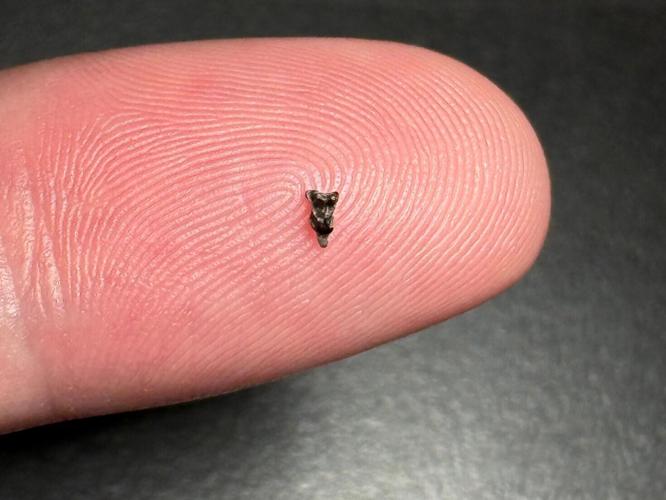
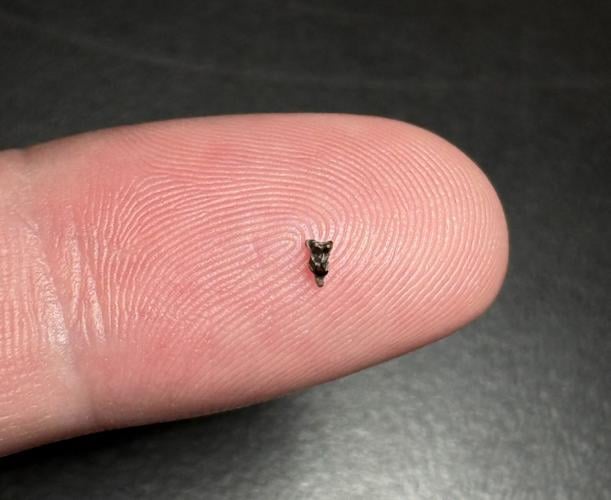
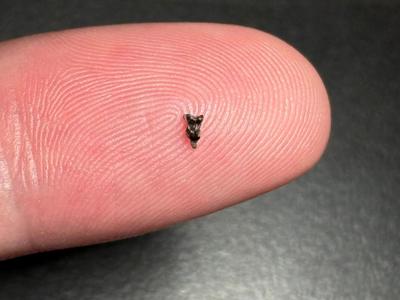

Tiny fossill of purgatorius upper molar from Corral Bluffs in Denver. (Dr. Stephen Chester via SWNS)
By Stephen Beech
A fossil that would fit on a baby’s fingertip has revealed fresh clues about the evolution of the earliest-known relative of all primates, including humans.
Remains of the now extinct shrew-sized mammal called Purgatorius had only previously been found in the northern United States and Canada.
But the "miniscule" new fossil was discovered 500 miles south in Colorado’s Denver Basin.
Palaeontologists say it suggests the species diversified soon after the mass extinction at the end of the Cretaceous period.
Thy explained that Purgatorius first appears in North America immediately after the extinction of the dinosaurs around 65.9 million years ago.

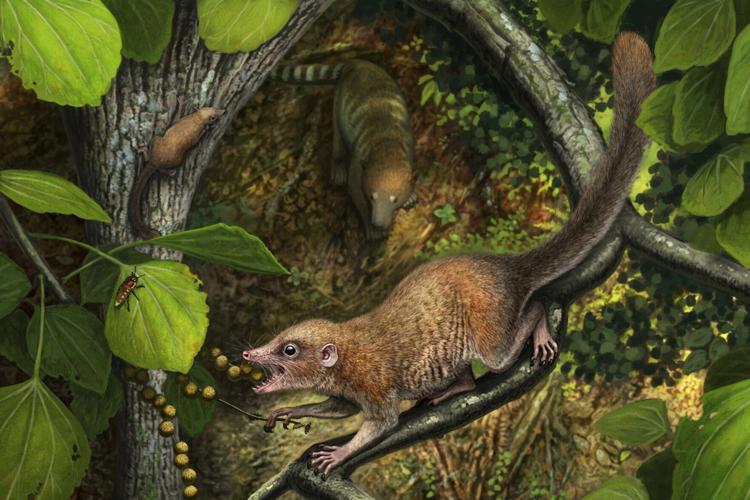
Illustration of a Purgatorius. (Andrey Atuchin via SWNS)
Fossils of the mammal had previously only been found in present day Montana and south-western Canada.
Researchers say the next set of primates include a diversity of relatives in the south-western United States, but they date to some two million years later.
The discovery of the southernmost fossil at Corral Bluffs in Colorado’s Denver Basin was reported in the Journal of Vertebrate Paleontology.
Study lead author Professor Stephen Chester, from City University of New York (CUNY), said: “The discovery helps fill the gap in understanding the geography and evolution of our earliest primate relatives.


“The presence of these fossils in Colorado suggests that archaic primates originated in the north and then spread southward, diversifying soon after the mass extinction at the end of the Cretaceous Period.

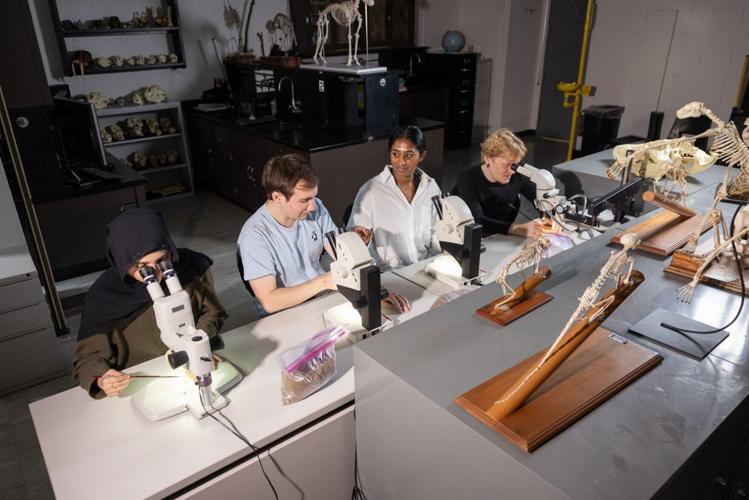
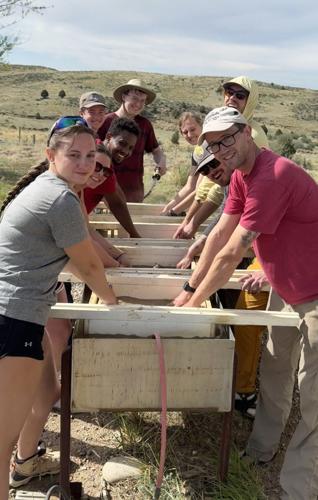
Brooklyn College Undergraduate Research assistants. (Dr. Stephen Chester via SWNS)
“Ankle bones of Purgatorius exhibit features that indicate it lived in trees, so we initially thought its absence south of Montana could be related to the sweeping devastation of forests from the asteroid impact 66 million years ago.
“However, our paleobotanical colleagues suggested the recovery of plants in North America was fast leading us to believe that Purgatorius should also be in more southern regions and perhaps we simply hadn’t looked hard enough.”
Dr. Chester and colleagues from the Denver Museum of Nature and Science (DMNS) deployed an extensive screen-washing technique conducted by students and volunteers.
It resulted in the discovery of several fossils of fish, crocodilians, turtles, and eventually, a few tiny Purgatorius teeth.
Dr. Jordan Crowell, a postdoctoral fellow at DMNS, says what is particularly “exciting” about the teeth is that they could in fact belong to an earlier species of Purgatorius.

DMNS interns and volunteers.(Dr. Tyler Lyson via SWNS)
He said: “The specimens have a unique combination of features compared to known species of Purgatorius, but we are awaiting the recovery of additional material to assess whether these fossils represent a new species."
Dr. Chester added: “Our results demonstrate that small fossils can easily be missed.
“With more intensive searching, especially using screen-washing techniques, we will undoubtedly discover many more important specimens.”
Study co-author Dr. Tyler Lyson, of DMNS , said: “Thanks to our long-term partnership with the City of Colorado Springs who own the land where the fossils were collected, as well as countless hours of work by our volunteers and interns picking through the dirt for the precious vertebrate fossils, we are building some incredible datasets that provide insights on how life including our earliest primitive primate ancestors, rebounded after the single worst day for life on Earth."


(0) comments
Welcome to the discussion.
Log In
Keep it Clean. Please avoid obscene, vulgar, lewd, racist or sexually-oriented language.
PLEASE TURN OFF YOUR CAPS LOCK.
Don't Threaten. Threats of harming another person will not be tolerated.
Be Truthful. Don't knowingly lie about anyone or anything.
Be Nice. No racism, sexism or any sort of -ism that is degrading to another person.
Be Proactive. Use the 'Report' link on each comment to let us know of abusive posts.
Share with Us. We'd love to hear eyewitness accounts, the history behind an article.