






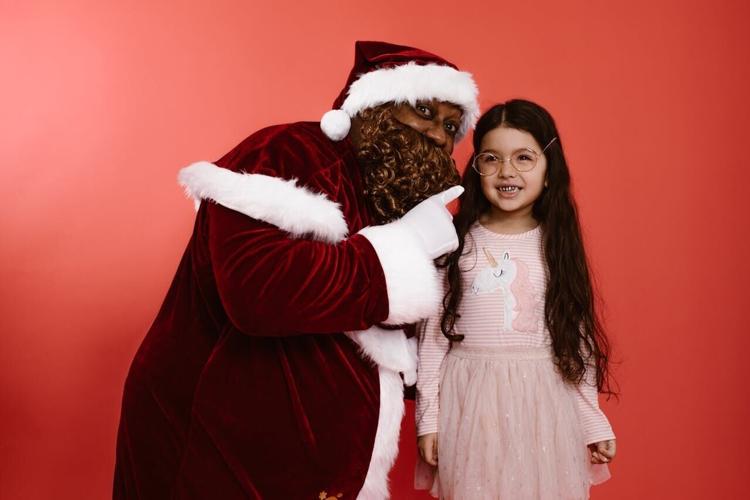

(Photo by cottonbro studio via Pexels)
By Stephen Beech
Santa doesn't need a white beard and a round belly to be a success in the role, according to new research.
A study involving hundreds of people who have taken on the role of Santa Claus suggests that a calling to play the man with the bag full of toys is enough to help candidates overcome a lack of typical attributes to fill his boots.
American researchers interviewed more than 50 people who have been employed as Kris Kringle and analyzed over 800 responses to a survey of professional Santas.
Study co-author Dr. Borbala Csillag, of Oregon State University (OSU), said: “There are pretty strong societal expectations around what Santa looks like, but we found that most anybody can be Santa if their heart desires it.
“When we looked at the people behind the suit, we found that the folks playing Santa are really more diverse than would be expected.”
Dr. Csillag and her colleagues were brainstorming themes they might research during the Covid-19 pandemic when study lead author Dr. Christina Hymer, who'd been watching festive movies with her child, suggested there might be something to learn about how Santas narrated their work experiences.

(Photo by KoolShooters via Pexels)
The findings, published in the Academy of Management Journal, showed that the professional Santas fell into three distinct groups.
Prototypical Santas bear most of the physical and internal attributes one might associate with Santa Claus.
Semi-prototypical Santas bear some but not all of the key attributes.
Non-prototypical Santas may not bear much resemblance at all to the man in the red suit, but have found ways to surmount the odds and become Father Christmas.
Each group of Santas has shared experience based on how typically they fit the role, according to the researchers.
Prototypical Santas, who tend to be older white men with beards and round bellies, shared a strong sense of unity with the calling and live out their Santa identity year-round.
Semi-prototypical Santas find ways to resolve the dissonance between their attributes and the Santa role.
For example, a skinny Santa wove an explanation of his lack of belly into his Santa identity, claiming that Santa was getting healthy.

(Photo by Samuel Peter via Pexels)


A Santa who uses cochlear implants told children it was a microphone to the head elf at the North Pole.
The non-prototypical Santas, such as a woman, an Orthodox Jew or a person of color, tend to strongly see themselves as "Father Christmas" on a year-round basis, still living out their feelings of being called to the Santa role despite their non-prototypical attributes.
Those interviewed told researchers they experienced rejection along their path.
An African American Santa was told a store wasn’t ready for black Santa, but he persisted.
A physically disabled Santa reinterpreted characteristics of Father Christmas to address his needs, such as using a motorized scooter to participate in a parade.
Dr. Csillag, an Assistant Professor of management in OSU’s College of Business, said: “These atypical Santas are trailblazers.
“The expectations for playing the role may seem exclusive, but they are surmountable.”
Dr. Csillag noted that the researchers only interviewed people who had successfully become Santa, so there may still be people with the desire to become Father Christmas who have not been able to achieve that goal.
She said the findings of the Santa study have broader implications for employers and potential employees as well.

(Photo by RDNE Stock project via Pexels)
For example, people who feel called to a role because of a personal, moral or social significance - such as teaching, nursing or faith-based jobs - may be able to succeed in that role, even if they don’t meet typical societal requirements.
Dr. Csillag said: “You don’t have to possess the ‘must-haves,’ such as looking a certain way or having a certain trait, to live out your calling.
“Think about your attributes in a comprehensive way so you can identify the dimensions of the role that are well-fitting.
"You will likely find attributes that map to that calling, even if they are not obvious at first.”
She says another takeaway from the research is that leaders who govern membership in professional organisations have strong influence on role expectation.
Dr. Csillag says such leaders can help make occupations to which people feel called more welcoming to diverse candidates by relaxing "exclusionary expectations" that don’t ultimately limit success in the role.
She added: “If we want to be open to a diverse set of people living out their calling, leaders might need to be a bit more flexible about what it means to fulfill the role."


(0) comments
Welcome to the discussion.
Log In
Keep it Clean. Please avoid obscene, vulgar, lewd, racist or sexually-oriented language.
PLEASE TURN OFF YOUR CAPS LOCK.
Don't Threaten. Threats of harming another person will not be tolerated.
Be Truthful. Don't knowingly lie about anyone or anything.
Be Nice. No racism, sexism or any sort of -ism that is degrading to another person.
Be Proactive. Use the 'Report' link on each comment to let us know of abusive posts.
Share with Us. We'd love to hear eyewitness accounts, the history behind an article.