


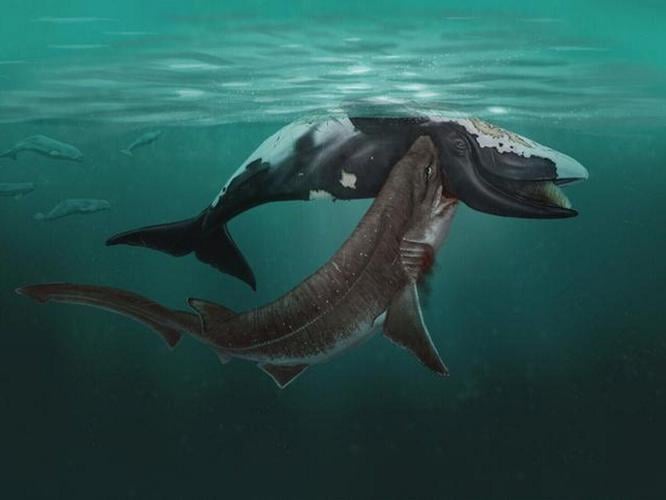
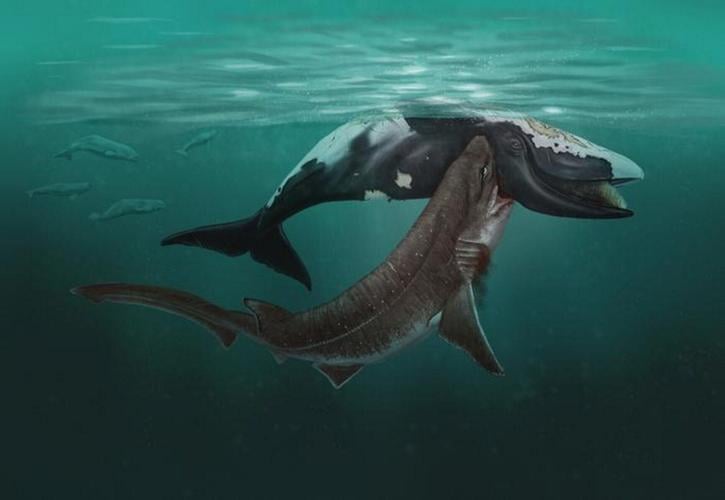
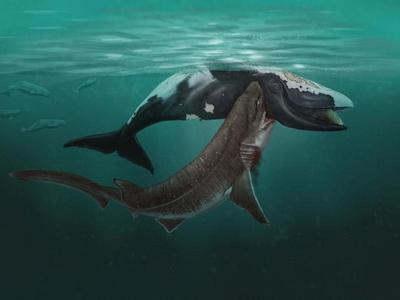

A painted reconstruction of a bluntnose six-gill shark (or cow shark) scavenging on a tiny extinct right whale carcass during the Early Pliocene of the southern North Sea. A pod of an extinct whale related to today's belugas swimming in the background. (Alexander Lovegrove via SWNS)
By Stephen Beech
Great white sharks' ancestors were attacking and eating whales in the North Sea five million years ago, reveals new research.
Detailed analysis of two fossilized whale skulls dating back around five million years found fragments of sharks’ teeth lodged inside them.
The discovery provides rare evidence of how sharks fed on whales in north European waters in prehistoric times, say scientists.
The study, led by researchers at the Royal Belgian institute of Natural Sciences in Brussels (RBINS), analyzed the fossils to determine how sharks fed on their prey.

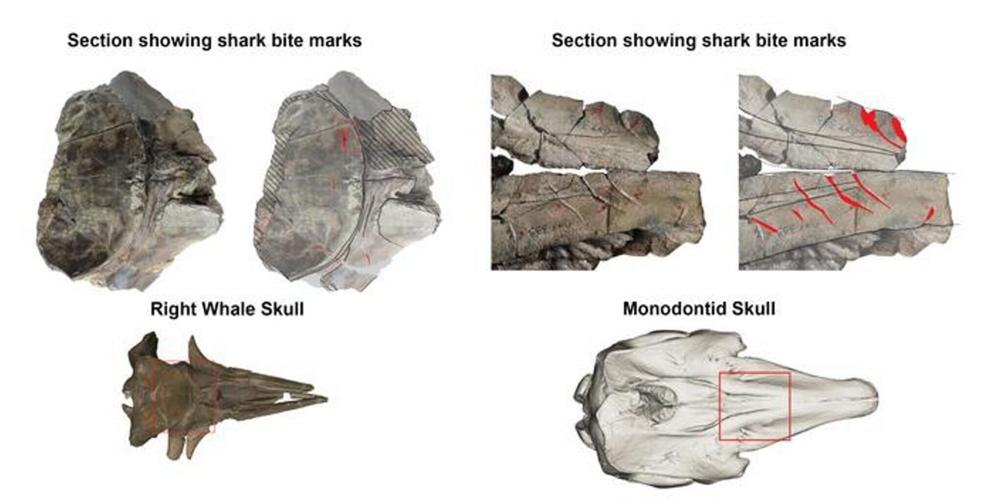
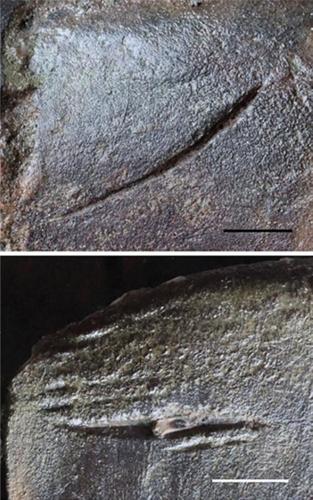
Photographs (left) showing the extinct right whale partial skull with shark bite marks highlighted in red. The more complete skull on the lower part of the illustration is from another individual of the same right whale species. Photographs (right) showing shark bite marks on the rostrum of the monodontid cranium, targeting the fat-rich melon. The skull on the lower part of the illustration is the one of a modern beluga. (Olivier Lambert via SWNS)
CT scans of the two skulls revealed teeth from a shark that had broken off and lodged in the whales' skulls during feeding.
Dr. Olivier Lambert, a paleontologist at RBINS, conducted the examination of the skulls.
He said: “Our knowledge of past marine mammal assemblages in the North Sea remains rather fragmentary, so any new fossil may prove informative.
"In this case, the studied skulls revealed some unexpected and fascinating clues about the way these whales' life ended.”
He explained that both skulls date from the Early Pliocene period, four to five million years ago, and were found in Belgium.
One of the skulls - from an extinct tiny form of right whale - was found in the 1980s by Professor John Stewart, from Bournemouth University, when he was fossil hunting with his father in the Antwerp docks in Belgium.
The second skull is of a monodontid, a relative of the present-day beluga and narwhal, and was found by fossil enthusiast Dr. Paul Gigase, who was a pathologist by profession, together with his son Pierre.

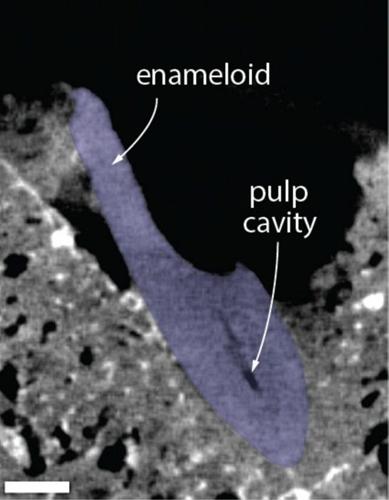
CT scan view of the tip of bluntnose six-gill shark (or cow shark) tooth (blue) found embedded in the extinct right whale skull. Scale bar = 1 mm). (Olivier Lambert via SWNS)


Forty years after Professor Stewart’s discovery as a teenager, modern technology has revealed some of the secrets within the two skulls.
Study co lead author Dr. Lambert said: “The CT scans revealed the shape of the teeth allowing the sharks’ identification without having to damage the skulls.
"The position of the bite marks in the upper part of the right whale skull tells us that the animal had probably already died when the shark scavenged its carcasses and that it was in a belly-up position, which is common for deceased whales.”
The tooth fragment found in Professor Stewart’s whale is from a cow shark, according to the study published in the journal Acta Palaeontologica Polonica.
The tooth fragment in the other skull belongs to a relative of the modern great white shark.
But the researchers said none of those species, or their modern relatives, are found in the southern North Sea today.
Stewart said: “Paleontologists often have to make assumptions about the interactions between many of the species from this period.

Photo detail of some shark bite marks on the skull of the extinct right whale. The lower photo shows a bite made by the bluntnose six-gill shark, with a tooth tip deeply embedded in the bone. Scale bars = 10 mm. (Olivier Lambert via SWNS)
"This study provides them with actual evidence they can work with – not just bite marks, but fragments from the predators who made the bites.”
Paleontologists are gradually piecing together a picture of a time when whales and large predatory sharks were swimming in seas around Northern Europe.
Dr. Lambert said: “These whale skulls provide a rare glimpse into the relationship between large predators and their prey off the coast of Northern Europe five million years ago.
"These findings are a first step towards understanding changes through time in the availability of prey in the southern North Sea and the loss of large predatory sharks in this area."
He added: "Given that ongoing climate change is altering the distribution of marine mammals, including in the North Sea, it is likely that the distribution of their predators will also change.
"Could great white sharks return to the North Sea to feed on local seal populations?”


(0) comments
Welcome to the discussion.
Log In
Keep it Clean. Please avoid obscene, vulgar, lewd, racist or sexually-oriented language.
PLEASE TURN OFF YOUR CAPS LOCK.
Don't Threaten. Threats of harming another person will not be tolerated.
Be Truthful. Don't knowingly lie about anyone or anything.
Be Nice. No racism, sexism or any sort of -ism that is degrading to another person.
Be Proactive. Use the 'Report' link on each comment to let us know of abusive posts.
Share with Us. We'd love to hear eyewitness accounts, the history behind an article.