



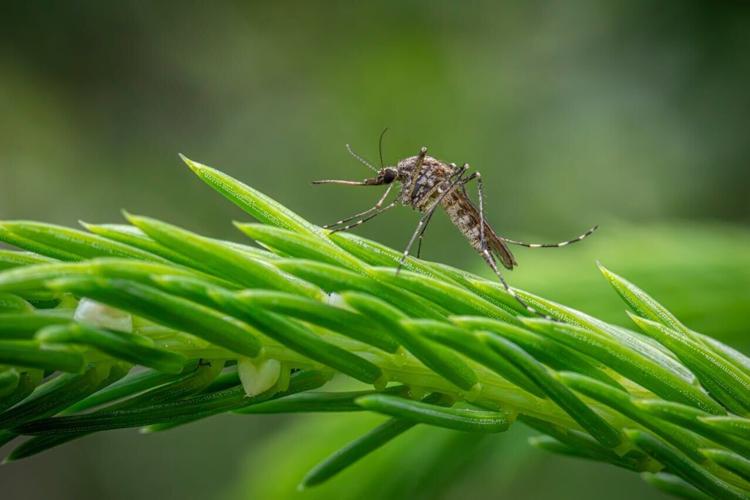

(Photo by Lana Kravchenko via Pexels)
By Stephen Beech
Female mosquitoes call the shots when it comes to mating, reveals new research.
Scientists discovered that a subtle behavior by the female of the species dictates whether the quick-fire procreation process is successful.
The American research team say their findings may improve methods of controlling populations of the disease-spreading insects.
They explained that female mosquitoes have just one shot to get reproduction right as they only mate once in their entire lives.
With the stakes so high, it would make sense for those insects to be quite choosey when it comes to selecting a mate.
But a long-standing assumption of researchers was that males controlled the process, and females were simply passive recipients of sperm.

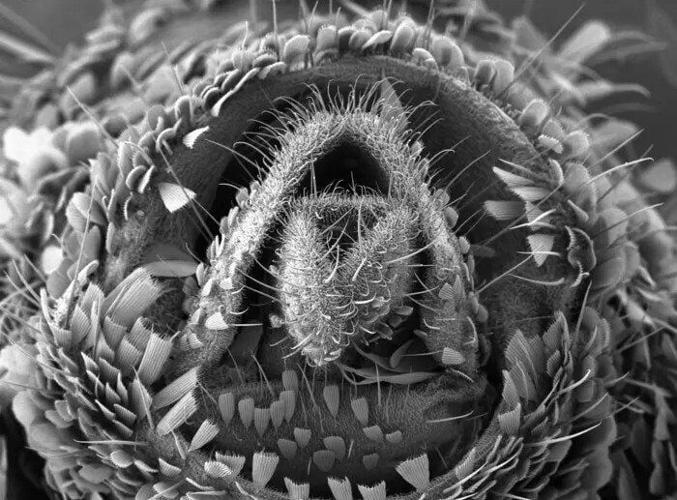
The external genitalia of a female Aedes aegypti. (H.Amalia Pasolli / Anurag Sharma via SWNS)
Study leader Professor Leslie Vosshall, of Rockefeller University in New York, said: “There’s an inherent contradiction in this assumption.
“If females have no say, then multiple males should be able to mate with them all the time.
"So how can a female mosquito both be a helpless creature but also the decision maker?”
Puzzled by the paradox, Vosshall and her team analyzed the moment-by-moment, nuts-and-bolts of mosquito mating.
The study, published in the journal Current Biology, uncovered the first evidence that scientists had it backwards.
They found what makes mating possible is a subtle behavior of the female - a physical movement of her genitalia.
The team found that no subsequent physical pairings trigger the behavior again, regardless of how many males try, or how often they try - and they try a lot.

(Photo by Santosh Maharjan via Pexels)
Study lead author Dr. Leah Houri-Zeevi said: “It’s a very fast, very subtle change, but it entirely dictates whether mating occurs.
“If she makes this movement, it happens. If she doesn’t, it doesn’t matter what the male does - no successful mating will occur.”
She says a single female mosquito can produce up to 1,000 eggs in a single lifetime.
Following her lone mating, she stores the male’s sperm in internal reservoirs.
Every three to four days, she feeds on the blood of a host, and once sated, draws from those sperm reservoirs to inseminate and lay her eggs in fresh water.
Despite studies on mosquito mating going back to the 1950s, the role of the female in the process remained obscure.
The speed of the process - the interactions that lead to mating take just one or two seconds - makes it challenging to capture, and might have been combined with hidden biases for what the female role in mating could be.


Vosshall said: “There’s a long history in biology of assuming male agency and female passivity.
“This study is a reminder that those assumptionsâ¯can get in the way of seeing what’s actually happening, even in something as well-studied as mosquito mating.”

(Photo by Jimmy Chan via Pexels)
The research team investigated the mating practices of two of the most invasive mosquito species in the world: the yellow fever mosquito and Asian tiger mosquito.
Collectively, they can spread dozens of viruses to humans, including yellow fever, dengue, Zika, and Chikungunya.
The research team analyzed the step-by-step interactions of different mating pairs both within and between species, including female mosquitoes that had never previously mated and those that had.
Using high-speed, high-resolution cameras, deep learning, and transgenic mosquitoes with fluorescent sperm, Dr. Houri-Zeevi and her colleagues discovered that the same three-step process leading to a successful mating between a virgin female and a male occurred in both species.
She said: "First, the male contacts the female genitalia with his genital tip.
"In response, the female chooses whether to elongate her tip to about twice its resting length.
"This behavior is critical for mating. If she doesn’t elongate her tip, mating cannot take place.
"If she does, the male’s internal genitalia interlocks with the female’s tip, and sperm transfers from one to the other."

(Photo by Erik Karits via Pexels)
The research team found that the “key” to unlocking the critical female response is rapidly evolving male structures, called gonostyli, that are inserted into the female genital tip and vibrate rapidly when the male attempts copulation.
Dr. Houri-Zeevi and the team also observed what occurred when a previously mated female and male attempted to interlock:
Step two didn’t occur. That apparently prevents step three - successful insemination.
Dr. Houri-Zeevi said: “After one successful mating, she will never elongate that tip again,”
They found that the tip elongation mechanism in both species, showing that female control over mating is shared in mosquitoes that diverged about 35 million years ago.
But they also noted differences between the two species, suggesting that within each species, there is a specific female lock and a specific male key.
The researchers say their findings may help explain why when Asian tiger mosquitoes move into an area, the population of yellow fever mosquitoes drops or vanishes.
They believe it may also help improve methods of mosquito population control.
Vosshall said: “It’s really important for people who work in an area to understand how the biology of females of a local wild population is going to interact with males from a genetically modified population.”
The team plan to explore the finer details of the "lock-and-key" mating mechanism for each species.
Vosshall added: “We want to understand the neuronal code the female is using to sense male stimulation and then make her decision.
“The question it comes down to is, how does she choose between different suitors given that it’s a once-in-a-lifetime choice?”


(0) comments
Welcome to the discussion.
Log In
Keep it Clean. Please avoid obscene, vulgar, lewd, racist or sexually-oriented language.
PLEASE TURN OFF YOUR CAPS LOCK.
Don't Threaten. Threats of harming another person will not be tolerated.
Be Truthful. Don't knowingly lie about anyone or anything.
Be Nice. No racism, sexism or any sort of -ism that is degrading to another person.
Be Proactive. Use the 'Report' link on each comment to let us know of abusive posts.
Share with Us. We'd love to hear eyewitness accounts, the history behind an article.