


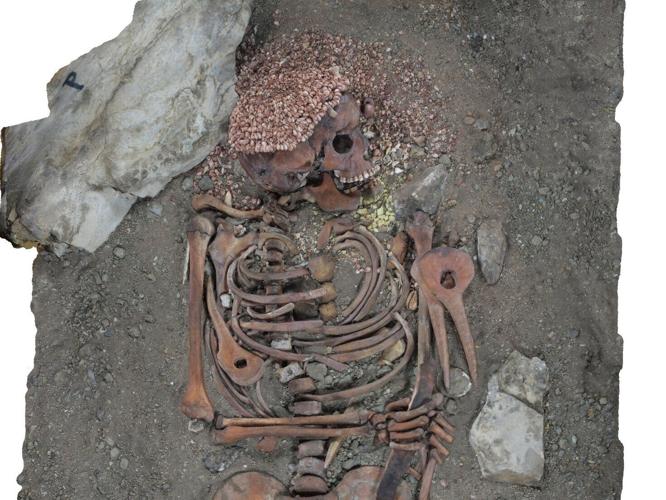
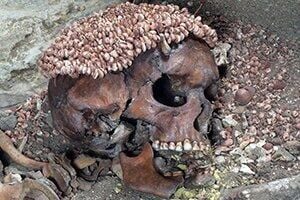
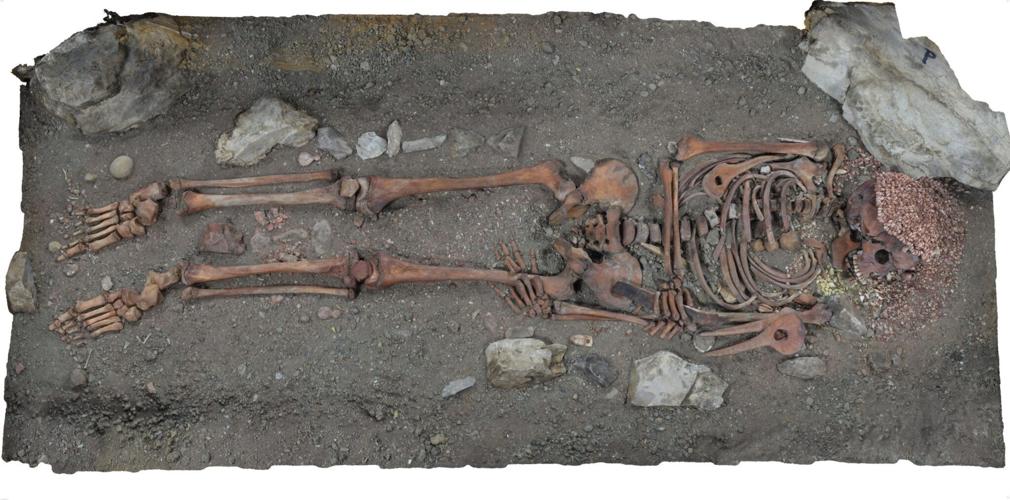
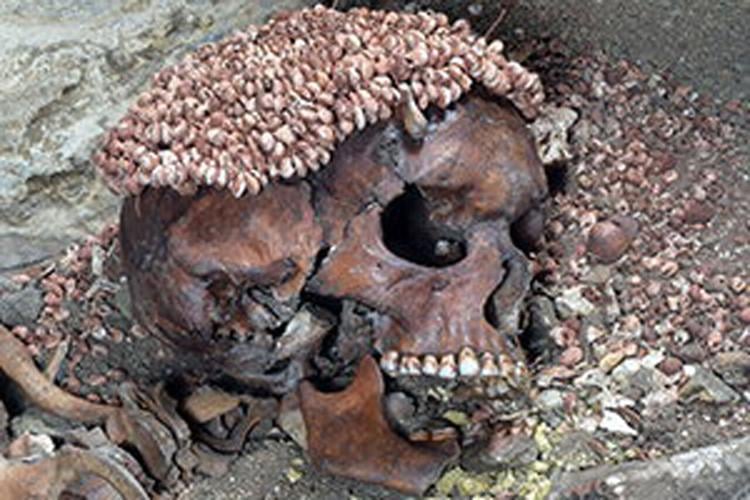

Archaeological records confirm that the "Prince" was buried with a headdress or cap made of hundreds of small pierced shells (plus deer canines and an ivory pendant), which had fallen into place around the skull after organic materials decayed. (V.S. Sparacello et al. via SWNS)
By Dean Murray
A prehistoric Italian teenager may have met a violent end at the claws and teeth of a bear, according to new research.
The adolescent, thought to have been 15–16 years old, was discovered in a cave in Liguria, Italy, in 1942.
An exceptionally rich funerary assemblage - which included a headdress made of hundreds of small pierced shells - led to him being known as the “Prince” of the Arene Candide Cave.
A multidisciplinary team from the universities of Cagliari, Florence, Genoa and Pisa, along with several international institutions, has reâexamined the remains buried some 28,000 years ago.
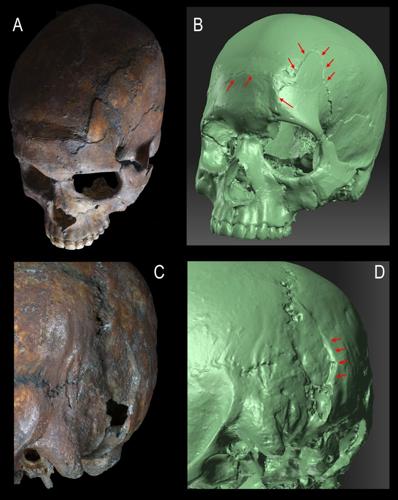
Their study, published in the Journal of Anthropological Sciences, focuses on the traumatic injuries known since the discovery of the burial – such as damage to the skull, face and shoulder, including the loss of the left half of the mandible and part of the clavicle.

Research indicates injuries inflicted by claws and teeth of a cave bear. (V.S. Sparacello et al. via SWNS)


The research revisits the original interpretation proposed by the excavators, who had suggested an animal attack, and confirms that these lesions are compatible with bites from a large carnivore or blows inflicted by a powerful paw.
The team also identified crushing fractures of the cervical vertebrae, consistent with violent compression of the neck.
In addition to these previously known but never fully documented injuries, the study uncovered new evidence, including bite marks on the right fibula and a linear incision on the skull, potentially compatible with a claw strike – most likely a brown bear or a cave bear.

Research indicates injuries inflicted by claws and teeth of a cave bear. Cranial fractures displaying characteristics compatible with perimortem trauma. (V.S. Sparacello et al. via SWNS)
Furthermore, the researchers documented traces of an initial inflammatory response in the spongy bone tissue, allowing them to estimate that the young individual survived – likely unconscious and in agony – for approximately 48–72 hours after the attack.
"The pattern of trauma is strikingly similar to the injuries observed in modern victims of bear attacks," the authors state, emphasizing that survival for several days after such devastating injuries may have profoundly affected the hunterâgatherer band to which the Young Prince belonged.
Researchers argue that the lavish burial rites that followed may have commemorated the exceptional nature of the death rather than the status of the individual.
"The richness of the Prince’s burial would reflect the exceptionality of the event itself, rather than the individual’s social rank," they conclude.


(0) comments
Welcome to the discussion.
Log In
Keep it Clean. Please avoid obscene, vulgar, lewd, racist or sexually-oriented language.
PLEASE TURN OFF YOUR CAPS LOCK.
Don't Threaten. Threats of harming another person will not be tolerated.
Be Truthful. Don't knowingly lie about anyone or anything.
Be Nice. No racism, sexism or any sort of -ism that is degrading to another person.
Be Proactive. Use the 'Report' link on each comment to let us know of abusive posts.
Share with Us. We'd love to hear eyewitness accounts, the history behind an article.