


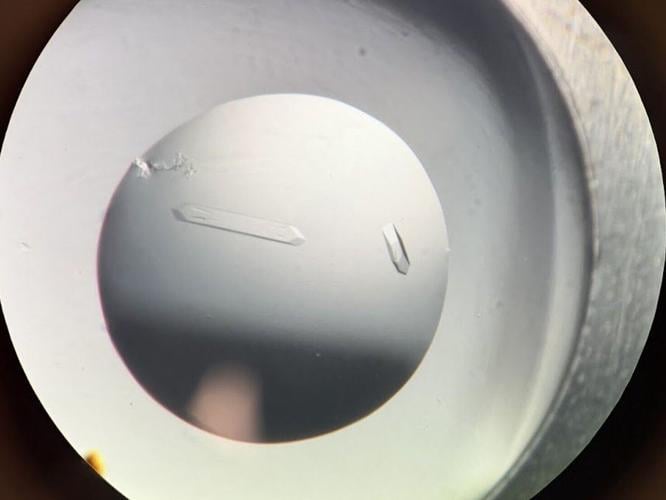
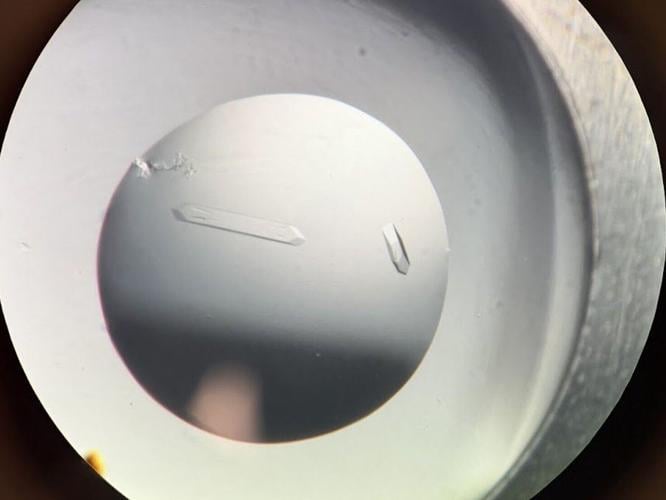
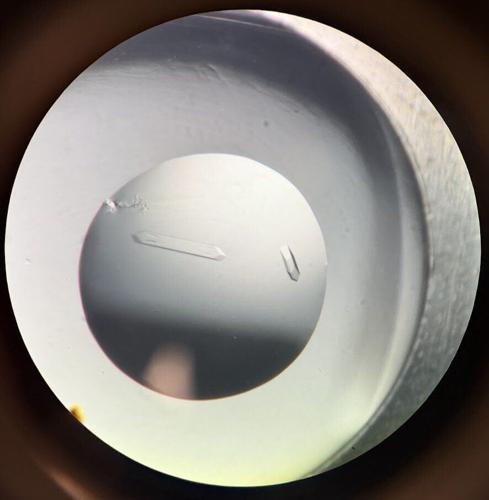

Light microscopy image of crystallised CHIP13 protein. (Kira Gysel via SWNS)
By Stephen Beech
Plants use a molecular “measuring tape” to tell friend from foe, reveals new research.
It enables them to distinguish harmful fungi from beneficial partners, say Danish scientists.
They explained that chitin, a chain of repeating sugar molecules, is the main building block of fungal cell walls.
When fungi grow or are broken down, fragments of chitin chains of different lengths end up in the soil, and plants detect them to monitor the microbes around them.
Long chitin fragments are commonly associated with fungal attack and trigger strong plant immune responses.
But not all fungi are bad, according to the study published in the journal Science.
Shorter chitin fragments are associated with beneficial partnerships, including interactions with symbiotic fungi that exchange essential nutrients with their hosts.
What remained unknown was how plants can tell these signals apart.
Researchers at Aarhus University combined structural biology, which reveals the three-dimensional shape of proteins, with biochemistry and experiments in living plants to investigate the receptors that detect chitin at the surface of plant root cells.
They discovered that a receptor called CHIP13 binds long chitin chains much more strongly than short ones.

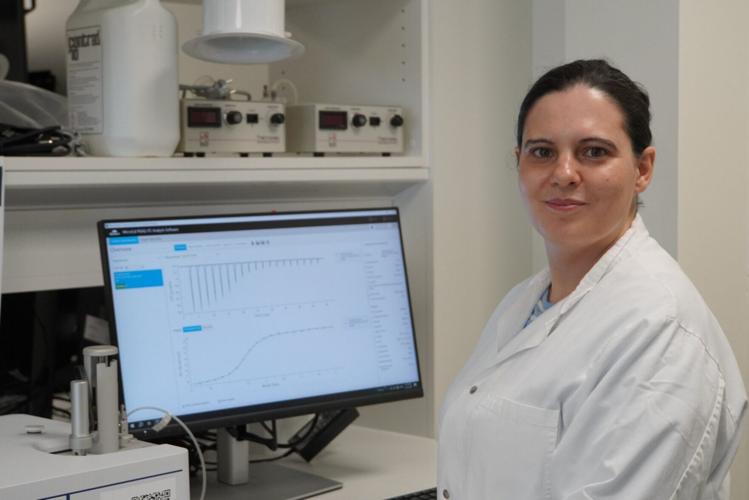
Kira Gysel at Aarhus University. (Emma Steer via SWNS)
A distinctive part of the receptor — which the team calls the “bridge domain” — helps it grip the chain at several points, so that only chains long enough to span them are held tightly.
Study co-leader assistant professor Kira Gysel says the bridge domain is a “hallmark” of a whole class of related receptors.
Gysel said: “The central question was how plants tell long chitin chains from short ones.
“We learned that CHIP13, and specifically its bridge domain, works like a measuring tape.
“That allows the plant to recognize signals associated specifically with a potential fungal attack and not confuse them with signals from potentially helpful microbes.”
She says plants also depend on a second receptor, called CERK6, to respond to chitin.


Gysel and her colleagues investigated how the two receptors work together.
The research team found that in the presence of chitin, CHIP13 recruits CERK6, and the two form a signaling complex that activates the plant’s immune system, with a clear division of labor between the two proteins.
Experiments in which either receptor was blocked confirmed that the plant needs both to mount a defense response.
Gysel said: “CHIP13 can recognize or ‘see’ the long chitin fragments associated with dangerous fungi in the soil.

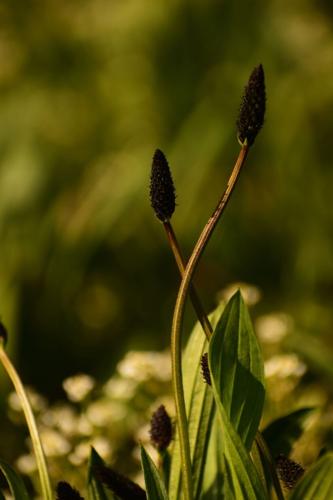
(Photo by ayana durand via Pexels)
“It then physically comes together with CERK6, and only CERK6 can sound the alarm for the rest of the plant.
“Both proteins have very specific jobs, and both are needed for this core pillar of the plant immune system.”
Study co-first author Simon Boje Hansen said: “We were facing a puzzle: how can CERK6 be essential for the plant’s response to chitin, when it can barely hold on to it?
“It turns out the two receptors split the work: one recognizes the signal, the other passes it on.
“Neither can do the job alone.”
Study co-first author Henriette Rübsam said: “We could see this directly in plants too.
“It was only when chitin was bound to CHIP13 that CHIP13 could call on CERK6.
“Importantly, we saw that this was also true in a second legume plant, showing that this mechanism is preserved across different species.”
Gysel says the research is more than just discovering the structure and mechanism of the proteins.
She said it provides valuable new insights into how plants perceive their environment and protect themselves from biological threats in soil.
Gysel added: “This research is a window into the complex pattern recognition system that plants use to interpret the microbial world surrounding them.
“If we can better understand this, we can start to think about designing receptors that read new signals altogether, expanding what plants are capable of sensing and responding to.”
She says the insight could help guide efforts to improve crop resilience.


(0) comments
Welcome to the discussion.
Log In
Keep it Clean. Please avoid obscene, vulgar, lewd, racist or sexually-oriented language.
PLEASE TURN OFF YOUR CAPS LOCK.
Don't Threaten. Threats of harming another person will not be tolerated.
Be Truthful. Don't knowingly lie about anyone or anything.
Be Nice. No racism, sexism or any sort of -ism that is degrading to another person.
Be Proactive. Use the 'Report' link on each comment to let us know of abusive posts.
Share with Us. We'd love to hear eyewitness accounts, the history behind an article.