





(Photo by Diana via Pexels)
By Stephen Beech
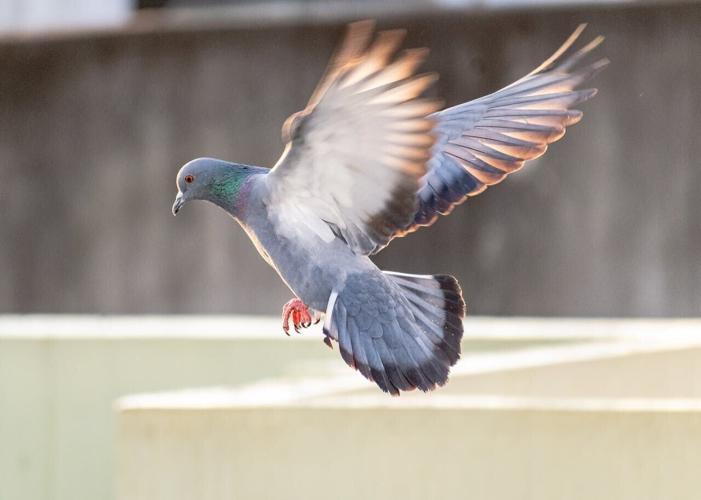
Pigeons find their way home by using magnetic sensors in their livers, suggests new research.
Immune cells packed with iron act as an "internal compass" — helping the birds detect the Earth's magnetic field, say German scientists.
How pigeons fly hundreds of miles and still find their way home has long fascinated people.
Now, scientists believe a surprising answer may be hidden, not in the birds' brains or eyes, but in their liver.
The new study, published in the journal Science, suggests that special cells in the liver of pigeons can sense the Earth's magnetic field, giving them an internal compass.
The special cells — known as "macrophages" — are immune cells that break down old red blood cells.
As part of the process, they accumulate iron, giving them quantum properties that may allow them to respond to magnetic fields.

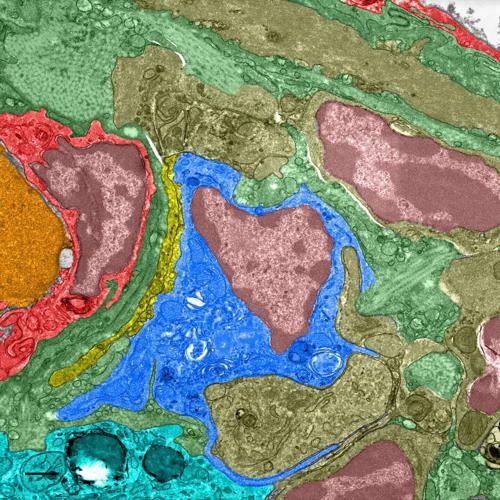
Electron microscopy image of pigeon liver tissue, with full colorization of cells. (Lisowski et al via SWNS)
But, without the cells intact, the study shows pigeons could not navigate home.
Study co-senior author Christian Kurts, director at the Institute of Molecular Medicine and Experimental Immunology at the University Hospital Bonn, said: "We didn't expect immune cells to act like sensors for magnetic fields at all.
"Our results reveal a previously unknown mechanism for magnetic perception in animals."
Co-senior author Martin Wikelski, director at the Max Planck Institute of Animal Behavior, said: "What looks like a 'gut feeling' in bird navigation may actually have a physical basis."
For decades, scientists have known that migratory birds and homing pigeons rely in part on the Earth's magnetic field to navigate.
But exactly how they detect it has remained one of biology's greatest unsolved mysteries.
Competing theories have suggested that birds might "see" magnetic fields through light-sensitive molecules in the eye, or detect them using tiny magnetic particles in the beak.

Homing pigeon being released by scientist at Max Planck Institute of Animal Behavior in Germany. (Christian Ziegler/ Max Planck via SWNS)
But none had come up with convincing experimental support.
The new study proposes a different mechanism for magnetic sensing, supported by a combination of lab tests and behavioral experiments.
The team included immunologists from the University of Bonn and the University Hospital Bonn; physicists from the University of Duisburg-Essen; and ornithologists at the Max Planck Institute of Animal Behavior (MPI-AB).
To identify where magnetic cells are found in pigeons, the research team used techniques known as "vibrating sample magnetometry" and "magnetic cell separation" to screen organs thought to be involved in magnetic sensing, including the eyes, beak, and brain.


They also examined the liver and spleen.
Study first author Clivia Lisowski, from the University of Bonn and the University Hospital Bonn, said: "We had some clues that the liver and spleen have magnetic properties, because they break down red blood cells and so store much iron in the body."
The results supported that idea.
Of all the tissues examined, the liver showed the highest concentration of iron.
Ulf Wiedwald, from the University of Duisburg-Essen, said: "Iron is crystallized in oxide nanoparticles making the cells superparamagnetic and reactive to magnetic fields.

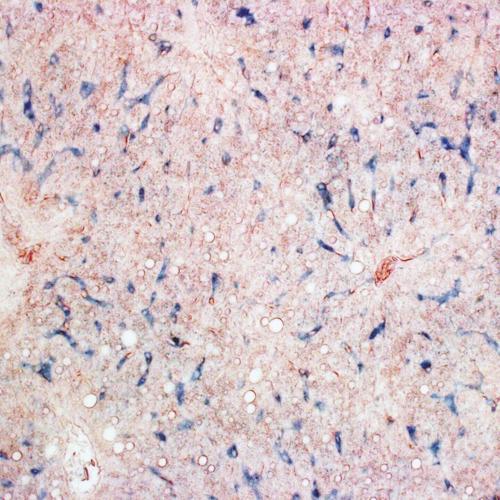
Histology of pigeon liver tissue, depicting iron-containing macrophages (blue). (Lisowski et al via SWNS)
"We found by far the strongest magnetic response in liver tissue."
Further analysis identified macrophages in the liver as the cells responsible.
To test if liver macrophages played a role in navigation, the ornithological team conducted experiments on pigeons that were trained to return from distances over 20 kilometers (12 miles) back to their aviary at the MPI-AB in Konstanz, Germany.
After the macrophages were removed, pigeons lost their sense of direction on overcast days when the sun was obscured.
But, when the sun was visible, the pigeons successfully navigated home, likely using solar cues.
The research team say that, together, the results illustrate the mechanism behind how birds use magnetic sensing, in addition to the sun's orientation, for navigation.
With evidence that the cells influence navigation, the team then looked for how signals from the liver might be relayed.
Electron microscopy showed that the iron-rich macrophages sit close to nerve fibers, suggesting a pathway for magnetic information to reach the brain.
Lisowski said: "These findings provide the first concrete evidence of how the Earth's magnetic field can be perceived within the body and passed on to the brain to guide movement."

(Photo by Rajesh S Balouria via Pexels)
The researchers say their study brings together known biological processes, including iron metabolism and how the immune and nervous systems communicate, into a "clear answer" to the fundamental question of how animals navigate.
Wikelski added: "Animal navigation is one of the most fascinating phenomena in nature.
"If immune cells are part of how birds sense direction, it would fundamentally change how we understand navigation."
He said that, beyond birds, the findings could have implications for animals such as sharks that navigate without light.
Wikelski believes that it's possible that other species — perhaps including humans — may respond to magnetic fields in ways not yet understood.


(0) comments
Welcome to the discussion.
Log In
Keep it Clean. Please avoid obscene, vulgar, lewd, racist or sexually-oriented language.
PLEASE TURN OFF YOUR CAPS LOCK.
Don't Threaten. Threats of harming another person will not be tolerated.
Be Truthful. Don't knowingly lie about anyone or anything.
Be Nice. No racism, sexism or any sort of -ism that is degrading to another person.
Be Proactive. Use the 'Report' link on each comment to let us know of abusive posts.
Share with Us. We'd love to hear eyewitness accounts, the history behind an article.