


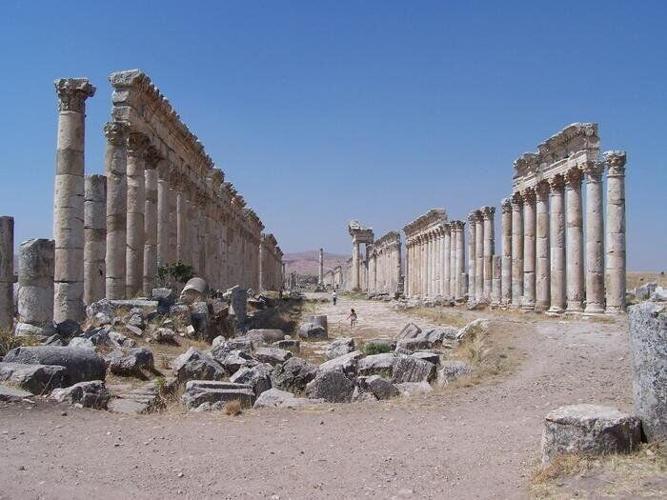



The Great Colonnade at Apamea, a major Roman city in western Syria, in June 2005, before the entire area around the street began to be heavily looted in 2011 to 2012. (Jesse Casana via SWNS)
By Stephen Beech
The devastating extent of "mechanized looting" across dozens of historic sites during Syria's civil war has been revealed by a new study.
Analysis of satellite images shows some significant archaeological locations were bulldozed during the conflict that saw the downfall of dictator and former President Bashar al-Assad's regime at the end of 2024.
The findings of the study, published in the journal Heritage, show that, from 2015 to 2025, more than half of 200 sites (59%) were looted, compared to 2011 to 2016, when 13% of sites were pillaged.
It was already known that several archaeological sites were destroyed by looting during Syria's civil war, which began in 2011.

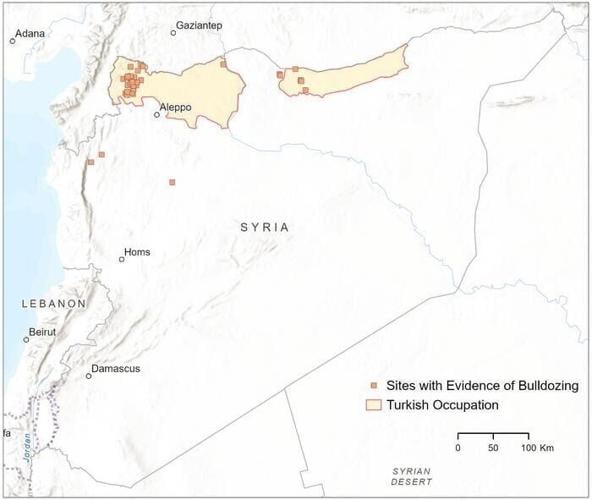
Map of Syrian sites that were systematically bulldozed due to mechanized looting. (Jesse Casana / Carolin Ferwerda via SWNS)
But the full extent of the devastation was unclear as the last comprehensive analysis was published in 2017.
Damage since 2106 to cultural locations — including at UNESCO World Heritage sites such as Palmyra and the ancient Roman city of Apamea, known for its Great Colonnade — has remained largely unknown.
The new study, led by researchers from Dartmouth College in New Hampshire, shows that many of Syria's archaeological sites were damaged not just by looting but that, in areas occupied by the Turkish military, sites were systematically bulldozed.
Using satellite imagery from Google Earth and the European Space Agency's Pleiades program, the team analyzed looting and damage at 200 sites throughout Syria.

Wikimedia Commons
The researchers classified the damage into four categories: "traditional looting," where individual holes were excavated on a site; "mechanized looting" by a bulldozer; "militarization," where dugouts and other features were installed; and "construction or encampments," including temporary shelters used by refugees.
Study lead author Jesse Casana said: "The mechanized looting in Syria and its association with military activities is really disconcerting.
"The military is supposed to protect the people, not destroy archaeological sites, which is a war crime."
In the Middle East, the military will often pick an archaeological site as a location to establish a base, as they tend to be tall mounds.

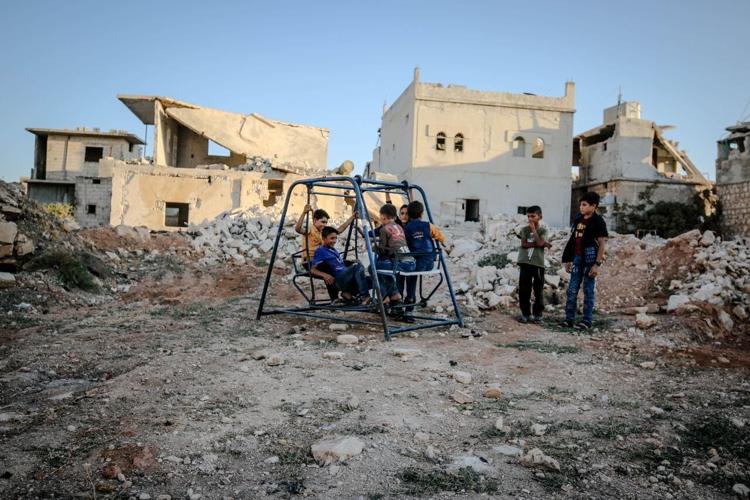
(Photo by Abd Alrhman Al Darra via Pexels)


Casana said: "Topographically, these sites have been formed progressively by occupation in the same place over time."
He explained that people build a house out of mud brick, and when it collapses, they build a new one on top of that.
Casana said: "This happens for thousands of years, resulting in mounds that can be more than 100 feet tall, which are just full of archaeology."
With mechanized looting, bulldozers scrape off the entire surface, people look for artifacts, and then the surface is scraped off again.
Casana says looters are typically looking for gold which he refers to as "aspirational looting" by people with limited economic means.
He said: "Looting is a whole lot of work, and a lot of destruction, with very little payoff."
Among the cultural sites that the researchers examined was Ain Dara, known for its Iron Age temple and large lion statues.
Based on the team's earlier analysis, as of 2014, no war-related damage was evident.

(Photo by Ahmed akacha via Pexels)
But images shows that by 2016, a military compound was under construction.
In February 2019, mechanized looting was "clearly" in progress, with bulldozing marks evident in four areas at the site.
Ground observations by people living in the area indicated that the Turkish-backed military was likely behind such activities, but this has not been independently confirmed.
By January 2022, nearly the entire surface had been combed by a bulldozer except for a stone-built temple complex dating to the !2th century BC.
Casana says the new study provides an important roadmap for mitigation efforts.
He added: "Before archaeologists potentially excavate any of these areas, there needs to be some sort of systematic investigation to check out every one of these sites because there will be ancient architecture and artifacts and all kinds of things just falling out of these sites that have been damaged in this way.
"We need to know where to prioritize efforts and what those efforts should look like."


(0) comments
Welcome to the discussion.
Log In
Keep it Clean. Please avoid obscene, vulgar, lewd, racist or sexually-oriented language.
PLEASE TURN OFF YOUR CAPS LOCK.
Don't Threaten. Threats of harming another person will not be tolerated.
Be Truthful. Don't knowingly lie about anyone or anything.
Be Nice. No racism, sexism or any sort of -ism that is degrading to another person.
Be Proactive. Use the 'Report' link on each comment to let us know of abusive posts.
Share with Us. We'd love to hear eyewitness accounts, the history behind an article.