






(Photo by MART PRODUCTION via Pexels)
By Stephen Beech
A new device can detect drinks spiked with a "zombie drug" called Devil's Breath in just 10 minutes.
The method changes the color of the drink if the hallucinogenic drug, real name scopolamine, has been secretly added to it.
Devil's Breath has been frequently used in "spiking" incidents when the victim is robbed or sexually assaulted as it has strong amnesic and sedative effects.
Its lack of color, odor and taste prevents it from being detected when ingested, say scientists.
The detection of drugs such as Devil's Breath currently relies on the use of instrumental analytical techniques.
While those methods provide high sensitivity, they require laboratory conditions and extensive sample preparation — making them impractical for rapid, on-site analysis.
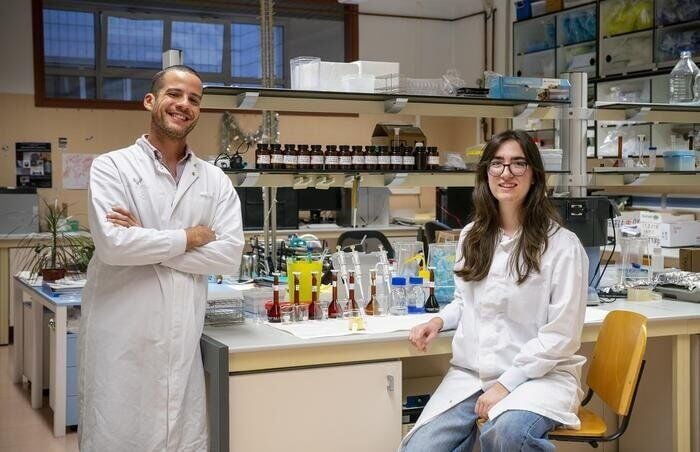
Isabel Poves-Ruiz and Enrique Azuaje, the second author of the article. This study forms part of the doctoral thesis being undertaken by Isabel Poves in the EHU Microfluidics Cluster group. (Nuria González. EHU via SWNS)
To address the lack of a portable, easy-to-use low-cost tool for detecting scopolamine without the need for a lab, scientists in Spain have developed a new method.
It consists of a self-powered microfluidic device with a paper support on which a reaction occurs, which results in a color change according to whether the result is positive or negative.
Study lead author Isabel Poves said: "The device is immersed in the sample for a few seconds, and after around 10 minutes the result can be seen with the naked eye, without the need for any other type of detector."
Poves, a Ph.D. student at the University of the Basque Country (EHU), added: "This device will help prevent drug-facilitated assault, because more important than detecting it after the fact, is trying to prevent it from happening in the first place.
"We need to be able to quickly detect whether a drink contains an adulterating substance.


"Microfluidic technology opens the door to a type of analysis that was impossible before."

(Photo by Kadir AvÅar via Pexels)
To find out whether something had been added to a drink, previously people would have had to take a sample to a specialized laboratory for analysis.
The Spanish research team says the new technology enables a preliminary analysis to be conducted on site.
Microfluidic technology consists of miniaturizing or simplifying processes that are carried out on a larger scale in a laboratory, so that the sample doesn't need to be handled in any way.
The research team says their findings, published in the scientific journal Talanta, helps bring closer their objective of developing a microfluidic platform capable of detecting several types of drugs through a single device.
That would involve integrating various known chemical reactions used for drug detection into microfluidic technology and improving the designs.

(Photo by Dominika Gregušová via Pexels)
Study leader EHU professor Lourdes Basabe said: "We are trying to adapt the colorimetric chemical reactions to microfluidic technology in order to simplify this type of detection, to lower costs, automate the process and, in particular, to be able to see with the naked eye a color change indicating that a beverage has been adulterated."
The EHU research group has recently developed a similar device aimed at detecting benzodiazepines — such as diazepam, medically used for treating anxiety and insomnia — in drinks.
Basabe added: "This is a laboratory level prototype that can be refined according to user needs.
"We need to continue to improve these devices to optimize the detection ranges, color changes, et cetera."
She said that, in the future, the analysis could potentially be conducted using existing smartphone applications that accurately analyze the color displayed on the device.


(0) comments
Welcome to the discussion.
Log In
Keep it Clean. Please avoid obscene, vulgar, lewd, racist or sexually-oriented language.
PLEASE TURN OFF YOUR CAPS LOCK.
Don't Threaten. Threats of harming another person will not be tolerated.
Be Truthful. Don't knowingly lie about anyone or anything.
Be Nice. No racism, sexism or any sort of -ism that is degrading to another person.
Be Proactive. Use the 'Report' link on each comment to let us know of abusive posts.
Share with Us. We'd love to hear eyewitness accounts, the history behind an article.