


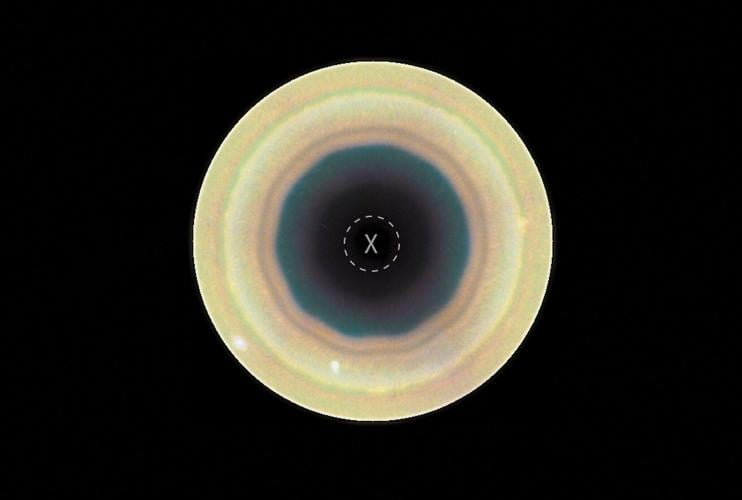
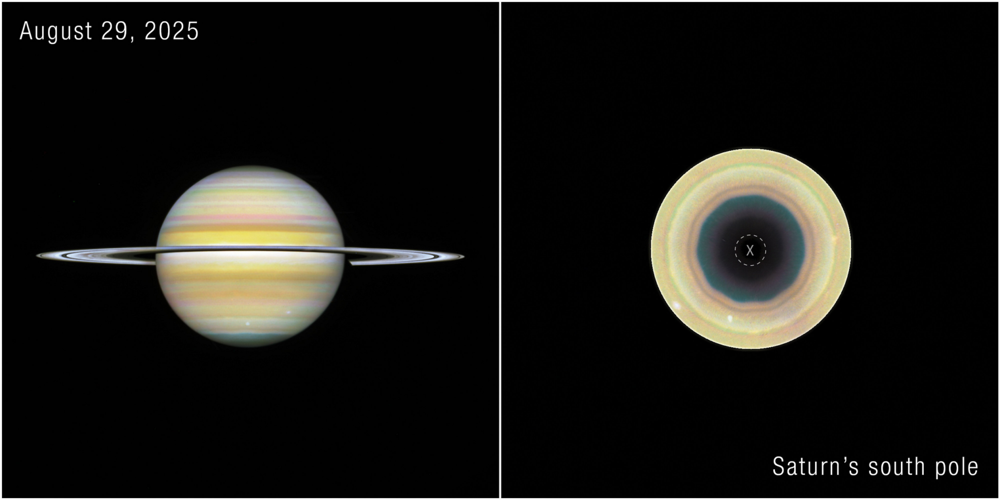

A view of Saturn from NASA’s Hubble Space Telescope revealing a giant, evolving 10-sided atmospheric wave encircling the planet’s south pole. (NASA/ESA/STScI/A. Sánchez-Lavega via SWNS)
By Dean Murray
A "mysterious" 10-sided structure, known as a decagon, has been discovered in the atmosphere of Saturn.
By using the Hubble Space Telescope, images from amateur astronomers and observations by a University of Leicester scientist, an international team of scientists has revealed the presence of a wave around the planet's South Pole that is a near twin of a long-lived hexagonal structure at its North Pole.
The details of the discovery – which the University of Leicester dubbed "mysterious" – have been published in the journal Science Advances on Wednesday, Sept. 2, and add to the continuing mystery of atmospheric phenomena on the gas giants of our solar system.
When the Voyager 1 and Voyager 2 spacecraft flew past Saturn in 1980 and 1981, one of their many discoveries was the presence, within the planet's clouds, of a hexagonal wave encircling its north pole. The hexagon has persisted to this day, for more than one Saturnian year (which is equivalent to about 30 Earth years).

The feature, called a decagon, is the first large, regular-sided pattern observed at Saturn’s southern hemisphere. (NASA/ESA/STScI/A. Sánchez-Lavega via SWNS)
Despite the symmetry in the distribution of winds and atmospheric dynamics across the planet, in all the years since then, no similar structure had been observed in the southern hemisphere.


But recently, as the planet's southern hemisphere became more visible from Earth between 2023 and 2025, images taken by amateur astronomers and the Hubble Space Telescope (HST) revealed not a hexagon but a decagonal structure (a 10-sided polygon) around the planet's south polar region.
Images subsequently obtained by the HST in 2024 and 2025, as well as those taken with ground-based telescopes, confirmed its existence.
Co-author Leigh Fletcher from the University of Leicester's School of Physics and Astronomy said: "Saturn still has the ability to surprise us – given the season, Saturn's southern hemisphere is emerging from more than a decade in winter darkness. Something has clearly changed during that long winter when we weren't looking, presenting us with this stunning new feature around the South Pole."

(NASA/ESA/STScI/A. Sánchez-Lavega via SWNS)
Lead author Agustín Sánchez-Lavega of Universidad del País Vasco EHU said: "This research raises many fundamental questions about atmospheric phenomena on gas giants. Why is Saturn the only planet to form this type of polygonal waves? Is the phenomenon in any way related to the 5- and 8-sided polygonal arrangement of the cyclones surrounding Jupiter's poles?"
Fletcher adds: "What's really exciting about this work is the involvement of amateur observers with their backyard telescopes, sharing their images online, and searching Saturn's clouds for new discoveries. It was their data that first hinted something exciting was going on.
"The hexagon itself is now hidden from view, as the North Pole disappears into autumn and winter. Who knows whether that will still be there next time we can look? And how long this new decagon will hang around for?"
Agustín Sánchez-Lavega adds: "Further observations over the coming years, as visibility of the planet's southern hemisphere gradually improves, will help to characterize it and develop advanced models that will enable us to solve this intriguing atmospheric mystery."


(0) comments
Welcome to the discussion.
Log In
Keep it Clean. Please avoid obscene, vulgar, lewd, racist or sexually-oriented language.
PLEASE TURN OFF YOUR CAPS LOCK.
Don't Threaten. Threats of harming another person will not be tolerated.
Be Truthful. Don't knowingly lie about anyone or anything.
Be Nice. No racism, sexism or any sort of -ism that is degrading to another person.
Be Proactive. Use the 'Report' link on each comment to let us know of abusive posts.
Share with Us. We'd love to hear eyewitness accounts, the history behind an article.