



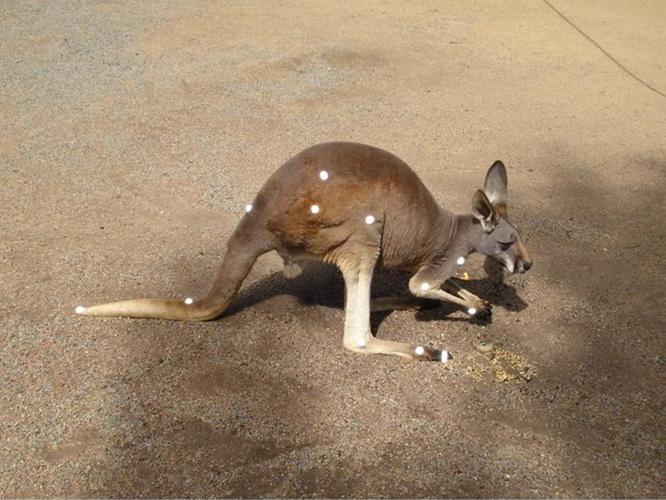

A kangaroo with reflctive markers used for the 3D motion capture system in the study. (Craig McGowan via SWNS)
By Stephen Beech
Kangaroos fix their posture in a unique way to save energy while hopping at high speed, reveals new research.
Scientists have taken a leap in understanding of the biomechanics of the iconic Australian marsupials.
The ground-breaking study shows that changes in kangaroo posture at high speeds increases their tendon stress and energy storage and return.
The increased energy storage and return counteracts the higher muscular force required at speed, according to Aussie scientists, explaining why the animals’ energetic cost remains unchanged.
They say their findings, published in the journal eLife, provide "convincing" evidence to help address a long-standing question in locomotion biomechanics.
The research team explained that kangaroos, wallabies and other macropods are unique in both their form and movement style.

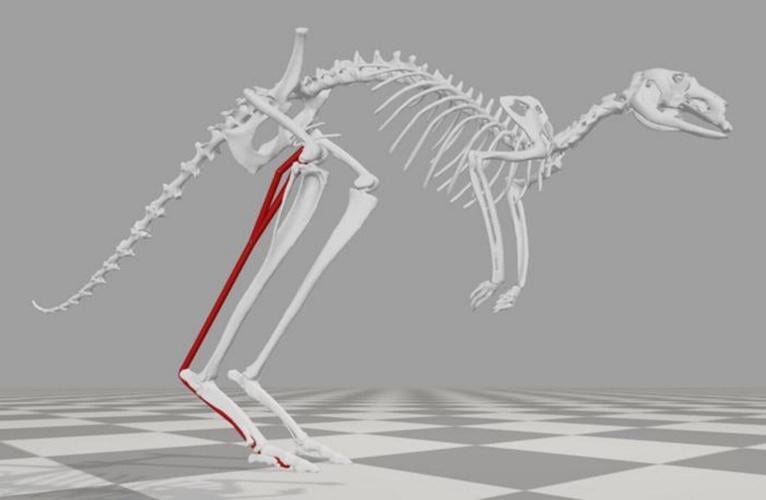
An illustration of the 3D musculoskeletal model of a kangaroo, developed by Lauren Thornton and colleagues. (Thornton et al via SWNS)
At slow speeds they use a "pentapedal" gait - where their forelimbs, hindlimbs and tail all contact the ground.
But at faster speeds they use their distinctive hopping gait.
The uniqueness also extends into the energetics behind those movements, according to the research team.
Study first author Dr. Lauren Thornton, from the University of the Sunshine Coast in Australia (UniSC), said: “The ‘cost of generating force’ hypothesis, refined in a previous study, implies that as animals move faster and decrease their ground contact time, their energy cost should increase – but macropods defy this trend.
“The underlying mechanisms that explain how macropods are able to uncouple their hopping speed and energy cost are still unclear, so we set out to address this by investigating their hindlimb motion, or kinematics, and the forces that impact this motion – the kinetics – as they hop around at various speeds.”
Dr. Thornton and her colleagues created a 3D musculoskeletal model of a kangaroo based on 3D motion capture and force plate data – concerning the force exerted on the ground during hopping – to analyse the movements of red and grey kangaroos.

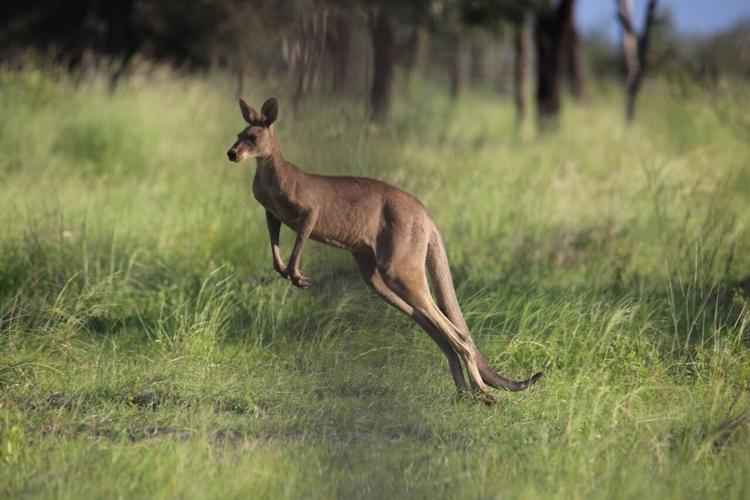
(Photo by Tharshikan Sivapprakasam via Pexels)


Using the model, they evaluated how the animals’ body mass and speed influence three aspects of their form and movement during hopping: their hindlimb posture; effective mechanical advantage (EMA) – a measure for understanding efficiency of movement – and its associated tendon stress in the ankle extensors; and their ankle work.
The analysis revealed that kangaroo hindlimb posture varied with both body mass and speed.
The researchers found that the hindlimb was more crouched as they moved at faster speeds, mainly due to the ankle and metatarsophalangeal joints.
Further analysis showed that the majority of the kangaroos’ work and power per hop in the hindlimb was performed by the ankle joint.
As the hindlimb became more crouched at faster speeds, the EMA of the ankle decreased.
Dr. Thornton said: “We found that as kangaroos hop faster, they crouch more, mainly by changing their ankle and metatarsophalangeal joint angles.
"This alters the geometry of the hindlimb, in particular, the moment arms to the Achilles tendon force and the ground reaction force, which decreases ankle EMA.
"Achilles tendon stress increases as a result, and therefore so does the amount of elastic energy it can store and return per hop.

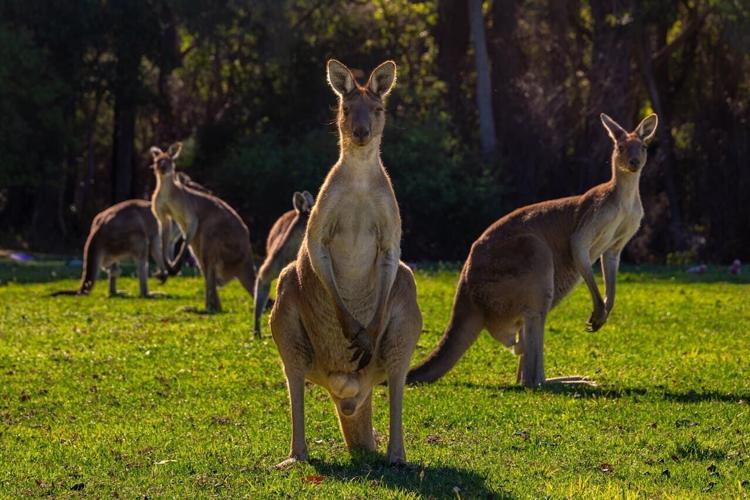
(Photo by Sergey Guk via Pexels)
“We found that this helps kangaroos maintain the same amount of net work at the ankle, and the same amount of muscle work, regardless of speed.”
Senior author Professor Christofer Clemente, also of UniSC, said: “Our findings suggest that kangaroos’ posture-controlled increases in energy absorption at the ankle provide energetic efficiency during hopping – although potentially constraining the maximum size achievable by larger species.”
Dr. Thornton said: “The contributions of changing posture can’t be overlooked.
“Changes in EMA have an effect on tendon stress comparable to that of the increase in peak ground reaction force that naturally occurs at faster speeds.”
Clemente said: “We’ve pieced together more of the puzzle of locomoter energetics in kangaroos, highlighting how EMA may be more dynamic than previously assumed.
“Our work also shows how musculoskeletal modelling and simulation approaches can provide insights into direct links between form and function, which are often challenging to determine from experiments alone."
He added: "It will be interesting to see future studies expand on this work to build a bigger picture of kangaroo kinematics.”


(0) comments
Welcome to the discussion.
Log In
Keep it Clean. Please avoid obscene, vulgar, lewd, racist or sexually-oriented language.
PLEASE TURN OFF YOUR CAPS LOCK.
Don't Threaten. Threats of harming another person will not be tolerated.
Be Truthful. Don't knowingly lie about anyone or anything.
Be Nice. No racism, sexism or any sort of -ism that is degrading to another person.
Be Proactive. Use the 'Report' link on each comment to let us know of abusive posts.
Share with Us. We'd love to hear eyewitness accounts, the history behind an article.