


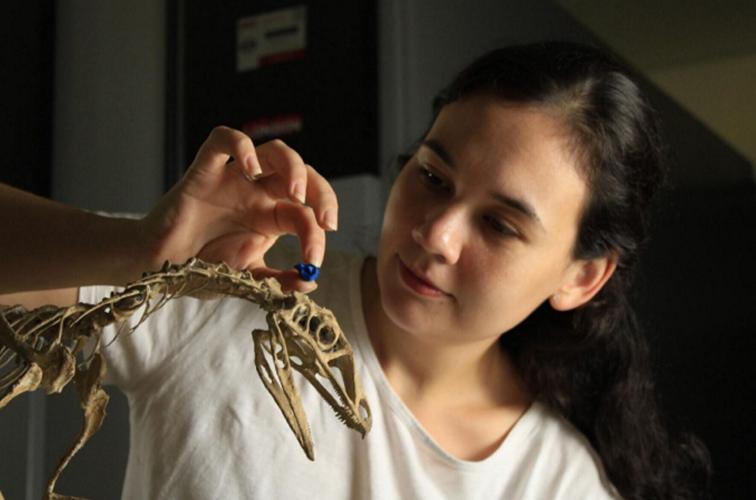

Paleontologist Lísie V. S. Damke holding an enlarged model of the brain of Venetoraptor gassenae. (Rodrigo Temp Müller via SWNS)
By Stephen Beech
The brain of a 233-million-year-old ancestor of the first flying reptiles has been reconstructed in a bid to work out how they took flight.
Scientists say Venetoraptor was around 13 inches (33 centimeters) tall and had a beak and scythe-like claws on long fingers, but did not have wings.
Although it was not capable of flight, it is believed that it moved among the treetops - using its recurved claws to grip branches.
Now palaeontologists in Brazil, where fossils of the extinct precursor of pterosaurs was first discovered, have reconstructed its brain based on computed tomography scans.
They say their findings will help work out how the pterosaur brain evolved to enable flight.
The study, led by researchers from the Federal University of Santa Maria (UFSM) with the participation of scientists from the United States, Argentina, and Germany, was published in the journal Palaeontology.

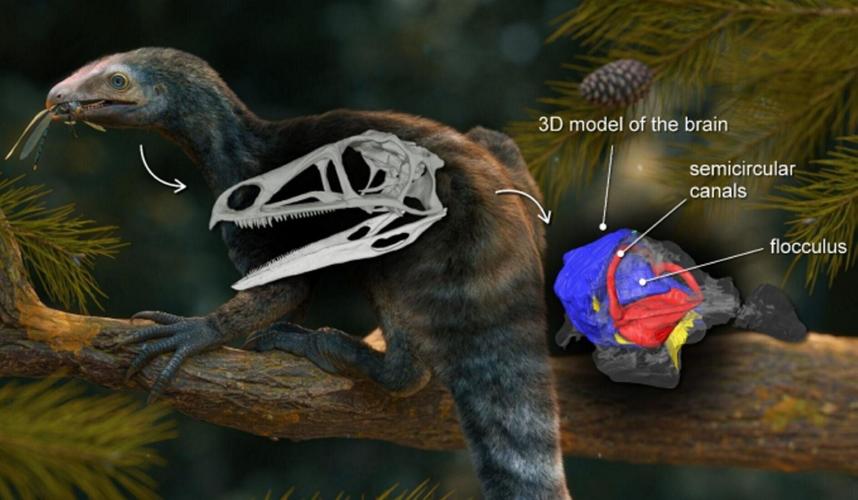
Artistic reconstruction of Venetoraptor gassenae showing the 3D model of its brain. (Caio Fantini via SWNS)
The research was conducted using a 233-million-year-old fossil discovered in the municipality of São João do Polêsine.
Dr. Rodrigo Temp Müller, of UFSM, explained that pterosaurs were reptiles that dominated the skies during the Mesozoic Era and developed the ability to fly even before birds.
He said: "Often mistaken for dinosaurs, these animals were abundant during the Jurassic and Cretaceous periods.
"However, their origin in the Triassic Period is still poorly understood.
"Among the various adaptations that this lineage developed for flight, changes in the brain are among the most striking and intriguing.
"The key to understanding how the pterosaur brain evolved to enable flight lies in understanding what the brains of their precursors were like, so that the differences between them can be identified.
"However, there are very few fossils worldwide of pterosaur precursors that preserve well the region of the skull that housed the brain.
"In this context, a Brazilian fossil has helped shed light on what the brains of these precursors of the flying reptiles were like.


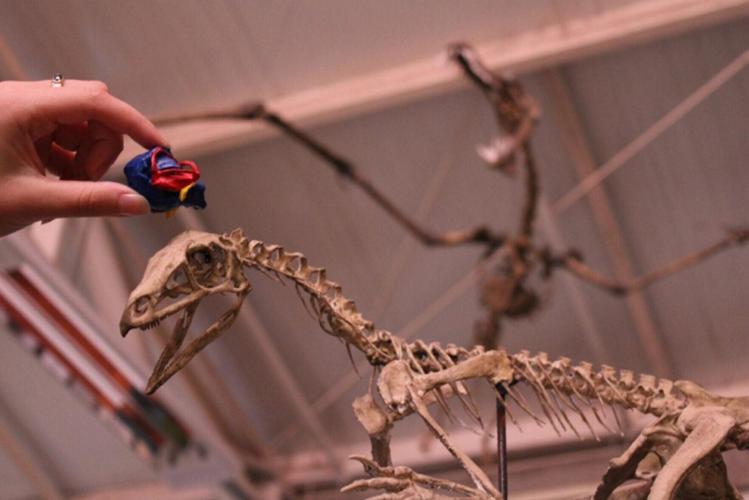
Skeleton of Venetoraptor gassenae and an enlarged 3D-printed model of its brain. (Rodrigo Temp Müller via SWNS)
"However, because the brain is composed of soft tissues that rarely preserve in the fossil record, studying its anatomy is a challenging task."
To overcome that limitation, the team use computed tomography scans to digitally fill the cavities of the skull that correspond to the space once occupied by the brain.
The internal structures are then digitally separated, allowing researchers to create an approximate three-dimensional model of the brain.
From that model, scientists can infer aspects of behavior and sensory abilities through measurements and analyses based on comparisons with living animals.
Dr. Müller said: "The excellent preservation of the fossilized cranial elements helped reveal important details of the anatomy of this animal’s brain and inner ear.
"One of the most striking features in the three-dimensional model is the flocculus of the cerebellum, a structure associated with balance and the stabilisation of vision during head movements.

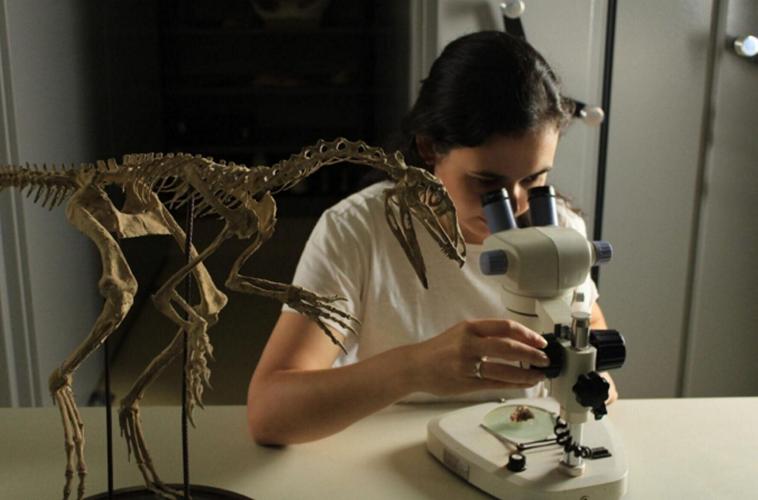
Paleontologist Lísie V. S. Damke examining the braincase of the Venetoraptor gassenae fossil. (Rodrigo Temp Müller via SWNS)
"In the studied species, this structure is well developed, suggesting that these animals already possessed refined control of head movements and vision."
The research also showed that portions of the semi-circular canals, structures of the inner ear that form part of the bony labyrinth and are fundamental for balance, display a "notable enlargement" compared with those of some other reptiles.
Dr. Müller said: "These abilities may have helped this animal capture prey and/or move more easily among the trees.
"In pterosaurs, the cerebellar flocculus is also very large, but the presence of this well-developed structure in Venetoraptor gassenae demonstrates that this condition was not exclusive to flying reptiles.
"Although much of the brain of Venetoraptor gassenae could be reconstructed, some regions remain unknown because the bones that surrounded them in life were not preserved.
"Among these are the olfactory bulbs, regions of the brain responsible for the sense of smell."
The research team hopes to discover new fossils of the species that preserve the portion of the skull associated with those structures, which may eventually allow them to infer the animal’s olfactory capabilities.
Dr. Müller added: "To achieve this, excavations are continuing at the fossil site that yielded the fossils of Venetoraptor gassenae in 2022."


(0) comments
Welcome to the discussion.
Log In
Keep it Clean. Please avoid obscene, vulgar, lewd, racist or sexually-oriented language.
PLEASE TURN OFF YOUR CAPS LOCK.
Don't Threaten. Threats of harming another person will not be tolerated.
Be Truthful. Don't knowingly lie about anyone or anything.
Be Nice. No racism, sexism or any sort of -ism that is degrading to another person.
Be Proactive. Use the 'Report' link on each comment to let us know of abusive posts.
Share with Us. We'd love to hear eyewitness accounts, the history behind an article.