


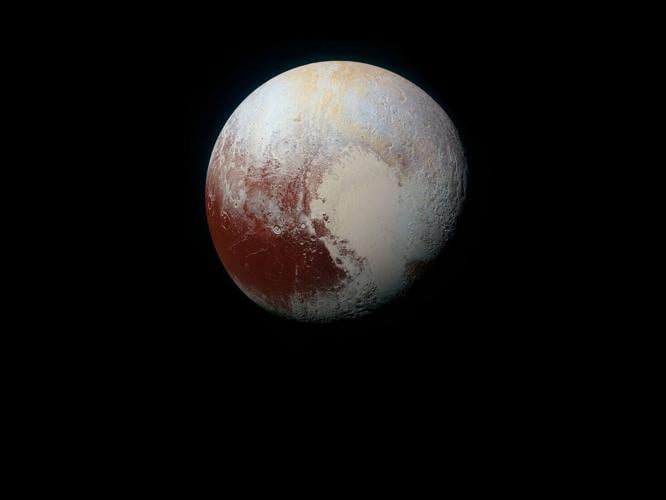




File photo: NASA's New Horizons spacecraft captured this high-resolution enhanced color view of Pluto. (NASA New Horizons via SWNS)
By Dean Murray
Move aside, Pluto, scientists have identified another possible dwarf planet in our solar system.
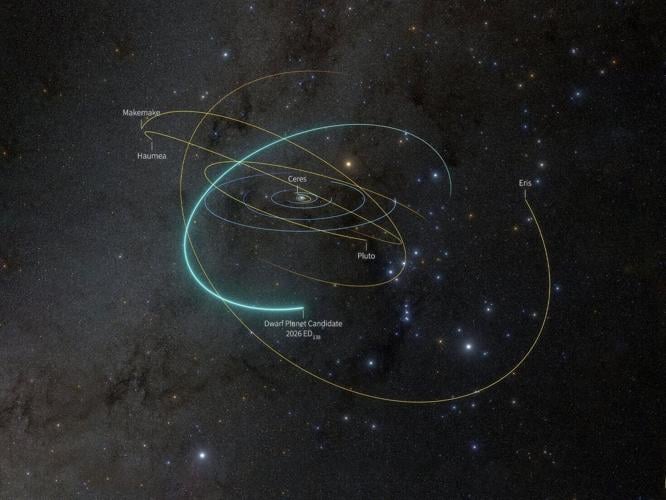
Astronomers using the NSF-DOE Vera C. Rubin Observatory in Chile have spotted a large object in the outer reaches of the solar system, beyond Pluto. It may be one of the largest dwarf planet candidates ever found.
If preliminary data analysis is confirmed, the object would join the five other known dwarf planets: Pluto, Ceres, Eris, Haumea and Makemake.
The discovery was enabled by Rubin Observatory’s unparalleled speed and its enormous camera, the largest ever created, which allows it to precisely capture every visible change in the Southern Hemisphere sky.

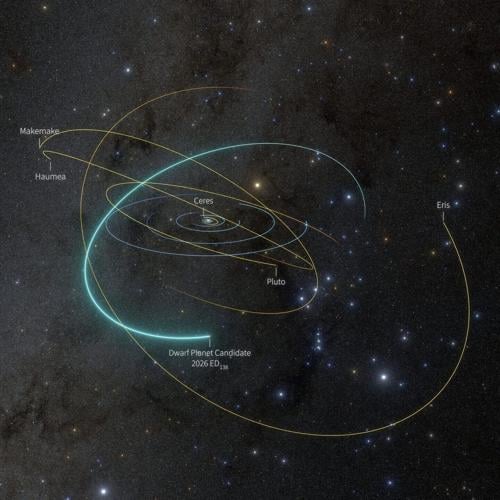
A view of the Solar System showing the orbital pathway of newly discovered dwarf planet candidate 2026 ED138 (ED138). (NSF–DOE Rubin / NOIRLab / SLAC / AURA via SWNS)
The International Astronomical Union Minor Planet Center has given the newly discovered object the provisional designation ED138.
ED138 was found in a region of sky close to the plane of the Milky Way, a region visually filled with millions of stars, which is likely why it was not discovered until now.
Rubin Observatory’s regular monitoring and powerful data algorithms allowed scientists to spot ED138 moving within the crowded field.


Edward Ajhar, NSF program director for Rubin Observatory, said: “Rubin Observatory’s superpower is the ability to clearly capture movement and change among a vast number of objects and phenomena that humans have never seen before.

A mosaic of images captured by NSF–DOE Vera C. Rubin Observatory of the newly discovered dwarf planet candidate 2026 ED138 (ED138). ED138 was discovered in observational data from Rubin spanning 4 March–11 July 2026. (NSF–DOE Rubin / NOIRLab / SLAC / AURA via SWNS)
“That power greatly extends our ability to reveal and understand new things about our solar system, the Milky Way, and billions of other galaxies across the universe.”
Scientists using other observatories can now make follow-up observations of ED138 to uncover more information about its nature.
ED138 is one of many solar system objects discovered by Rubin this year. In April, Rubin submitted observations of over 11,000 new asteroids.

LSST Camera Deputy Project Manager Travis Lange shines a flashlight into the LSST Camera at SLAC National Accelerator Laboratory, California before it moved to Chile. (J. Ramseyer Orrell / SLAC NAL via SWNS)
Kathy Turner, Department of Energy program manager for Rubin Observatory, said: “Rubin Observatory’s unique strengths make it an incredible tool for investigating a wide range of astrophysical phenomena, from dark energy to the discovery of this dwarf planet candidate.”
Pluto was reclassified as a dwarf planet in 2006 under International Astronomical Union rules. A planet must orbit the sun, be nearly round and have cleared its orbital neighborhood; a dwarf planet meets the first two conditions but not the third.
Rubin Observatory is jointly funded by the U.S. National Science Foundation and U.S. Department of Energy’s Office of Science.


(0) comments
Welcome to the discussion.
Log In
Keep it Clean. Please avoid obscene, vulgar, lewd, racist or sexually-oriented language.
PLEASE TURN OFF YOUR CAPS LOCK.
Don't Threaten. Threats of harming another person will not be tolerated.
Be Truthful. Don't knowingly lie about anyone or anything.
Be Nice. No racism, sexism or any sort of -ism that is degrading to another person.
Be Proactive. Use the 'Report' link on each comment to let us know of abusive posts.
Share with Us. We'd love to hear eyewitness accounts, the history behind an article.