





Gabriel Weyand
AI assistants (32%), working from anywhere (30%) and four-day weeks (29%) are the future of work, according to new research.
A survey of 5,750 international freelancers and employees looked at how workplace trends have shifted their day-to-day, and what the future of work looks like, too.
Respondents anticipate that skills being more valued than degrees or titles (27%) will become common, too, with nearly a quarter of employed respondents already seeing this (24%).
AI fluency is also expected to become a job requirement (26%), and is already the reality for 22% of employees.
Conducted by Talker Research for Fiverr, the survey looked at what it would take for respondents to build their ideal workday.
According to the data, the traditional 9-to-5 may no longer be the norm: Half of those polled say the perfect workday starts before 9 a.m. (51%), with 42% also wanting to clock out before 5 p.m.
More than a third of all respondents want a four-day workweek or shorter (37%) that doesn’t exceed 28 hours.
One in five want off on Mondays (19%), and twice that percentage would want their weekend to start on Fridays (40%).
During the day, the average respondent wants to have no more than three meetings. A third of respondents currently have more than this, but freelancers average fewer.

While freelancers are currently working two hours per week longer than full-time employees, many of the other sought-after workplace norms are already standard practice for them.
Full-time employees have been adopting “freelancer first” practices over the years. Flexible work hours (26%), setting their own daily priorities (23%) and tracking their own output (22%) are some of the top habits they’ve employed.
The freelance way of working has begun to bleed into full-time workers' routines, such as maintaining a professional profile (21%) and having their meetings via video calls instead of in-person (21%).
Respondents are also observing their company encouraging the use of other initiatives that are freelancer-forward, like using generative AI tools (37%) and even being paid on a per-project basis (17%).


It’s not just the workday that’s changing, but views on what “counts” as a job are shifting, too.
Respondents think that a “real job” should most clearly have financial security in the form of a steady paycheck (44%) and being a primary source of income (42%).
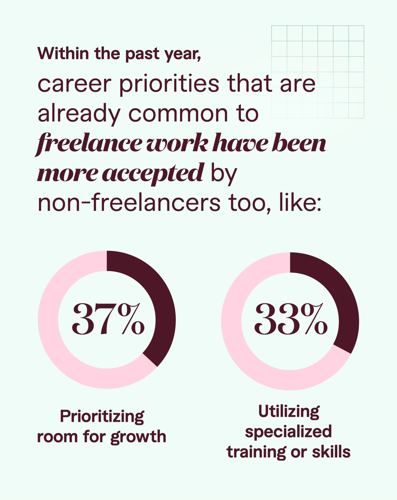
Within the past year, however, facets of “real jobs” that are already common to freelance work have been more accepted by non-freelancers, too, like prioritizing room for growth (37%) and utilizing specialized training or skills (34%).
“We’re seeing a confluence of reasons that are pushing the world to work the way freelancers do, from freedom and flexibility to the chance to pursue their passions and choose the projects they work on, " said Sharon Steiner, chief human resources officer at Fiverr. “Our data shows that 77% of full-time employees are interested in transitioning to a freelance career, and 67% say they’re likely to make freelance work their primary source of income within the next three years. These findings point to a growing desire for greater choice and control over how people work.”
While freelancing may come with its perks, there are aspects about it that still frustrate.
Freelancers polled wish freelancing was seen more as a legitimate career path and not “side work” (29%). They also want more acknowledgement for their independence (28%), expertise (24%), discipline (21%) and passion (21%).

Brett Jordan
With 67% of non-freelancers saying the career shift to be a freelancer is more within reach for them than ever before, respondents are getting serious.
Forty-three percent of full-time employees would take a pay cut if it meant they were able to be their own boss — with the average person saying they’d cut a quarter of their salary to make it a reality (24%).
For many, that means prioritizing upskilling (43%) and folding AI into their work as they go.
The majority of respondents think it’s important to invest time into education about how AI can help improve workflow (74%), and then follow through on it (71%).
The data found that freelancers were on the ground floor of AI, with 33% saying they wanted to adopt it "immediately" — only 27% of full-time employees said the same.
“The emergence of AI has fundamentally shifted how, where and when people are working today,” said Steiner. “Whether you’re full-time or freelance, those who have upskilled with AI not only improve their quality of work but also free up their time to focus on the things they want to pursue like freelancing or passion projects.”
Research methodology:
Talker Research surveyed 2,850 freelancers and 2,900 full-time employees from the U.S., UK, Canada, Germany and Australia who have access to the internet; the survey was commissioned by Fiverr and administered and conducted online by Talker Research between Sept. 21 and Sept. 29, 2026. A link to the questionnaire can be found here.
To view the complete methodology as part of AAPOR’s Transparency Initiative, please visit the Talker Research Process and Methodology page.


(0) comments
Welcome to the discussion.
Log In
Keep it Clean. Please avoid obscene, vulgar, lewd, racist or sexually-oriented language.
PLEASE TURN OFF YOUR CAPS LOCK.
Don't Threaten. Threats of harming another person will not be tolerated.
Be Truthful. Don't knowingly lie about anyone or anything.
Be Nice. No racism, sexism or any sort of -ism that is degrading to another person.
Be Proactive. Use the 'Report' link on each comment to let us know of abusive posts.
Share with Us. We'd love to hear eyewitness accounts, the history behind an article.