


Mail voting in the 2026 midterm elections will go on as usual – now that the Trump administration’s major efforts to disrupt how Americans vote by mail have been blocked by the U.S. Supreme Court.
The U.S. Postal Service had recently implemented new rules placing unprecedented restrictions on the practice of mail voting in federal elections. State officials and voting rights organizations immediately challenged these rules, arguing that the executive agency has no authority under the U.S. Constitution to unilaterally regulate election practices.
On Sept. 14, 2026, the U.S. Supreme Court signaled agreement with these claims, voting 7-2 to uphold a preliminary injunction blocking enforcement of the new rules that will likely remain in place through the November midterm elections.
The controversy began in March 2026, when President Donald Trump issued an executive order designed to ensure “integrity in federal elections.” The executive order — among other things — mandates that the U.S. Postal Service, or USPS, implement uniform ballot and envelope requirements for mail and absentee ballots used in federal elections.
The order also required states to provide the Postal Service, 60 days prior to Election Day, with lists of all voters eligible to vote by mail or absentee. If a ballot sent via mail didn’t comply with the USPS’ requirements, or was sent by somebody not on a state-provided list, the order instructed the USPS to not deliver the ballot, effectively canceling that vote.
Two lawsuits challenging the executive order were immediately filed in federal court, one by state officials and the other by voting rights organizations.
Their arguments were straightforward: The president does not possess unilateral authority to alter the methods of voting in federal elections. Rather, the Elections Clause of the U.S. Constitution vests the authority to regulate the “time, place, and manner” of federal elections in the states and, if it chooses to act, Congress.
Federal judge rules against administration
The two lawsuits were heard by the same federal district court judge in Boston, who ultimately agreed with the plaintiffs and issued injunctions against the federal government. Those injunctions forbade the president and all relevant federal officials and agencies, including the USPS, from carrying out any aspects of the executive order regarding mail and absentee voting.
The lawsuit led by state officials ultimately made its way to the Supreme Court, which on Aug. 24 voted 6-3 along ideological lines in favor of the Trump administration. The court did not decide on the constitutional issues raised in the case but instead found that the states lacked the injury necessary to have standing to bring the case. The court reasoned that because the USPS had yet to implement the executive order, the states were not yet affected by it.
At the same time, the USPS began writing the rules and processes governing how it would carry out the executive order. These steps blatantly violated the remaining injunction in the voting rights organizations’ lawsuit. But the district court judge ended up dissolving that injunction on Aug. 26 in light of the Supreme Court’s decision in the other case.
That same day, the USPS officially published its new rules for mail ballots.
Widespread confusion
The USPS rules contained three key provisions.
First, states must design their ballot envelopes in accordance with USPS requirements, and the envelopes must be submitted to the USPS for final approval. Second, state and local election officials must input voters qualified to vote by mail or absentee into a USPS-run electronic portal at least 30 days before the date of a federal election. Lastly, any mailed ballot that does not adhere to the design requirements, or that is sent by somebody not on the USPS’ electronic portal, “will not be accepted” by the USPS.
These rules led to widespread confusion among election officials, who remained uncertain about how to apply them to the 2026 midterm elections. For one, the rules laid out no clear deadline for USPS approval of envelope designs. Moreover, the electronic portal’s 30-day deadline conflicted with state voter registration deadlines, with all states allowing individuals to register to vote at some point within 30 days of Election Day, and many far later.


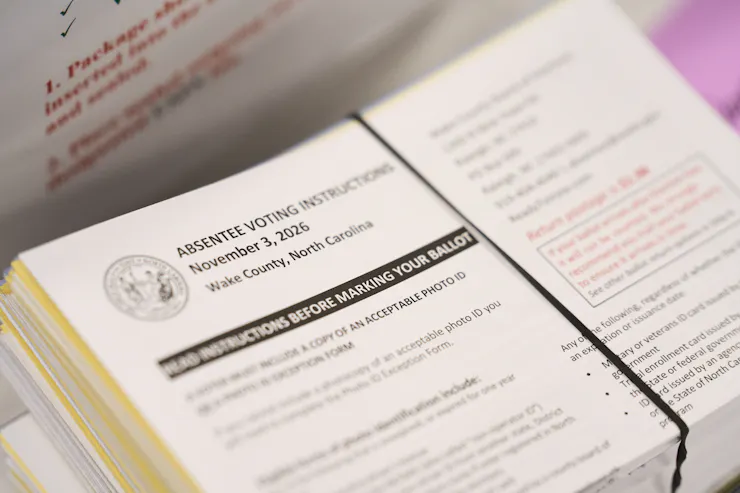
Election officials were also left wondering how to adhere to these rules under such short notice. Some states, such as North Carolina, have already distributed mail ballots to voters. Election officials in Utah were meanwhile considering setting up their own distribution centers to bypass the USPS rules.
Following the USPS rules’ enactment, the plaintiffs from the original two lawsuits renewed their constitutional challenge, arguing that they now had standing to sue.
On Sept. 4, the federal district court issued a new preliminary injunction pausing the implementation or enforcement of the USPS rules. The court, in short, found that the USPS likely infringed upon Congress’ and the states’ Elections Clause powers.
On Sept. 6, the federal government petitioned to the U.S. Supreme Court seeking a stay – or pause – on the preliminary injunction.
In its petition, the government contended that the USPS rules do not unduly impede states’ administration of elections but rather “impose reasonable preparation requirements for certain election-related mail.” The petition elicited 20 amicus briefs, largely in opposition to the USPS, including one signed by seven Republican chief election officials detailing the impracticality of the USPS rules.
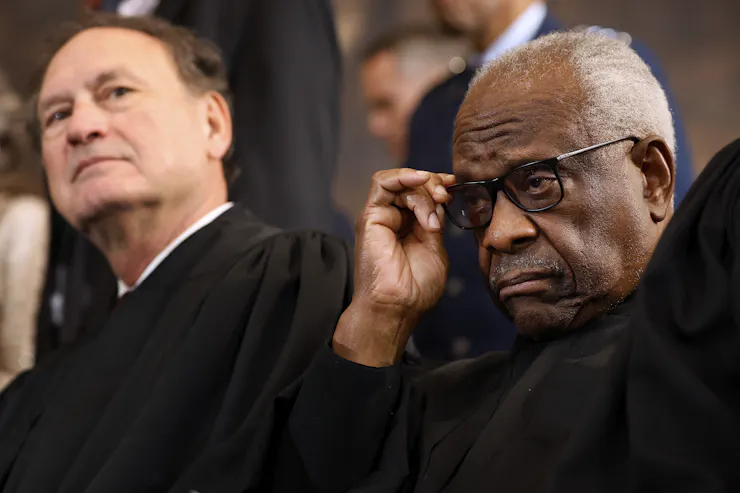
On Sept. 14, the U.S. Supreme Court ultimately voted to uphold the preliminary injunction, with Justices Clarence Thomas and Samuel Alito dissenting.
In one brief paragraph, the court stated that the federal government “is unlikely to succeed on the merits of its challenge,” suggesting that a supermajority of the court believes the USPS exceeded its constitutional authority. Given that the litigation is still ongoing in district court, though, the Supreme Court did not issue any final decision on the merits of the parties’ claims.
Practically speaking, this ruling likely settles the question of whether the USPS rules will have any impact on the midterm elections in November.
With less than two months until Election Day, and a preliminary injunction remaining in effect with the Supreme Court’s endorsement, the federal government’s hands are tied until the litigation over the issue fully plays out in the federal district court.
By the time that happens, the country may already be looking ahead toward the 2028 presidential election.
This article is republished from The Conversation, a nonprofit, independent news organization bringing you facts and trustworthy analysis to help you make sense of our complex world. It was written by: John J. Martin, Quinnipiac University
Read more:
- Narrow mail‑in voting ruling by Supreme Court adds uncertainty to midterm elections without addressing constitutionality of Trump’s executive order
- Supreme Court to decide on whether Trump’s voting‑by‑mail rules can go into effect – but might not rule yet on whether they’re constitutional
- Citizenship voting requirement in SAVE America Act has no basis in the Constitution – and ignores precedent that only states decide who gets to vote
John J. Martin does not work for, consult, own shares in or receive funding from any company or organization that would benefit from this article, and has disclosed no relevant affiliations beyond their academic appointment.


(0) comments
Welcome to the discussion.
Log In
Keep it Clean. Please avoid obscene, vulgar, lewd, racist or sexually-oriented language.
PLEASE TURN OFF YOUR CAPS LOCK.
Don't Threaten. Threats of harming another person will not be tolerated.
Be Truthful. Don't knowingly lie about anyone or anything.
Be Nice. No racism, sexism or any sort of -ism that is degrading to another person.
Be Proactive. Use the 'Report' link on each comment to let us know of abusive posts.
Share with Us. We'd love to hear eyewitness accounts, the history behind an article.