


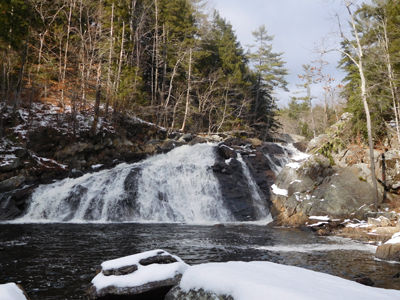
Profile Falls in Bristol
By Gordon DuBois
Nestled along the Pemigewasset River just north of Franklin lies Old Hill Village, or the remains of the village that was moved to higher ground in 1940. Now the reborn town of Hill sits along Route 3A, the main artery between Franklin and Bristol. Someone driving this road, passing through the town would only see a general store and a few homes. Through the trees one may spot the school, town offices, church and a few other homes set off the highway on Crescent Street. One would have little idea that this town is a planned community, created out of the U.S. Army Corps of Engineers' design to harness the river waters of the Pemigewasset River, by building a flood control dam in Franklin, thus flooding the village.
I first learned of Old Hill Village about 30 years ago when a friend invited me to cross country ski the old route 3A. The abandoned road bisects the uninhabited village, and offers an ideal track for cross country skiing. It was a crisp cold evening in January when we parked at the gate of the old road. It led us down to the old streets of the village. Snow blanketed the ground and the light of the full moon reflected off the fresh snow creating a sparkling light show as we skied along the almost perfectly flat roadway. It was a memorable evening and I have often returned to ski or walk the roads of Old Hill Village.
This past week I decided to return, this time walking the road from Bristol. I drove to Bristol from my home in New Hampton, taking Route 104 and turning left onto Route 3A south. I drove about two miles until I came to Profile Falls Road. Turning left, I headed down into the river valley, and drove into the parking lot adjacent to Profile Falls. A marked trail led me to the picturesque falls that are worth the trip just in themselves. As Reuben and I were starting out we noticed a musher's truck loaded with 12 sled dogs. They had come for the day to run the road from the parking lot to Old Hill Village and back again, a total of 12 miles. I stopped to chat with the dogs' owner and musher, Rachel Arnold, from South Berwick, Maine. She told me that she came to this area because it's ideal place for the dogs and her to train. She explained that it's used by many others in the sled dog community for training and she planned to return the following day. It was an amazing sight to watch Rachel as she calmly hitched up her 12 Siberian Huskies and take off down the road. I think Reuben wanted to join them, but must have realized that a 12-mile run might be a little too much as he turned back.
I followed after Rachel and her team of dogs, walking with Reuben along the road, which showed tracks of previous walkers and skiers. We passed along old stone walls, foundations, fields and dams that reminded me of an earlier time when this road was once lined with homes, farms, and businesses. Back then it was busy with traffic, but now it lies silent, with only the calls of chickadees and a few crows breaking the peace and quiet. When we reached Dyer Brook, we crossed the bridge and found a side path that led into the woods. We walked along this trail which led us down along the river. The path turned out to be a loop trail that took us back to the road, ending in an abandoned farm site of C. Favor, one of the early settlers in the area. Reuben and I returned to the parking lot, walking a total of three miles which was a nice warm-up to the day. I then decided to drive to Hill and hike into Old Hill Village and once again explore the streets of the abandoned village.
Hill was first settled in 1765 and called New Chester, because the original proprietors were from Chester, New Hampshire. By the late 1700s, several families began settling along the banks of the Pemigewasset River due the proximity to the river for transportation and the bottom land which offered good tillage for crops and meadows for grazing livestock. In addition, Needleshop Brook dropped steeply to the river. This meant the opportunity to harness the power of falling water to run a saw mill and, most likely, a grist mill. It was an ideal location for a settlement in the wilds of New Hampshire in the post-colonial period. In 1836, the name of the town was changed to Hill in honor of Governor Isaac Hill, 1836-1839. He also served in the New Hampshire Senate and the U.S. Senate from 1831-1836. Many were opposed to the name change, perhaps because Hill was a staunch Jacksonian and on the day following the change from New Chester to Hill, a letter was posted in town, "Twixt Hill and Hell, there is but one letter, if Hill were to be called Hell, it would be much better."
Over the next 100 years Hill grew and prospered. Mills were erected on Needleshop Brook. Two churches, a library, town office, and two schools, and a railroad station were built. Stores opened, families moved in and built homesteads. Even an orphanage, the Golden Rule Farm, was located in the center of town. In 1889, Hill fielded a baseball team. The Main Street was graced with stately trees and family homes lined the thoroughfare. In many ways it was an idyllic small New Hampshire village. But, all that changed in 1938.
In that year villagers learned they would have to move to make way for a flood control reservoir. The US Army Corp of Engineers had developed plans to build a dam in Franklin, as part of a comprehensive strategy of flood risk management for the entire Merrimack River. The project began in November, 1939 and completed by 1943. Perhaps there was increased impetus to construct the dam because of the Great Hurricane of 1938. All homes and other structures along the nine-mile flood plain from the proposed dam to Bristol had to be destroyed or moved. As one might expect, Hill residents were upset with the idea that they had to move not only their homes, but their entire community to higher ground. However, they gradually began to accept the idea and started moving the entire village, including the cemetery, to its current location. By 1941, the new village of Hill was relocated, including school house and town hall. About 30 homes were built and occupied by this time.
I drove to Needleshop Brook Recreation Area, which lies just above Old Hill Village off Route 3A. I parked the truck and followed an old road that led me along Needleshop Brook and the foundations of several mills that lined the water way. I found the Main Street of the old village. What was once a thriving community was now woods and fields. I walked along the abandoned road and found signs placed in locations where once stood the hotel, orphanage, town hall, store and homes. My imagination wandered back to the time when Hill was a close-knit community, villagers working, attending church, going to school and shopping alongside one another on this tree-lined street. Now the new village stands as a testament to villagers' fortitude and courage to rebuild, not only their homes but also their spirit of community. In the words of Hill resident Ed Amsden, "When you consider what the new village cost in personal and town indebtedness you've got to admire these people for their willingness to do a lot of extra work and make a lot of sacrifices, all for an ideal. They wanted to stay together badly enough to do whatever they had to do as a price."
After walking the road for a mile and exploring a few byways, Reuben and I returned to my truck. I know I'll be back Old Hill Village and the vast trail system along the Pemigewasset flood plain. If you would like to visit the this area you can choose to start at Profile Falls in Bristol or Needleshop Brook Recreation Area in Hill. Either way you will be well rewarded whether biking, skiing or walking. As an added prize you may encounter a dog sled team running the trails with you. It's a beautiful sight to behold.
I would like to thank Lynn Christopher, Hill librarian, and community member Paula McDonough for their support and assistance in writing this article. If you are interested in learning more about Old Hill Village, visit the library and Lynn will gladly lend you a hand. If you are interested in learning more about the recreational opportunities along the river, check out the many web sites associated with the Franklin Falls Dam.


(0) comments
Welcome to the discussion.
Log In
Keep it Clean. Please avoid obscene, vulgar, lewd, racist or sexually-oriented language.
PLEASE TURN OFF YOUR CAPS LOCK.
Don't Threaten. Threats of harming another person will not be tolerated.
Be Truthful. Don't knowingly lie about anyone or anything.
Be Nice. No racism, sexism or any sort of -ism that is degrading to another person.
Be Proactive. Use the 'Report' link on each comment to let us know of abusive posts.
Share with Us. We'd love to hear eyewitness accounts, the history behind an article.