


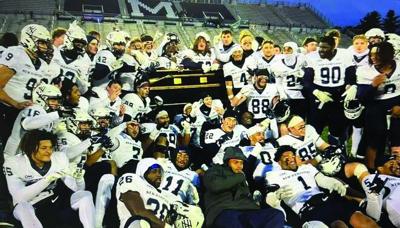
DURHAM — It's a pay day of sorts for collegiate student-athletes nationwide, including those at the University of New Hampshire.
The state’s flagship university is opting into the watershed $2.8 billion settlement from the House v. NCAA lawsuit, a funding pool allowing colleges and universities to pay their student-athletes in exchange for their name, image and likeness in promotions and sales. Payment to student-athletes will take effect this coming academic year.
Allison Rich, athletic director at the University of New Hampshire since July 2022, reported the school’s opt-in to employees July 1.
“This decision marks a significant milestone in the evolution of college sports and reflects our steadfast commitment to supporting student-athletes, preserving institutional integrity, and responsibly managing resources,” Rich wrote in a message to university employees.
To read more, visit seacoastonline.com/story/sports/2025/07/01/unh-to-pay-student-athletes-after-joining-28-billion-dollar-ncaa-settlement-fund/84436949007.
Rich did not reveal a specific settlement fund rollout plan for eligible students.
Hundreds of Wildcats are student-athletes on the school’s flagship Durham campus. The university boasts 18 NCAA Division I teams.
Rich announced the school's decision to the wider community later Tuesday afternoon.
"We believe this new model offers exciting opportunities to strengthen support for our student-athletes by providing enhanced recruitment and retention capabilities, and greater flexibility in scholarship and NIL activities," she wrote. "Opting in allows us to prioritize donor intent in funding such initiatives for our Wildcats. We recognize the need to be thoughtful and strategic, remaining aligned with the realities of today's athletics model while staying true to our mission and positively representing the University and serving the state of New Hampshire."
Higher education institutions across the country opted into the settlement pool on Tuesday, the same day the changes took effect after a federal judge granted final approval of the settlement terms on June 6. Colleges had until Monday to opt in to the settlement.


Charlie Baker, president of the NCAA and Massachusetts’ former governor, penned a letter after the judge’s ruling stating each university joining the settlement could direct upwards of $20.5 million to its student-athletes in the 2025-2026 season.
The entire $2.8 billion pot of funding will be paid out over a 10-year period to participating schools.
“This is an exciting moment for everyone involved in college sports,” Baker wrote. “As the defendant conferences now own several facets of rulemaking and enforcement related to specific settlement areas, the NCAA will be able to move away from certain enforcement activity that, despite the best efforts of many, wasn't working well. Rather, we will focus on further enhancing what is working: elevating the student-athlete experience and maintaining fair playing rules and eligibility and academic standards. Student-athletes will benefit from the rich opportunities they enjoy now, plus far more scholarship opportunities, landmark financial benefits and a streamlined NCAA to support them.”
The NCAA and the country’s major collegiate athletic conferences - the ACC, Big 12, Big Ten, Pac-12 and SEC - were the defendants targeted in three separate antitrust lawsuits, all of which were resolved with the settlement.
The University of New Hampshire’s entry into the settlement came one day after school president Elizabeth Chilton announced an additional $17.5 million in cuts will be made to stabilize its budget woes. The New Hampshire budget approved for the next two fiscal years is reducing state aid to the University System of New Hampshire by a combined $18 million biennium-over-biennium.
Chilton reported in May that 35 employees were laid off in a $12.5 million spending reduction but cautioned further reductions were necessary.
“Like all of you, Athletics has to adjust to a significant expense reduction in the FY26 budget, highlighting the importance of stewarding institutional resources responsibly,” Rich wrote to staff Tuesday. “To that end, for our participation in this new world of college athletics we are relying on (the) support of donors and fans, whose philanthropy aligns with making a direct and positive impact on the lives of our Wildcat student-athletes. Additionally, Athletics is positioned to manage the financial impact associated with the settlement within budget so as to minimize any negative effect to the larger University community.”
The university’s fall semester kicks off Aug. 25.
•••
These articles are being shared by partners in the Granite State News Collaborative. For more information, visit collaborativenh.org.


(0) comments
Welcome to the discussion.
Log In
Keep it Clean. Please avoid obscene, vulgar, lewd, racist or sexually-oriented language.
PLEASE TURN OFF YOUR CAPS LOCK.
Don't Threaten. Threats of harming another person will not be tolerated.
Be Truthful. Don't knowingly lie about anyone or anything.
Be Nice. No racism, sexism or any sort of -ism that is degrading to another person.
Be Proactive. Use the 'Report' link on each comment to let us know of abusive posts.
Share with Us. We'd love to hear eyewitness accounts, the history behind an article.