



As federal immigration enforcement intensifies, industries that depend heavily on foreign-born workers are beginning to feel the strain. One of the most exposed is the U.S. construction sector, where immigrants—both documented and undocumented—make up a substantial share of the workforce. These workers are integral not only to residential and commercial building projects, but also to the maintenance and repair of the nation's aging infrastructure.
Recent data reveal that in several major U.S. cities, foreign-born workers account for more than half of all construction industry employment. These concentrations are especially notable in parts of the country with large immigrant populations, long-standing labor pipelines, or occupational niches historically filled by foreign workers. As immigration enforcement measures ramp up, these metro areas may face disproportionate labor disruptions, with potential consequences for timelines, costs, and the broader economy.
Here are some of the key findings from the report:
- The construction industry has a growing reliance on foreign-born employees. The share of foreign-born workers in the construction industry has trended upward for more than a decade, rebounding after the Great Recession and reaching 26% nationally.
- Immigrant employees make up a majority of the construction industry workforce in several major metros. In cities like Miami, Los Angeles, DC, and Houston, more than half of all construction industry employees are immigrants.
- Drywallers, roofers, and painters are most likely to be foreign-born. More than half of employees in each of these construction-related occupations are immigrants—far above the overall industry average.
How Has Foreign-Born Construction Industry Employment Changed Over Time?
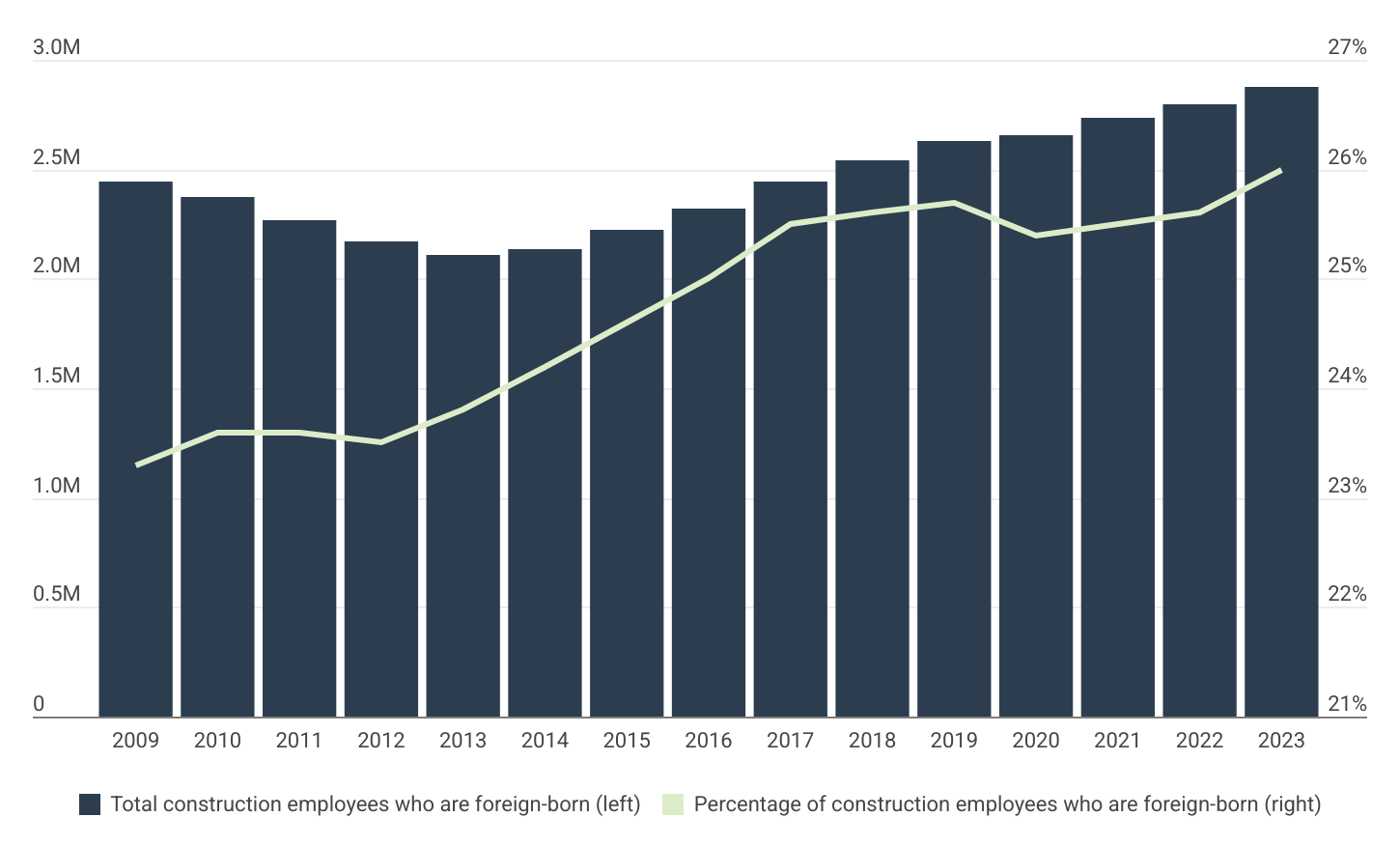
With nearly 2.9 million immigrants employed, the construction industry is increasingly made up of foreign-born workers
Source: Construction Coverage analysis of U.S. Census Bureau data | Image Credit: Construction Coverage
The construction industry workforce includes a wide range of occupations—from traditional roles like construction laborers, plumbers, and carpenters to support roles such as office clerks, accountants, and company executives. Across this full spectrum of construction industry employment, the share of foreign-born workers has steadily increased for more than a decade.
In 2009, immigrants made up 23.3% of all construction industry employees. That share has grown nearly every year since, reaching 26.0% by 2023. Over the same period, the total number of foreign-born employees in the construction sector rose by more than 435,000, from over 2.4 million to nearly 2.9 million. This suggests a gradual but sustained increase in the industry's reliance on foreign-born workers—a shift that continued through the economic recovery after the Great Recession and into the post-pandemic construction boom.
Which Construction Industry Occupations Rely Most on Foreign Workers?
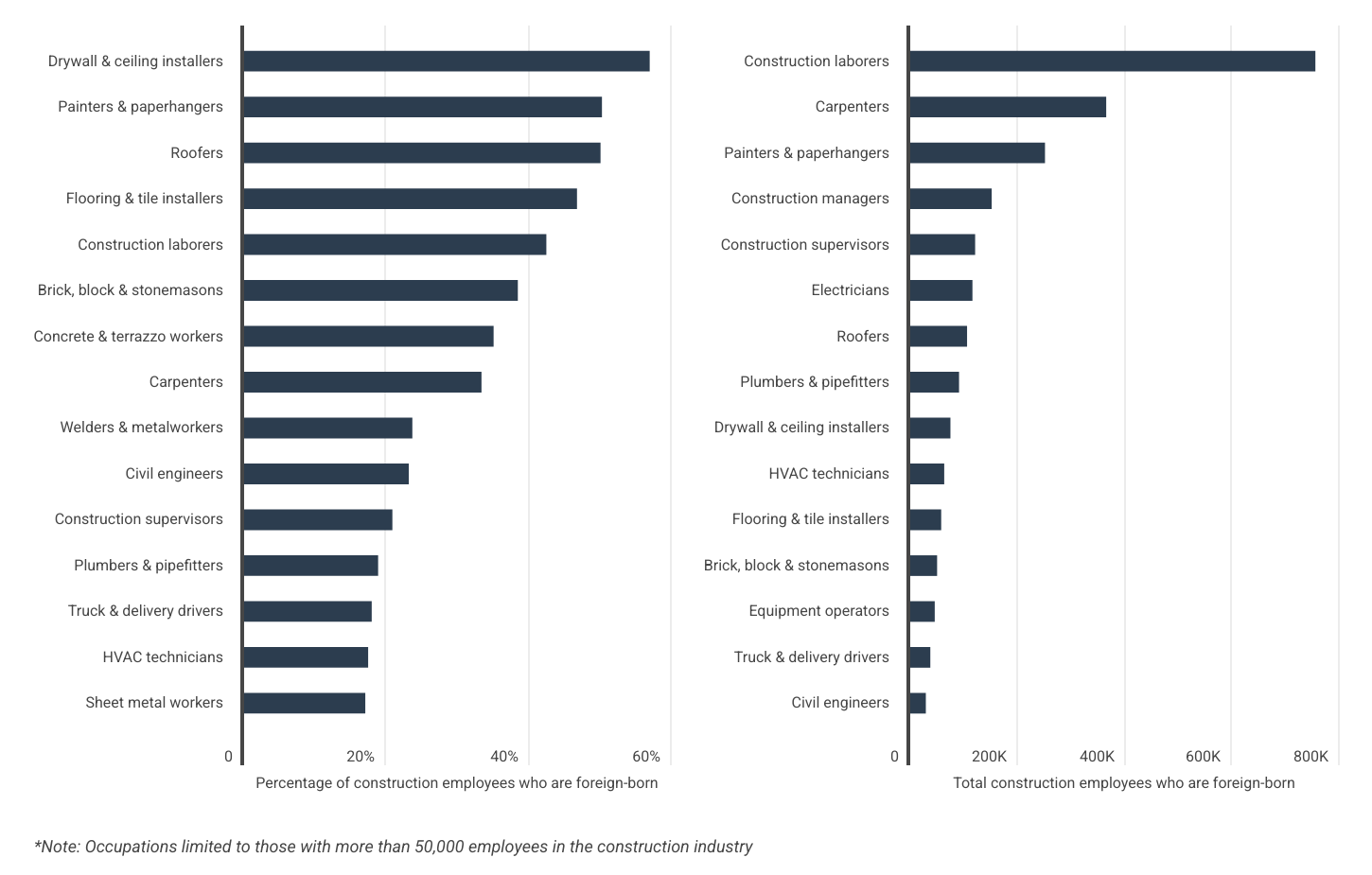
While over 750,000 U.S. construction laborers are foreign-born, 56.9% of drywallers are immigrants
Source: Construction Coverage analysis of U.S. Census Bureau data | Image Credit: Construction Coverage
Some of the most essential construction occupations are also the most reliant on foreign-born labor. There are three occupation groups where foreign-born workers make up a majority of the workforce: drywall and ceiling installers (56.9%), painters and paperhangers (50.2%), and roofers (50.0%). Other high-dependence trades include flooring and tile installers (46.7%) and construction laborers (42.4%). These roles represent a large portion of on-site construction work and are among the most physically intensive occupations in the industry.


By total headcount, the largest group of foreign-born employees are construction laborers, with 754,476 immigrant workers nationwide. Carpenters (364,941) and painters and paperhangers (250,940) also account for a significant portion of the workforce. These figures highlight both the concentration and scale of immigrant employment in key construction trades.
Foreign-Born Construction Industry Employment by State
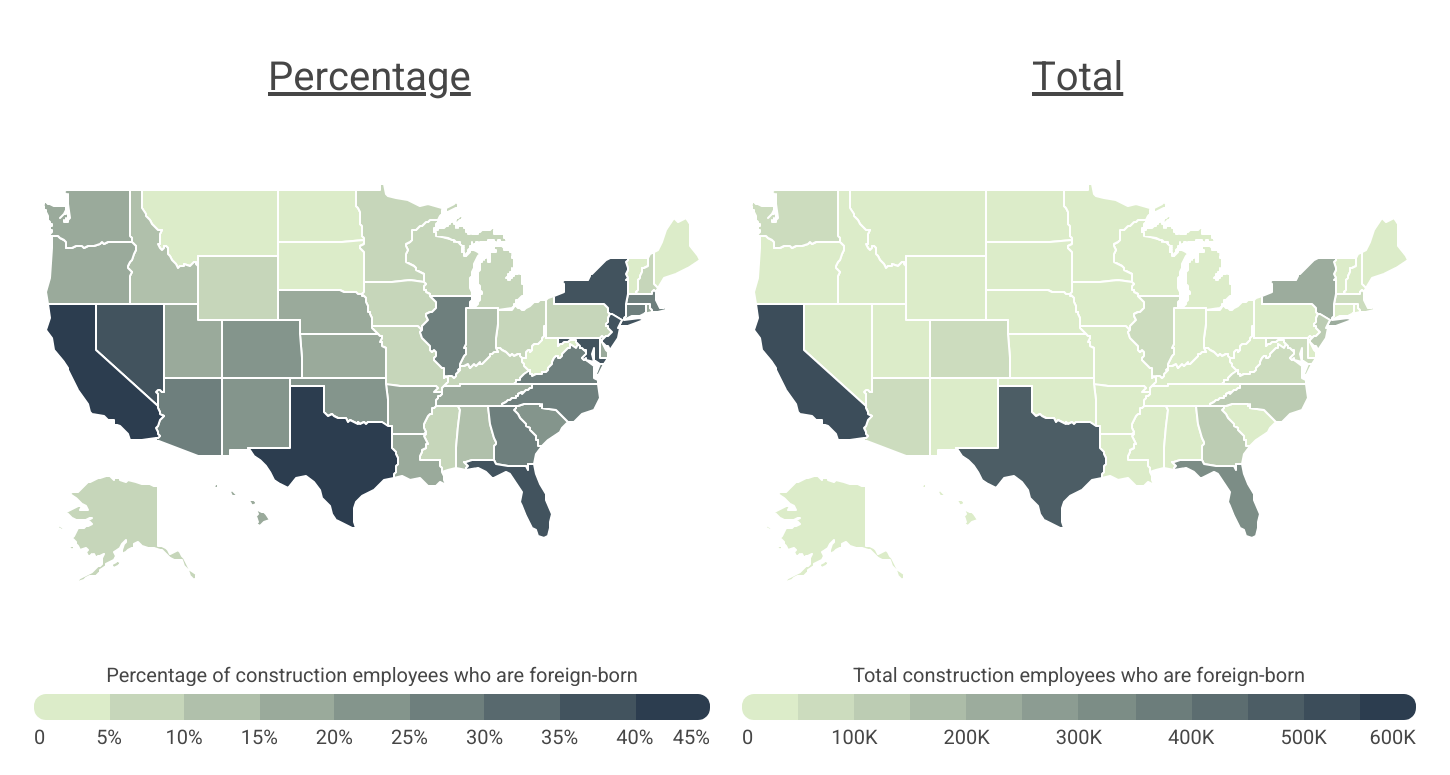
521,000 foreign-born workers account for 41.5% of California’s construction industry employment
Source: Construction Coverage analysis of U.S. Census Bureau data | Image Credit: Construction Coverage
While 26% of U.S. construction industry employment is foreign-born, this immigrant dependence is not distributed equally. Foreign-born workers make up a substantial share of the construction workforce along the West Coast, the Southwest, and the Northeast. California leads the nation with 521,249 foreign-born construction industry employees, representing 41.5% of the state’s total construction workforce. Texas follows with 491,132 foreign-born workers (40.2%), while New Jersey (38.7%), Florida (37.9%), and New York (37.1%) round out the top five. Together, these five states account for more than 1.6 million immigrant construction industry employees nationwide.
At the other end of the spectrum, foreign-born workers make up only a small fraction of the construction workforce in many Mountain West and New England states. In Montana, Maine, and Vermont, fewer than 3.5% of construction industry employees are foreign-born. These regional differences reflect long-standing immigration settlement patterns as well as variations in local labor supply and industry demand.
These statewide trends are even more pronounced at the metro level. In several large urban areas, foreign-born workers make up more than half of all construction industry employment. The share is highest in Miami (66.2%), followed by Los Angeles (53.7%), Washington, D.C. (51.7%), and Houston (51.4%). Other major metros with high immigrant concentrations include New York (48.9%), San Francisco (47.0%), and San Jose (47.0%). These patterns reflect the geographic clustering of immigrant populations, the scale of urban construction activity, and the deep integration of foreign-born labor into local building trades.
This analysis was conducted by researchers at Construction Coverage—a publication that provides data and research on factors that shape the construction industry—using the latest available data from the U.S. Census Bureau.
Here is a summary of the data for New Hampshire:
- Percentage of construction employees who are foreign-born: 7.2%
- Total construction employees who are foreign-born: 3,915
- Total construction industry employment: 54,606
- Percentage of all workers who are foreign-born: 8.2%
For reference, here are the statistics for the entire United States:
- Percentage of construction employees who are foreign-born: 26.0%
- Total construction employees who are foreign-born: 2,879,267
- Total construction industry employment: 11,070,540
- Percentage of all workers who are foreign-born: 18.7%
For more information, a detailed methodology, and complete results, see Cities Where the Construction Industry Depends Most on Foreign Workers on Construction Coverage.


(0) comments
Welcome to the discussion.
Log In
Keep it Clean. Please avoid obscene, vulgar, lewd, racist or sexually-oriented language.
PLEASE TURN OFF YOUR CAPS LOCK.
Don't Threaten. Threats of harming another person will not be tolerated.
Be Truthful. Don't knowingly lie about anyone or anything.
Be Nice. No racism, sexism or any sort of -ism that is degrading to another person.
Be Proactive. Use the 'Report' link on each comment to let us know of abusive posts.
Share with Us. We'd love to hear eyewitness accounts, the history behind an article.