


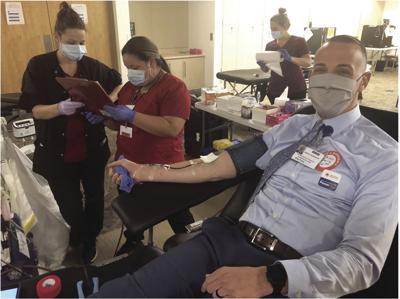
Anthony Sebattus has been donating blood for 55 years.
The Meredith resident who lives on Lake Waukewan started when he was an undergraduate at the New England College of Pharmacy in Boston. He said the $25 he would get would “be beer money for the month.”
“I initially started because it was a great way to give while getting money (for it),” said Sebattus, 73. “I had a frat brother in charge of blood donation at Brigham and Women’s (Hospital) so it was easy to do. Then I started to donate at the Red Cross and have been doing it forever.”
Since the Covid-19 pandemic hit in mid-March, however, Sebattus has had difficulty donating. While he was wintering in Florida at the start of the pandemic, and now in the Lakes Region, he has been unable to secure an appointment.
That may come as a surprise since the American Red Cross has been regularly advertising and putting out public service announcements saying the need for blood is “critical.”
It would appear since appointments at drives and donation centers are booked that blood is flowing freely out of donor arms and into collection bags. But since the coronavirus has dominated every aspect of life, the Red Cross has had to perform a juggling act like it has never seen before.
On one hand, you have donors who want to help quell the need for blood on hospital and health care center shelves. But at the same time there are roadblocks: people fearful of contracting the novel virus while donating; organizations that normally host drives are shuttered with their employees working from home; and, hospitals and donation centers limited on the number of appointments they can handle, to name a few.
Even a $25 incentive to donate wouldn’t be able to change things.
“Back in early April when the pandemic hit, it hit the Red Cross very, very hard,” said Mary Brant, American Red Cross external communications. “We had thousands of drives cancelled - not just in New Hampshire but across the country. It was unprecedented. We need people to give and get donors through the door.
“The blood drive sponsors we work with - churches, schools, businesses - all had to close their doors for the safety of their staff so we had thousands of drives and donors cancel.”
Red Cross blood drives in New Hampshire saw a significant drop at the height of the pandemic. In April there were 102 drives and in May 111, compared to 169 and 177, respectively, for those two months in 2019. That is a 38 percent decrease. June’s decrease of 9 percent (143 in 2020 and 157 in 2019) is a step in the right direction.
The one good thing the pandemic did in terms of blood supply needs, was it kept the majority of people inside. That limited New Hampshire residents driving and getting into accidents, while also stopping tourists from visiting.

Even though there was less traffic and tourists, blood was in the “below-normal” range, according to Sandy Moreau, director of Lab Services for SolutionHealth System, which includes Eliott and Southern New Hampshire Medical Center. That was due, in part, to the lack of drives.
Now drives and donors are starting to come back. But with summer being the busy season and elective surgeries appearing on hospitals schedules, the critical need for blood donation hasn’t lessened.
But even with more drives the need remains in critical mode due to limitations set forth by the Centers for Disease Control and the state of New Hampshire.
“Even now with CDC guidelines loosened we’re accepting about four donors an hour,” Macenzie said. “That way we can still sanitize, allow for drying time in between sanitizing and go through the screening process.”
Since hospitals and the Red Cross can’t predict when the next catastrophe will hit, and summer being a challenging time for blood donation organizations, the need is still there.
“Since we are in an unprecedented pandemic and we are entering the summer months – the time between Memorial and Labor Day is historically one of the most challenging for the Red Cross – this is a difficult time to maintain our supply,”
“We are adding blood drives as fast as we can. We not only count on volunteer donors but also blood drive sponsors like a church, school or a civic organization.”
MacKenzie doesn’t see an end to the juggling act she and her colleagues will face for the foreseeable future.
“It is hard to predict (our blood supply) with Covid so unpredictable,” she explained. “Are we going to surge again, are we not? Every single day we try to figure out what we are going to do for our blood bank and what our hospital needs.”
•••
These articles are being shared by partners in The Granite State News Collaborative. For more information visit collaborativenh.org.


(0) comments
Welcome to the discussion.
Log In
Keep it Clean. Please avoid obscene, vulgar, lewd, racist or sexually-oriented language.
PLEASE TURN OFF YOUR CAPS LOCK.
Don't Threaten. Threats of harming another person will not be tolerated.
Be Truthful. Don't knowingly lie about anyone or anything.
Be Nice. No racism, sexism or any sort of -ism that is degrading to another person.
Be Proactive. Use the 'Report' link on each comment to let us know of abusive posts.
Share with Us. We'd love to hear eyewitness accounts, the history behind an article.