


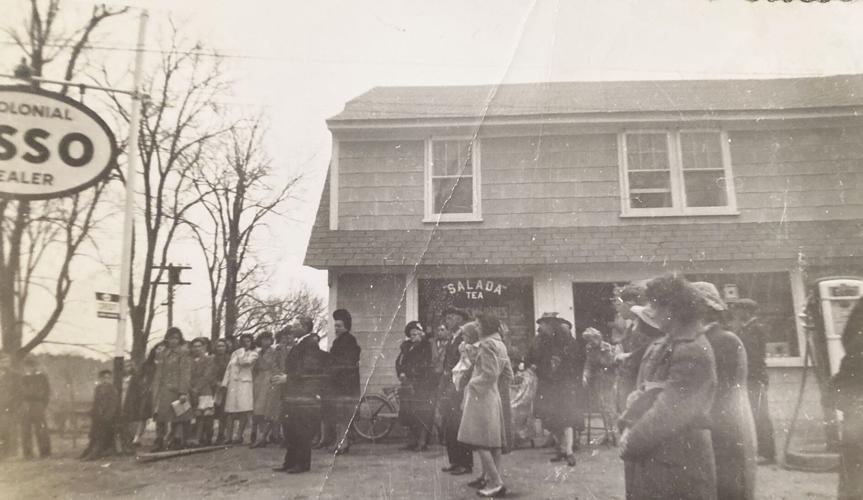
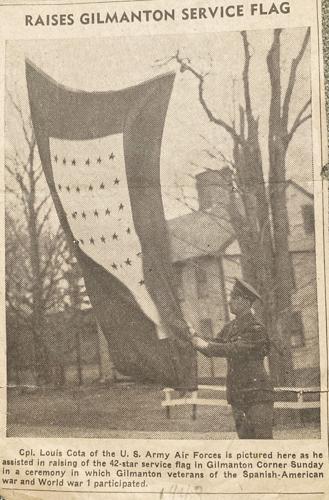


As Tuesday’s primary nears, my mind keeps tumbling back to a photo that captures a crowd gathered outside The Gilmanton Corner Store on April 26, 1943, to witness the unveiling of a flag saluting 42 Gilmanton men and women serving in the U.S. military. The photo captures a sturdy, black-suited Laconia pastor, John Watson — look for him just beneath the left edge of the roof — dedicating the flag, and it remembers a day that saw Army Cpl. Louis Cota, a Gilmanton resident, raising the banner.
This was an important ceremony. A stooped, white-haired woman with a walker (she’s directly in front of the store’s door) took the trouble to get there, as did a small boy and girl, on the far left. But what was the crowd honoring?
It was honoring Gilmanton’s dedication to preserving global order. In late April 1943, Adolf Hitler’s Nazi troops were busily “liquidating” Poland’s Warsaw Ghetto. By May 15, they would kill off 7,000 of the ghetto’s Jewish residents and deport 49,000 more to concentration camps. Gilmanton’s soldiers were standing against Hitler’s evil. The people gathered at the store were backing them in this quest.
Three years earlier, such a gathering almost certainly wouldn’t have happened in Gilmanton. In 1939, 84% of Americans were, according to a Gallup poll, opposed to sending American troops to fight in World War II, even though Hitler had already invaded Austria, Czechoslovakia and Poland, driven by a frightening hatred of Jewish people. The Americans standing against World War II involvement were called isolationists. They felt Europe could sort out its Hitler problem without U.S. help, and the most virulent of the isolationists adopted a rallying cry, “America First.”
Most isolationists were Republican. In the 1940s, Gilmanton was, as it is today, a Republican stronghold, and it had its own folksy isolationist hero. New Hampshire U.S. Sen. Charles Tobey, a Republican, was a chicken farmer and a fire-eating Baptist. When he hosted hymn-fests at his farmhouse in Temple, west of Nashua, his loyalists would arrive from all corners of the state. He was beloved in Gilmanton. When he successfully ran for Senate in 1938, 58% of Gilmanton voters picked him.
Tobey was a member of the America First Committee, and in September 1941, when he addressed a huge gathering of that group in New York, he declared that President Franklin Roosevelt was heading a “giant conspiracy” aimed at pulling the U.S. into the war. He worried that, if the U.S. sent troops to fight Hitler, it would grow weaker and would be overtaken, either by fascists or communists. “This is a fateful hour in the history of the nation,” Tobey said.
But on Dec. 7, 1941, it suddenly became clear how misguided the America First movement was. That morning, Germany’s ally, Japan, dropped bombs on Pearl Harbor, Hawaii, killing over 2,400 Americans. The attack laid bare that isolationism is a dangerous stance. There is no hiding from evil, and the only way to survive in the interconnected modern world is via cooperation with other nations.
The America First movement disintegrated, almost overnight. The U.S. joined England and the Soviet Union in the war against Germany and, with millions of other Americans, the people of Gilmanton threw themselves at the cause in beautiful and moving ways. Our town’s soldiers fought in the war. Residents wrote them letters and held parties for them when they came home on furlough. As Christmas neared in 1943, they sent a 5-pound package of gum, candy and cigarettes overseas to each enlisted person from Gilmanton.
Even after the war ended, in August 1945, U.S. patriotism remained high and citizens maintained a global perspective. In November 1945, Atlantic Monthly wrote, “It is no exaggeration to say that the American people as a whole are now the most world-minded on earth. Even the average Britisher seems to be less keenly aware of his involvement in the affairs of the world — especially those of the Pacific — than the average resident of the Mississippi Valley.”
The cresting globalist spirit gave birth to the United Nations in 1945 and to NATO in 1949. Both organizations were created to prevent a madman-like Hitler from ever threatening world order again, and they came to life only after a long, costly fight. Millions of people died fighting Hitler, and three of them were from Gilmanton.
Charles William Levitt, 22, an Army sergeant, died in Italy in 1945. That same year, Henry Page Ellis, Jr., an Army private, was buried in Luxembourg, at the age of 21, and Duncan A. Geddes, an Air Force sergeant, was lost on the North Sea, off Britain, at the age of 20. In 1946, Geddes was presumed dead.
But here we are today, on the cusp of New Hampshire’s first-in-the-nation primary, contending with a Republican frontrunner who seems intent on destroying world order. Donald Trump is, like Tobey that old chicken farmer, an isolationist. He’s brought back the slogan “America First” to describe his foreign policy, which involves withdrawing the U.S. from international treaties.
Worse, Trump does not seem to apprehend the gravity of leading a nation that, at this moment, sits on the verge of World War III. He’s palsy walsy with Kim Jong Un, the dimwitted, nuclear-weapons-obsessed overgrown teenager now serving as the dictator of North Korea. In 2022, as Vladimir Putin stole a page from Hitler’s megalomaniacal playbook and moved on Ukraine, Trump offered not a policy proposal but a high-five. He called Putin a “genius” and praised his “savvy.” If Trump is elected again, there’s a good chance he’ll withdraw the U.S. from the United Nations and NATO.
It’s likely Trump will get more votes here in Gilmanton than any other Republican at Tuesday’s primary. He’s significantly ahead of his Republican rivals, and this town seems to love him. In the 2020 presidential election, he got 1,423 votes here, as opposed to Biden’s 1,020. (Belknap County, meanwhile, proved the most Trump-friendly county in the state, with 54.4% of the voters backing No. 45.) Still, I cannot keep silent as Trump presses on with his terrifying lurch towards the White House.
There are lots and lots of reasons to oppose Trump. We could start with his decision, in 2018, to call American soldiers who’d died in World War I “losers” and “suckers.” But the reason most relevant in Gilmanton is that Trump stands against the decency and honorable purpose that shout out from the 1943 Corner Store photo above — that shout out, in fact, almost every day in the Lakes Region. A vote for Trump is a vote for chaos and malevolence. It’s a vote for a world in which (I’m quoting the poet William Butler Yeats), “Things fall apart; the center cannot hold; mere anarchy is loosed upon the world.”
On Tuesday, when we knock the snow off our boots and shuffle up the steps of Gilmanton Academy, and on toward November, let’s remember this photo. And let’s remember the proud men, women and children who, on a chilly spring day in 1943, stood outside the Corner Store and stood up for a world built on order and hope.
•••
Bill Donahue has written for Outside, Harper's, The Atlantic and The Washington Post Magazine. He lives in Gilmanton, and his book, "Unbound: Unforgettable True Stories From The World of Endurance Sports," will be published by Rowman & Littlefield in June. This column is adapted from his online newsletter Up The Creek.


(0) comments
Welcome to the discussion.
Log In
Keep it Clean. Please avoid obscene, vulgar, lewd, racist or sexually-oriented language.
PLEASE TURN OFF YOUR CAPS LOCK.
Don't Threaten. Threats of harming another person will not be tolerated.
Be Truthful. Don't knowingly lie about anyone or anything.
Be Nice. No racism, sexism or any sort of -ism that is degrading to another person.
Be Proactive. Use the 'Report' link on each comment to let us know of abusive posts.
Share with Us. We'd love to hear eyewitness accounts, the history behind an article.