


New Hampshire is a snowmobiler’s playground. The state boasts more than 7,000 miles of trails – that’s the same distance required to drive from Concord to Guatemala City and back. That network of trails, though, is like a house of cards. Nearly all of those miles of trails are on privately-owned land, if just one of the landowners on a trail loses patience, an entire trail can be put in jeopardy.
Sometimes all it takes is a single incident. On Jan. 7, a pair of snowmobilers were trying to access a new trail that the Sno-Streakers Club built on conserved land off Barnard Ridge Road in Meredith. The snowmobilers got stuck in the front yard of Sheila Burke’s home after going over her stone wall. Burke approached them to ask them to leave, words were exchanged, there was even some physical contact. Meredith Police Chief Kevin Morrow confirmed that an officer spoke with both parties, but that no charges were brought.
“I think people aren’t aware of the damage they’re doing when they go off-trail,” said Ernie Inman, president of the Sno-Streakers. The club was able to create the new trails in the Page Pond area, thanks to the Meredith Conservation Commission, but if too many nearby residents find that the snowmobile trail is a nuisance, they worry that their welcome will be worn out.
That would be a shame for the Sno-Streakers, who spent the off-season building a couple of bridges on the conservation property – spans stout enough to carry an emergency vehicle, and cut brush for a 1.5-mile loop that can be used by the local high school’s Nordic ski team. The trails will allow snowmobilers from all over the state to enjoy the conserved property at the base of Meredith Neck, as the local trails connect to networks that stretch from the Massachusetts border all the way to Canada.
There’s more at stake than just a snowmobiler’s weekend of recreation. The sport brings close to a billion dollars to the state’s economy every winter. A Plymouth State University study found that the 2010-2011 snowmobile season had an economic impact of $586 million, and although more recent data isn’t available, Dan Gould, executive director of the New Hampshire Snowmobile Association, said that he suspects the current impact is even greater.
“The trails are like a chain,” Inman said. “All it takes is for one landowner to break that link.”
Bruce Vaal, trailmaster for the Meredith-based Sno-Streakers, spent countless hours of volunteer time negotiating with property owners, building new bridges and 2,500 feet of new trail when a single property owner said the snowmobile trail was no longer welcome.
And all that work could be for naught, if the trail users don’t exercise good etiquette.
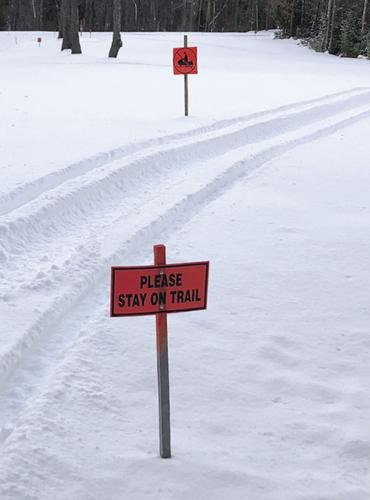
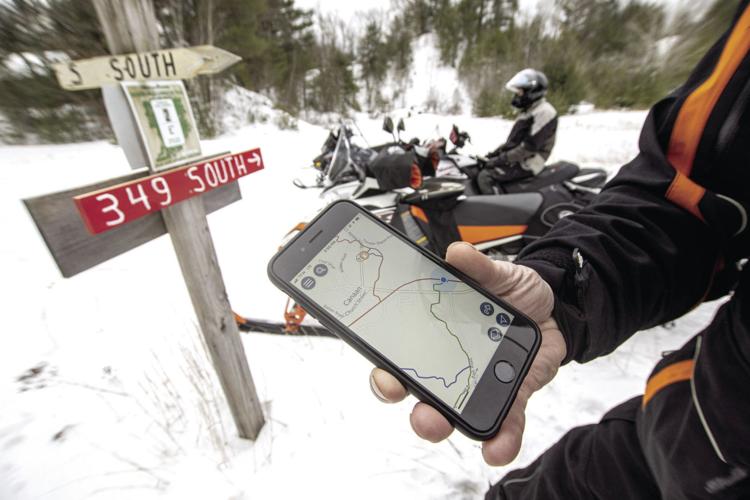
The biggest problem for the Sno-Streakers is trespassing riders. There shouldn’t be any good excuse, as the trail maps, snowmobile registration documents, and countless signs along the routes drive home the message: Stay on the trail or stay home.
But, increasingly, Inman and Vaal say, the sight of a wide open field or distant pond is too tempting to pass up. A rider decides to turn the handlebar and hit the throttle to tear through the fresh snow. Then, when there’s already a set of tracks through the field, other riders might think they’re entitled to follow suit.
But those impulsive riders don’t know why the trail is marked to go along the edge of that field, not through it. Next winter, that trail might be gone.
“A lot of landowners don’t even snowmobile – it’s just out of the kindness of their hearts,” that they allow the trails to go through, Inman said. Yet, more and more, clubs are hearing complaints from those landowners about discourteous riders.
“Picture a large field with a groomed trail that goes on the edge of the woodline, that landowner has indicated that is the specific area where snowmobiling is allowed,” Gould said. “Out of that groomed area, we don’t know what’s under there.” There could be crops or seedling trees just under the snow, he said. “When snowmobilers venture off that groomed area, even by a few feet, that can put the trail at risk.”
“Illegal trespass is a nationwide problem. I would go so far as to say it’s North America problem,” Gould said. “It’s always been a problem, but it seems to have gotten worse the past few years. Some snowmobilers don’t truly understand what trespass is – if your snowmobile leaves the groomed trail, you could very well be trespassing.”
Policing the trails
This season, snowmobilers who break certain laws – too loud exhaust, speeding, or trespassing – could find themselves holding a ticket for $248. That’s more than double what it was previously, and Gould said his association wholeheartedly backed the increase. In fact, he’s in favor of doing more to discourage misbehavior on the trails. A committee at NHSA is currently studying the problem.
“Educating the snowmobilers is the most important thing. Some clubs have even been installing surveillance cameras, trying to figure out who these people are,” Gould said. “Unfortunately, there are just people in this world who are disrespectful of everybody, it’s a small percentage, but they cause huge headaches.
“It’s almost like a younger generation that feels that they’re entitled to this stuff. Maybe it’s just a few that didn’t have the upbringing to have appreciation,” said Steve Sawicki, trailmaster of the T-N Arch Trail Travelers, a snowmobile club in the Tilton-Northfield area. “It just doesn’t make sense to me. If I was going to use your property, why would I be rude to you?”
Inman and Vaal, with the Sno-Streakers, think property owners ought to gain some sort of benefit for opening their land to snowmobilers. Perhaps a break on their property taxes, they suggested.
The T-N Arch Trail Travelers aren’t waiting for such a law, Sawicki said. Their landowners’ most common complaint isn’t trespassing snowmobilers, he said, it’s ATV and off-road trucks that illegally use the trails when the snow is gone, causing damage and erosion.
“I don’t think it’s always malicious, people just want to recreate and have a good time,” Sawicki said.
While the Arch Trail Travelers haven’t found a way to keep the four-wheelers away, they have found a solution that helps build patience among property owners. For the past 15 years at least, the club has held a fundraising evening. Sawicki prepares invitations for local property owners.
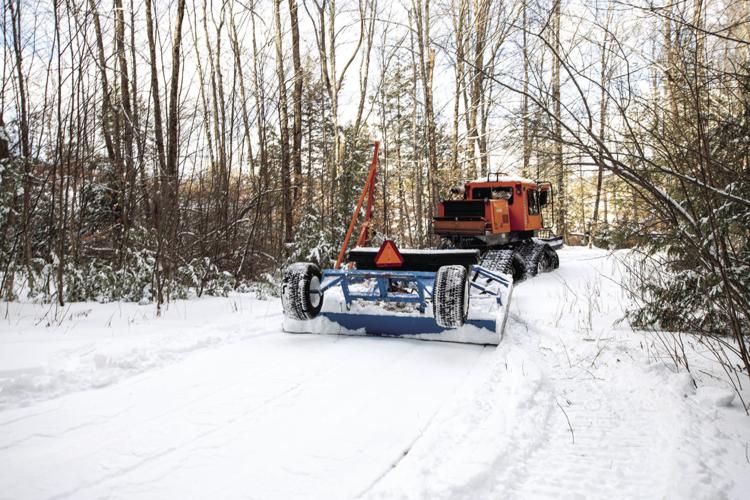
“I hand deliver them and personally thank them for letting the club use their property,” Sawicki said. “We get a great turnout. I just think it gives the landowners a different look at who the people are who use the land. It also gives the snowmobilers a face to put with the land that they’re riding on.” The property owners get to know who the club officers are, who operates the groomer on the trails and who trims brush in the off-season. “I think it makes a big difference. I’ve even had some of the guys in the snowmobile club get to know the landowners. I think it’s easier to deal with those landowners once they meet the people in the club. When they’ve been to one of these events and see how they behave, they see families with their kids, they’re enjoying these trails because the landowners let us. That’s the bottom line, because without the landowners, we’re done.”
Sawicki, as trailmaster for his club, is the one whose phone rings when a property owner is upset.
“For the most part, it’s a pleasure doing what I do. I enjoy dealing with the landowners, we definitely try to keep the landowners happy and the snowmobilers happy at the same time, it can be a challenge,” Sawicki said. “There’s a ton of people who work hard to keep (the trails) open, there’s a few who make your work a lot harder.”


(0) comments
Welcome to the discussion.
Log In
Keep it Clean. Please avoid obscene, vulgar, lewd, racist or sexually-oriented language.
PLEASE TURN OFF YOUR CAPS LOCK.
Don't Threaten. Threats of harming another person will not be tolerated.
Be Truthful. Don't knowingly lie about anyone or anything.
Be Nice. No racism, sexism or any sort of -ism that is degrading to another person.
Be Proactive. Use the 'Report' link on each comment to let us know of abusive posts.
Share with Us. We'd love to hear eyewitness accounts, the history behind an article.