


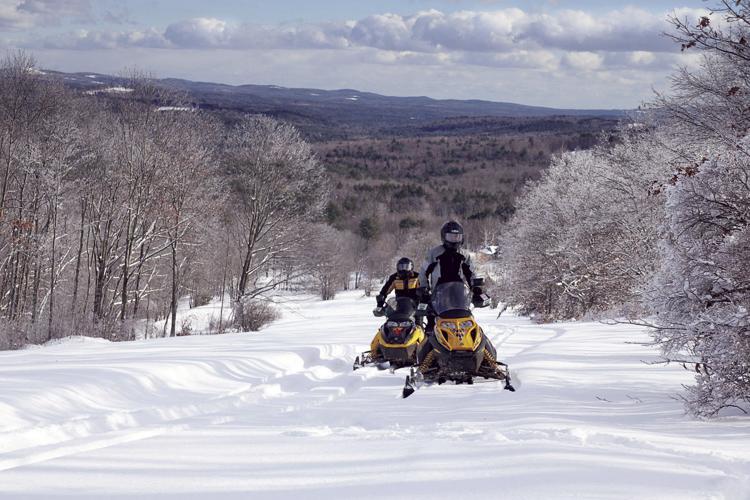
LACONIA — Times have really changed since those winter weekends in the 1960s when snowmobile buffs would congregate in Labonte’s Field in Gilford to ride and swap stories.
“They would ride around on that open field on Hoyt Road. That’s all you could do on a snowmobile back then,” said Richard Grenier, who grew up in Weirs Beach and is now the treasurer of the Belknap Snowmobilers. “There were no trails for snowmobiles. You really couldn’t go anywhere.”
Today, Grenier says there are 7,600 miles of trails across the state and it’s possible to ride a snowmobile from the Massachusetts state line all the way to the Canadian border.
There were 23,143 snowmobiles registered in the state as of Jan. 14, according to the state Department of Fish and Game. Out of that total, 8,432 machines are registered to out-of-state residents. For the last five years the number of registrations has averaged 41,160, according to Fish and Game statistics.
Unlike motor vehicle registrations, snowmobile registration numbers fluctuate, depending on the weather.
According to Lisa Whalley, manager of snowmobile dealer HK Powersports in Laconia, while some snowmobilers register their machines every year no matter what, others wait until there’s enough snow to go riding before doing so.
Suffice it to say, snowmobiling has experienced extraordinary growth since the ‘60s.
While snowmobiling has experienced a decline in some places, like Europe, the sport is holding its own here in the U.S., according to Dan Gould, the executive director of the New Hampshire Snowmobile Association.
In central New Hampshire alone there are 12 snowmobile clubs, stretching from Northfield in the south to Campton in the north.
The Belknap Snowmobilers, one of the state’s larger clubs, has about 186 members, according to Grenier, and maintains 64 miles of trails in Laconia and Gilford.
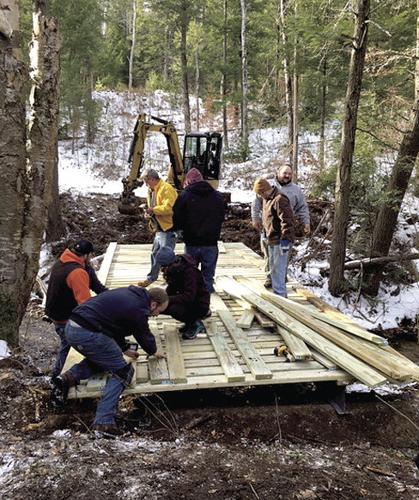
Keeping the trails maintained means smoothing them with sophisticated grooming machines during the winter, and in the warmer months repairing or replacing bridges and trimming back tree branches that are encroaching on the trails, Grenier said.
“All this work is done by club members who volunteer their time to make sure the trails are fun and safe to ride,” Grenier explained.
Snowmobiling is an outdoor activity that knows no age gap.
“There are the 20- to 30-year old crowd who have been in it since they were kids,” Whalley said, “and there are some who are in their 90s.” Riders in their 70s and 80s remain particularly active, she added.
Corey Hilton, president of the Central New Hampshire Snowmobile Club in Campton, is the third generation of his family to belong to the club. “My father and grandfather were members,” he said.
The Central New Hampshire Club, founded in 1970, is similar in size to the Belknap Snowmobilers. It has 150 members and 70-plus miles of trails running from lower North Woodstock to Plymouth, and includes miles of trails in Campton and Thornton.
“It’s a good time to enjoy the woods and the other joys of the outdoors,” Hilton said, explaining why he got into the sport.
Grenier agrees.
“There are views in this area that you can only see in the winter from a snowmobile, because the rest of the year many trails are closed to the public,” Grenier explained.
New Hampshire’s network of snowmobile trails is an asset that clubs are anxious to preserve. In much of the state, including central New Hampshire, most of the trails are on private land. The clubs negotiate with individual landowners to allow the clubs to create a trail on their property, with the understanding that riders will stick to the marked trail and not venture off into other areas.
Grenier said that signs that read “Stay On Trail” should not be ignored.
“When snowmobilers go off the trail it’s very upsetting to the landowners and it’s very upsetting to us,” he said. Repeated instances of snowmobilers who don’t abide by the rules can cause a landowner to close their land to snowmobiles entirely. “You’re one landowner away from losing your trail system,” Grenier pointed out.
The improved economy is being credited with the recent upswing in snowmobile activity.
Whalley said the economy has helped spur sales at HK Powersports which she described as “great.”
“I see new faces and people coming back, and part of that is the economy for sure,” said the snowmobile association's Gould.
Considering how much it costs to get into snowmobiling, it makes sense that higher economic confidence will lure more people into snowmobiling.
It's an expensive sport, Hilton readily acknowledges.
According to Gould, new snowmobiles cost $10,500 and up, although it’s possible to buy used machines for between $3,000 and $5,000. A trailer typically runs $3,000, and a suit and helmet cost about $400. Many snowmobilers try to cushion the hit on their wallets by buying accessories at swap meets and flea markets, he said.
Today’s snowmobiles are much more advanced than the machines that were on the market in the 1970s. The new Skidoos and Polarises are “a little zippier” than last year’s models, said Whalley. But in addition to higher speed and improved acceleration, Gould noted today’s snowmobiles also meet emissions requirements and get better mileage. “The technology is trickling down into the product,” he said.
It stands to reason that a pastime that requires a significant financial outlay also contributes significantly to the state’s overall economy.
According to the most recent economic assessment undertaken by The Institute for New Hampshire Studies at Plymouth State University in 2012, snowmobiling delivers an economic impact of $586 million to the state annually.
“Snowmobiling is a huge economic driver in the North Country,” Gould said, “but it also has a real impact all over the state.”
Locally, some hospitality businesses, such as restaurants, benefit from being located near snowmobile trails.
“It’s an important boost to our winter business,” said Megan Page, general manager of Patrick’s Pub & Eatery in Gilford, which is directly across a trail which parallels Route 11. “When they can ride right to our door, it’s great.”
The PSU study found that snowmobiling generated more that $1 million in rooms and meals tax revenue, and was responsible for the creation of 4,637 full-time jobs.
However, the study noted that nonresidents accounted for only 43 percent of snowmobile travel party spending, as compared to 80 percent of overall traveler spending, and 75 percent of all alpine and Nordic skier spending. Those findings prompted the report’s authors, PSU economists Mark Okrant and Brian Lee, to conclude that the overall economic impact from snowmobiling within the state — while impressive — would be enhanced considerably by attracting substantially more out-of-state snowmobilers to the state.


(0) comments
Welcome to the discussion.
Log In
Keep it Clean. Please avoid obscene, vulgar, lewd, racist or sexually-oriented language.
PLEASE TURN OFF YOUR CAPS LOCK.
Don't Threaten. Threats of harming another person will not be tolerated.
Be Truthful. Don't knowingly lie about anyone or anything.
Be Nice. No racism, sexism or any sort of -ism that is degrading to another person.
Be Proactive. Use the 'Report' link on each comment to let us know of abusive posts.
Share with Us. We'd love to hear eyewitness accounts, the history behind an article.