


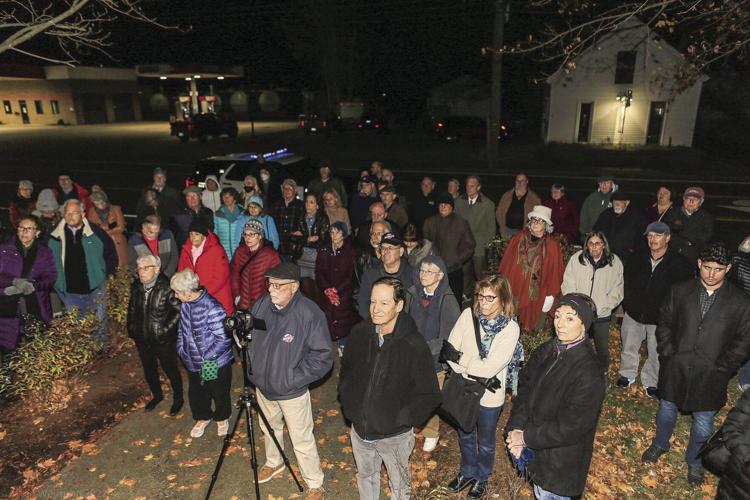
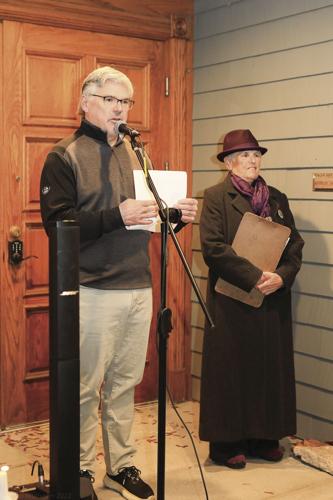
LACONIA — Members of Temple B’nai Israel held a special ceremony last week to observe the 84th anniversary of Kristallnacht, the infamous Nov. 9, 1938, "The night of broken glass," or "Kristallnacht," during which Jewish businesses, homes, and synagogues were destroyed across Germany's Third Reich.
The event was a grim harbinger of what was to come. Thirty thousand Jewish people were captured and later sent to concentration camps, and nearly 100 people were murdered.
While not an annual observance at the temple, recent events in Laconia inspired one synagogue member to hold the night of remembrance.
Last winter, a swastika was found carved into a shelf at the Laconia Public Library. Then, red and black spray paint was used to vandalize Opechee Park in September. Among the crude symbols was a red swastika, a symbol associated with the Nazi Germany, painted on the surface of a picnic table. The Local Human Relations Committee held a vigil shortly after the incident.
“It was fabulous that the human rights committee did that vigil. It was fantastic,” said Lois Kessin, a member of the synagogue. “But it was up to the Jewish community to take a stand.”
Kessin rallied her community to put together the night of remembrance. Kessin appeared pleased with the results.
“We were pleased with the speakers, they were terrific,” Kessin recalled, “and the turnout. There were 70 people there. It was not all the Jewish community. It was mostly non-Jews. It was grand.”
Despite the Nazi imagery appearing in Laconia, Kessin said she was not fearful during Wednesday night's event.
“I am not fearful at all,” Kessin said. “We did have a policeman there because of what happened in Newark. I wanted people to be comfy outside of the synagogue, so we decided to have a police presence there.”
An arrest was made last week during an FBI investigation in New Jersey of a threat of violence against synagogues in that state, posted on social media.
It was the initial responses to the vandalism, and not just the incidents themselves, that inspired Kessin to hold the rally.
“I was really upset with the library's decision not to report the graffiti until the second incident,” said Kessin. “I was angry about that and I thought, what can I do about it? I decided it would be a good thing to do another Kristallnacht remembrance.”
Kessin invited members and leaders from all faiths, as well as Laconia's Mayor Andrew Hosmer, to attend. Although the recent vandalism acts are insensitive and utilize imagery highly inflammatory to the Jewish community, Kessin said she believes that such actions must be addressed and faced head on.
“Why I did it in general, is no hate message should go unchallenged,” Kessin said. “Carving a swastika into something, even if it's just a 12-year-old kid [doing it], is not acceptable in my book.”
Rabbi Jan Katz, the temple's rabbi, was not in attendance, but shared a written statement.
“For us today at this moment, the connection that looms large in our memory and in our heart is that of the Night of Broken Glass on Nov. 9, 1938, when the large- to-infinitesimal, jagged, sharp, penetrating glass shards shattered the lifelines of Jewish existence — the stores, synagogues, and community service organizations. The Nazis and their sanctioned acts of brutality threatened to quash the spirit and freedom of the Jewish people. Despite the ensuing rotting away of civil and human rights and the eventual genocide of 6 million Jews, the Jewish people persisted.”
Over the past decade, white nationalism has grown more visible in America. Several mass shootings have occurred in synagogues, prompting the Jewish community to take more precautions, and remain outspoken about what hatred, bigotry and dehumanization can become if left unchecked.
Kessin said that things are better in the Lakes Region than when she was growing up.
“When we moved here, the Jewish doctors were not allowed in the clinic. They had hospital privileges but had offices outside the clinic,” Kessin recalled. “Of course, it's not that way anymore.”
Kessin also recalled being teased by other children for being Jewish.
Kessin tied this bigotry to common racist myths about Jews. Dispelling the myths can be difficult, especially when the living reminders of the end result of such misconceptions are almost all gone.
“The loss of the World War II vets and the Holocaust survivors, Romanis, communists, homosexuals, those stories are being lost,” Kessin said, continuing that she was old enough to remember growing up with Holocaust survivors in Laconia.
“You knew their stories and knew what they lost. You could see the tattoos,” Kessin recalled, referencing the numbers tattooed on the wrists of concentration camp prisoners by their Nazi captors. “Some were resilient and functioning, and some were broken. Just absolutely broken. When you see that as a 6-year-old, that's worrisome.”


(0) comments
Welcome to the discussion.
Log In
Keep it Clean. Please avoid obscene, vulgar, lewd, racist or sexually-oriented language.
PLEASE TURN OFF YOUR CAPS LOCK.
Don't Threaten. Threats of harming another person will not be tolerated.
Be Truthful. Don't knowingly lie about anyone or anything.
Be Nice. No racism, sexism or any sort of -ism that is degrading to another person.
Be Proactive. Use the 'Report' link on each comment to let us know of abusive posts.
Share with Us. We'd love to hear eyewitness accounts, the history behind an article.