


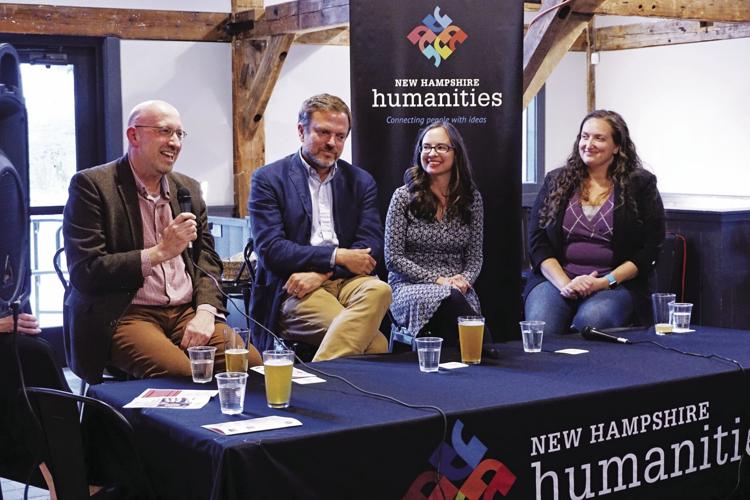
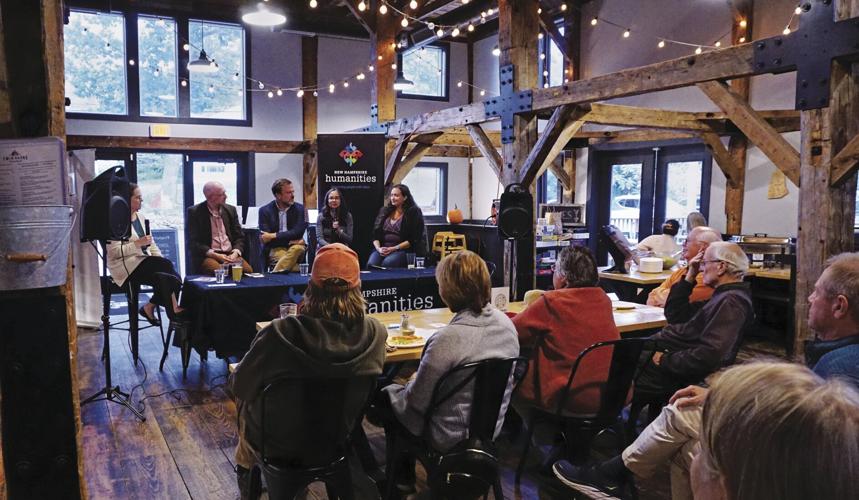
MEREDITH — Ideas on Tap, a series hosted by New Hampshire Humanities, brought its “pint sized conversations about big ideas” to Twin Barns Brewing Company on Tuesday evening.
At “All Eyes on New Hampshire: Political Coverage in the Granite State,” a panel of local, state and national journalists alongside a political scientist shared their perspectives on the changing political and media landscape in New Hampshire and the impact on reporting, debates about New Hampshire’s “First in the Nation” primary status, and ways that consumers feel about their news diet.
The panel included Dr. Dante Scala, a political science professor at the University of New Hampshire; Josh Rogers, a reporter for New Hampshire Public Radio; Holly Ramer, a reporter for the Associated Press who got her start in the Granite State, and Julie Hirshan Hart, editor at The Laconia Daily Sun.
Panelists fielded questions from moderator Dr. Christine Gustafson, a professor at St. Anselm College, and an audience of about 30 people.
All politics are national?
As social and digital media have come to dominate how voters get and digest information, political culture — in New Hampshire and everywhere — becomes increasingly focused on national issues. With this, panelists said, the famous Tip O’Neil adage that “all politics is local” has been turned on its head.
“Increasingly, most politics are national,” Rogers said. One way this is reflected in New Hampshire politics is who is running for office and why. In the past, the citizen legislature has been populated by local political regulars such as selectboard or school board members. Now, Rogers noted, state candidates are more likely to be fueled by national politics.
“It’s more of an activist-driven legislature, and the middles of both parties have sort of been hollowed out,” Rogers said.
The nationalization trend has spread to coverage as well, Scala added. With the New Hampshire primary, for example, the result has become more contextualized in a national backdrop: New Hampshire is now just one stop on the primary train and the outcome holds less weight.
“I think we have less influence over who becomes the nominee than we did 25 years ago,” Scala said. “When I got here, New Hampshire was bragging, ‘Well, you know, always first, always right...' We've really come down several pegs for that.”
In turn, coverage of the New Hampshire primary is now further from New Hampshire issues and New Hampshire outlets. Candidates are increasingly giving offering town hall meetings to national outlets, Scala noted: “We don't have an exclusive seat. And that's a big, big difference.”
The changing media landscape
Panelists discussed how the changing informational landscape impacts how reporters must approach political coverage and the press’ relationship with campaigns.
“Candidates don’t need the press the way they used to, and, particularly within the Republican Party, there is an institutional hostility to the press,” Rogers noted. As a result, it is more difficult to get access to campaigns, and that relationship has become “a very negotiated thing.”
Rogers noted that he understood why campaigns, when they could use social media to put everything in exactly their own words and in their own spin, wouldn’t need the press anymore and might even be apprehensive toward the press. At the same time, he emphasized, campaign access is important for reporters to understand the tone of a campaign, its candidate and its supporters.
“It's a challenge if somebody wants to actually watch voters and their discernment process and see what candidates are saying,” he said.
Hirshan Hart reinforced this point for media at the local level, sharing that coverage of the Belknap County primary races was hindered by some candidates' disinterest in sharing their platform with a reporter.
Ramer agreed. Both the changing relationship with candidates and the scarcity of resources available to news sources means national reporters, in particular, are changing how they contextualize stories.
“I think that's true at all levels: the candidates don't need the press as much as they used to — and there just aren't as many of us even if they did.” She noted that when she began at the Associated Press, there were more than a dozen staff in the New Hampshire office. Now, she said, there are only three.
This, combined with the nationalization of politics and its coverage, means her reporting has pivoted.
“AP is really shifting towards a more national focus,” Ramer said. “Instead of writing for your state, we're supposed to write from our state. So we're supposed to constantly be thinking, ‘How does what's going on in New Hampshire fit in with national trends?’”
Scala described a hollowing of the middle infrastructure of news, where national outlets thrive, some local outlets survive, and other outlets are lost in between.
As that layer of mid-level sources struggle, the vibrancy of local news remains important, even as it also clings to scant resources.
Rogers noted that local papers are needed to get boots on the ground to lay groundwork for stories — for both citizens and other journalists — that bigger outlets can’t or don’t field. “It's very helpful to get one's bearings,” he said.
Ramer echoed this point. “I rely on the local views to sort of elevate issues that might be statewide or national interest,” she said. “I think local news is incredibly essential, but I don't know the answer to make it sustainable.”
How to know what news to read
The panel concluded with a question from the audience about how, with so many different types of information, consumers can navigate an overwhelming media landscape as responsible citizens.
“Where do we go to get objective, honest, true news?” the audience member asked. “That's why I came here tonight: I don't know where to go.”
Many members of the public aren’t trained in media literacy, and trying to recognize the differences between analysis and reporting — and to know what reporting they can trust as neutral — can be frustrating and exhausting.
Ramer noted that there are third-party groups that analyze the neutrality and accuracy of different outlets, which can help readers equip themselves.
Panelists concluded with the advice that, if a reader has doubts, they should do some of their own fact-checking and read a range of sources.


(0) comments
Welcome to the discussion.
Log In
Keep it Clean. Please avoid obscene, vulgar, lewd, racist or sexually-oriented language.
PLEASE TURN OFF YOUR CAPS LOCK.
Don't Threaten. Threats of harming another person will not be tolerated.
Be Truthful. Don't knowingly lie about anyone or anything.
Be Nice. No racism, sexism or any sort of -ism that is degrading to another person.
Be Proactive. Use the 'Report' link on each comment to let us know of abusive posts.
Share with Us. We'd love to hear eyewitness accounts, the history behind an article.