


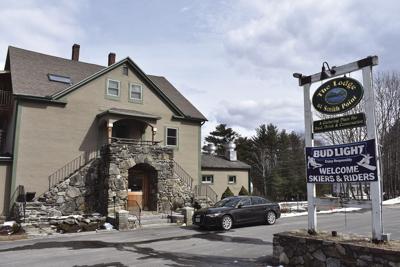
Mark Poirier, owner of The Lodge at Smith Point in Alton, said he is doubly frustrated by the hits restaurants are taking due to the coronavirus pandemic. First came the governor’s order forcing restaurants to curtail service or shut down during the crisis; then he learned that the business interruption insurance he carries is unlikely to cover the losses he is incurring.
On the first point, while conceding that Gov. Chris Sununu had to act, Poirier said, “I’m frustrated and a little annoyed. We’re a dine-in business, and the take-out option doesn’t work for us, but other people [who can offer take-out] are allowed to keep going.”
As for the insurance, he said that, through the businesses he has owned, “I’ve put millions into the hands of the insurance companies, and in my hour of need, where are they?”
Poirier had a lengthy conversation with the state’s new insurance commissioner, Chris Nicolopoulos, who reiterated that business interruption insurance is for a “direct, physical” loss and that carriers typically exclude economic losses unaccompanied by “a distinct and demonstrable loss of the physical use of the business property.”
Because several businesses were asking the same questions, the insurance department placed relevant information online at https://tinyurl.com/vntf7mv.
One common question was the effect of Sununu’s emergency order. “The state of emergency does not change the terms of your business interruption coverage," the Insurance Department posting said. "Your policy likely will provide some coverage for the peril of ‘civil authority.’ The typical business package policy would likely still require that a direct physical loss be present.... However, it is important to read your specific policy to determine the scope of coverage that your insurer has agreed to provide.”
Sununu acknowledged that problem in a March 23 letter he wrote to congressional leadership:: “In the long term, we can hope that Congress will work with both state regulators and the insurance industry to develop a more permanent solution to this coverage problem. The National Flood Insurance Program and the Terrorism Risk Insurance Act are examples of such efforts. Now, however, what is needed is a short term and temporary solution that goes beyond the Economic Injury Disaster Loan Program administered by the Small Business Administration.”
Coping with change
Alan Beetle, co-owner of Patrick’s Pub in Gilford, also learned that his insurance policy would not come into play during the pandemic.
“The current 90 percent drop in revenue will not be recovered,” Beetle said.
“We’re not to be deterred,” Beetle went on to say. “We’re working to get a sustainable business model with exceptional curbside and delivery services, following CDC guidelines. … We’re not there yet, but there’s things we’re learning now that will carry forward when the restaurant eventually reopens [to inside dining]. It will be better because of what we’re doing right now.”
Beetle said Patrick’s remains open despite the reduced revenue because their commitment “has and always will be to our staff and our customers and our community, and we feel if we can stay open, it’s better for all of those people.”
Of the 85 people that Patrick’s employed, all but 10 have been laid off, Beetle said. There is a core group of four full-time employees, with some hourly workers, still on the job, and Beetle said he hopes to be able to continue to keep them employed and bring back others as things improve.
Patrick’s delivery service covers Laconia and Gilford.
“Our commitment is to stay open,” he said. “Week by week as things unfold, our decisions and criteria may change.”
He added, “Our heart goes out to the many restaurants and hospitality and many other businesses downstream and all around that are facing these same issues today.”
Alex Ray, owner of the Common Man family of restaurants, had not even checked on insurance coverage when contacted. “How can you think about draining the swamp when you’re facing alligators?” he asked. “I’ve been thinking about how to have 700 people safe, and I’m not sure unemployment is enough.”
Seven out of the 16 Common Man restaurants are open, one in each area of the state, Ray said. Two diners are open all day and the other restaurants are open 4-8 p.m. with front-door service only. Of the roughly 700 workers he employs, 650 have been furloughed.
“It will change tomorrow; everything we do is dynamic, so we’re dealing with today,” he said.
What he has been able to do is to prepare fresh meals daily for the employees, and he allows them to call in orders for takeout to their households at no charge.
The Common Man also placed $10,000 in its Employee Emergency Assistance Fund and is donating all gratuities on takeout orders into the fund.
Ray later did check with his insurance provider about possible coverage and found out it did not cover this crisis. “Of course I’m not happy,” he texted.
Reuben Bassett who, with his wife, own four restaurants, said only Burrito Me’s Laconia location was able to remain open because it is best-equipped to handle takeout orders.
“If to-go sales don’t do it, we’ll have to cut back more,” Bassett said.
He hadn’t checked about insurance because he didn’t expect to be covered, and said with sales down 60 percent, he’s “definitely hurt, but a lot of our regulars still come in.”
He described it as a daily challenge but has succeeded in moving a lot of the business to phone and online orders. Having customers stop in for takeout is a problem because waiting in line at the counter does not afford the social distancing required during the pandemic.
Coming at a slow time for the business, the reductions are taking a toll. “We’re equipped for a couple of days of interruption, but it catches up real fast without a line of credit,” he said, adding that it’s hard for restaurants to qualify for line-of-credit loans. “Discounted loans would help,” he said.
Insurance obligations
Poirier plans to fight for the insurance coverage he believes he is owed, and anticipates class-action lawsuits to follow in the wake of the insurance companies’ denial of business interruption claims on the pandemic.
Insurance companies in the past tried to avoid the cost of environmental cleanups which they argued were not outlined in their coverage policies, but when it went to court, the justices ruled that, without a specific exclusion, the cleanup costs had to be covered. The same may apply to the current situation.
That is what Gerry Kennedy believes. President of Massachusetts-based Charles River Risk Solutions, LLC, and an Alton homeowner, Kennedy says the insurance companies failed to prepare for today’s situation, despite warnings that they should do so.
As a risk management specialist, Kennedy has been telling insurance companies that they need to prepare for business disruptions from computer viruses, and he said a biological virus has a similar effect. In fact, he says, insurance companies are facing a double whammy because the coronavirus is prompting businesses to ask employees to work from home, increasing the risk of a hacker getting a back door to business computers.
On his LinkedIn site, Kennedy writes, “I just had a good conversation with a colleague about the cause-and-effect of the pandemic forcing people to work from home. With everyone working from remote sites is going to open up tremendous amounts of unsecured access points all at once for the next few weeks. The hackers are already sending nefarious packets under the guise of coronavirus education. … The data will be flowing from unsecured homesites ….”
Poirier said insurance companies “have the potential to be the good guy and step up” to address the needs of clients, but are not showing any indication of doing so.
According to Kennedy, the insurance companies are negotiating with the government today about bailing them out again, but will “miss the mark because they can’t see the target.”
“Enjoy the sigh of relief when the Gov bailout hits it will be short lived and you will not be able to ask a THIRD TIME!” he posted.


(0) comments
Welcome to the discussion.
Log In
Keep it Clean. Please avoid obscene, vulgar, lewd, racist or sexually-oriented language.
PLEASE TURN OFF YOUR CAPS LOCK.
Don't Threaten. Threats of harming another person will not be tolerated.
Be Truthful. Don't knowingly lie about anyone or anything.
Be Nice. No racism, sexism or any sort of -ism that is degrading to another person.
Be Proactive. Use the 'Report' link on each comment to let us know of abusive posts.
Share with Us. We'd love to hear eyewitness accounts, the history behind an article.