


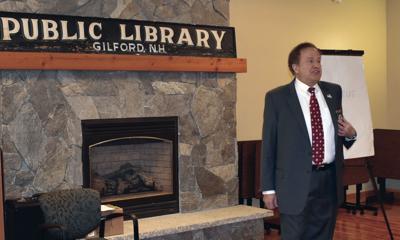
GILFORD — Norman Silber, a Gilford attorney and former state legislator, discussed five “critical issues” that may come before the United States Supreme Court and how a change in the makeup of the court could affect those decisions, during a presentation Thursday evening at the Gilford Public Library.
Silber has been presenting his program on “The United States Supreme Court Today & Tomorrow” throughout the state in hopes of informing the public about the foundations of the U.S. Constitution and how cases make their way to the nation’s highest court. Thursday’s cold snap, however, limited attendance to those already quite familiar with the court and who, for the most part, shared Silber’s conservative viewpoint about how the court should operate.
Silber, along with at least four current Supreme Court judges, identify with the Federalist Society for Law and Public Policy Studies, a group of conservatives and libertarians who believe “it is emphatically the province and duty of the judiciary to say what the law is, not what it should be.”
The liberal faction on the court, which views the U.S. Constitution as a “living document” whose language must be reinterpreted in light of current society, includes Ruth Bader Ginsburg, whose health problems may bring her term on the court to an end, and Stephen Breyer, who has indicated that he may be retiring soon. That means that President Donald Trump may be in the position of making two Supreme Court appointments in the next two years — a chance to bring more conservatives to the bench.
However, Silber noted, confirmations of Supreme Court justices are becoming more contentious, including challenges based on nominees’ religious beliefs. While the current court has six Catholics and three Jewish members, and the U.S. Constitution makes no mention of religious tests, U.S. Senators now criticize nominees for being Catholics or members of the Knights of Columbus, he said.
Silber, who is Jewish, repeatedly returned to the U.S. Constitution to note how it emphasized the preservation of freedom and gave states broad authority on matters not specifically identified for federal jurisdiction. However, he said, “Mischief occurs when the government gets involved.”
As Supreme Court decisions build upon earlier decisions, the federal government continually broadens its scope, he said, leading to cases such as “Kelo” where property was taken by eminent domain to benefit a private developer. New Hampshire responded by passing a law to prevent such taking, and Silber said the Supreme Court may revisit its decision.
In Roe vs. Wade, which legalized abortion, Silber pointed out that it grew from an earlier case out of Connecticut where the Supreme Court ruled that the state could not confiscate birth control items — a decision that established the “right to privacy” which was used in the Roe case. While it is unlikely that Roe v. Wade will get another day in court, Silber said it is possible.
Other matters that may return to the court are issues dealing with religious freedom and the Affordable Care Act, and the deference clause contained in Chevron and Auer.
In the latter case, the court ruled that it could apply the Interstate Commerce clause in a matter involving only one state because phone messages might be routed outside of the state and even to a satellite.
In response to a question near the end of his talk, Silber said that, if President Trump were to ignore a federal court order on immigration, it would constitute grounds for impeachment. Trump would have to wait for a reverse of the decision as it it makes its way from the federal circuit court to the Supreme Court because he has to follow the law of the land, Silber said.


(0) comments
Welcome to the discussion.
Log In
Keep it Clean. Please avoid obscene, vulgar, lewd, racist or sexually-oriented language.
PLEASE TURN OFF YOUR CAPS LOCK.
Don't Threaten. Threats of harming another person will not be tolerated.
Be Truthful. Don't knowingly lie about anyone or anything.
Be Nice. No racism, sexism or any sort of -ism that is degrading to another person.
Be Proactive. Use the 'Report' link on each comment to let us know of abusive posts.
Share with Us. We'd love to hear eyewitness accounts, the history behind an article.