


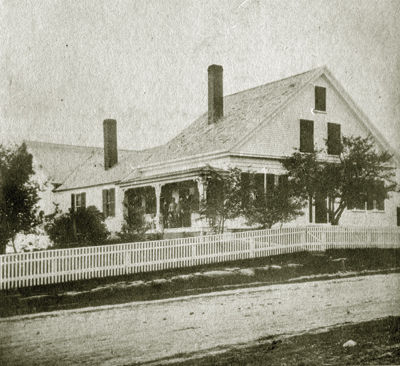
A frame from a stereoscopic photo of the French-Taylor House in Moultonborough. (Courtesy Photo)
Preservation of French-Taylor House would counter threat faced by historic properties
By THOMAS P. CALDWELL, LACONIA DAILY SUN
MOULTONBOROUGH — It is a not-uncommon story. A historic building becomes vacant and is boarded up, and sits idle without an apparent purpose while weather and time take a toll on the structure. Eventually, there are calls for its destruction to make way for new development — often in the form of a box store or a national restaurant chain.
The New Hampshire Preservation Alliance’s inclusion of the French-Taylor House on its Seven To Save list could prevent that from playing out in Moultonborough.
“Here’s an opportunity to see it doesn’t become a drive-through restaurant in the middle of the village,” said Norman Larson, a preservation architect who also serves on Moultonborough’s Heritage Commission and Planning Board.
Residents at the 2014 Moultonborough Town Meeting voted to purchase the historic building, which sits on five acres at 970 Whittier Highway, even though there was no clear use for the building. It is considered significant for its community history as well as its architecture.
There had been a study of possible ways to reuse the property, with options ranging from renovating the building for office or retail use to razing the structure for use of the property as a park or common space, or, between those options, using all or part of the building as part of a community center or other civic use, according to Larson.
“With a new town planner, we would like to see a community process to determine what the best options would be,” he said. “It’s a very important part of the work to involve the community as a whole.”
That did not happen with Laconia’s Hathaway House, which, like the French-Taylor House, had been deteriorating from sitting idle. A group of Laconia residents trying to save the Hathaway House found that the cost of rehabilitating the structure was beyond their means. The building finally was razed to make way for a small commercial development.
Jennifer Goodman, executive director of the New Hampshire Preservation Alliance, said, “We know we can’t save everything, but there are ways to work through the challenges. I think there’s a lot of good news in the preservation movement in New Hampshire.”
Conflicting views
James Garvin, the former architectural historian for the state, said many well-built historic buildings were lost to urban renewal when planners seeking to revitalize towns and cities ordered the destruction of old buildings to make way for new downtown designs. Unfortunately, he said, many of the new structures, built during the 1960s and 1970s, were not built as well as the buildings they replaced.
“Today they are the buildings people are looking to take down,” he said during a reception at the Wolfeboro Town Hall where the Preservation Alliance had just announced its 2017 Seven To Save.
“The Main Street character is very important to communities’ identities,” Goodman said. “Landmarks like the Colonial Theatre in Laconia are being revived, but there are still lots of challenges and opportunities.”
She said many communities have downtown revitalization and land conservation as goals, but their land use tools are not aligned with those goals. Lancaster is one such community, and town officials are working to bring those elements into alignment. Lancaster’s Parker J. Noyes Building is another community landmark identified on this year’s Seven To Save list.
Larson said that, even when there is an alignment between goals and land use regulations, the big picture can be lost.
Planning boards look at site plans and can address things like parking spaces and landscaping, but a town’s code enforcement officials are looking at life-safety issues that do not take aesthetics into consideration.
Larson remains frustrated at the loss of the former Country Fare Inn in Moultonborough, which was torn down in September. The 1843 building had served as a Methodist Church, a residence, a doctor’s office, a boarding house, and an inn and restaurant.
Developer Steven Bradley, who also purchased the adjacent Berry Pond Motel, said he wanted to save the Country Fare, but the building had been too compromised by the various renovations through the years, as well as deterioration from sitting idle. In addition to mold and asbestos that would have to be remediated, he said old beams had been painted, some had been cut up or pulled out, and floor joists were braced.
“The beams weren’t all that attractive,” Bradley said. “But the attic had been virtually untouched for 150 years. Those beams and roof boards were original and unspoiled.”
He was able to save that top section of the house to cap the new barn-based structure being built on a freshly poured foundation as part of a retail and professional building. Bradley said the understructure of that section will use posts and beams removed from a farm in Maine.
With revised landscaping plans approved by the Planning Board, Bradley said the framing of the new building will begin next week and the main construction will take place in the next 30 days.
Worth saving?
Cristina Ashjian, chairman of the Moultonborough Heritage Commission, has championed the preservation of the French-Taylor House in the face of new calls for its demolition.
“The Taylor House, as it is known locally, stands directly across Route 25 from the Moultonborough Grange Hall, owned by the Moultonborough Historical Society and listed to ‘Seven To Save’ in 2012,” she said. “Loss of either or both of these buildings at the core of the historic village would severely impact Moultonborough’s unique character, streetscape, and sense of place.”
The property’s purchase by the town was seen as a “placeholder for future community uses,” she said, but, “the vacant house has languished without planning, and deteriorated without proper attention and maintenance.”
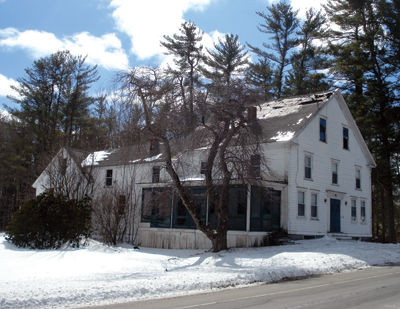
Last December, selectmen discussed demolishing the building as having no value to the community. That was before Tropical Storm Stella tore large sections of shingles from the roof of the house and barn in March, allowing water infiltration. While the town placed a temporary cover over the damage, it was not until this week that the selectmen agreed to make roof repairs to prevent further deterioration.
Larson said that the problem in deciding the value of an old building lies in the differences in perspective. Some see historic properties only in terms of their monetary value, while others also see the cultural and historical value, and it can result in confusion, as if they speak separate languages.
Either perspective requires an idea of what future use a property can have.
The Gale School in Belmont, another on this year’s Seven To Save list, may become office space for business startups or nonprofit organizations. The Laconia Area Community Land Trust has agreed to assist in redevelopment plans.
One goal identified in Moultonborough’s Village Vision Committee report in 2015 is to “preserve and strengthen the existing small-town character of Moultonborough village, with its unique and landmark historic buildings, streetscape, scale and ambiance … focusing on practicality and improving on what already exists in Moultonborough Village.”
For the French-Taylor House, the report encourages “potential adaptive reuse of [the] historic building for community or commercial use” while noting the larger property’s “potential for open space/town common/town green;" and as a key property for a future “village expansion/potential roadway connector south of Route 25.”
The Heritage Commission initiated an evaluation of the property in May, focusing on its possible community use. The New Hampshire Division of Historical Resources determined that the French-Taylor House is eligible for the New Hampshire Register of Historic Places, and the New Hampshire Preservation Alliance, with funding from the Land and Community Heritage Investment Program, provided a $3,500 grant match for a conditional assessment and structural evaluation of the building. That report is currently underway.
Historic characteristics
The 1840-era building is deemed important as a “representative example of a broad-gabled Greek Revival dwelling,” according to Garvin’s study of the building. Although vinyl shingles were placed on the building in the 1960s, the building still has the wide corner boards and paired eaves brackets that date back to 1900, when a major renovation took place.
Originally one-and-a-half stories in height, the turn-of-the-century renovations included lifting the roof and adding another story beneath it — a common practice at the time.
Documentation shows that the building was owned by Matthias Weeks, a marble worker, in 1861. He sold it to August P. Jaclard in 1865. James E. French, a prosperous local business owner and longtime state legislator from Moultonborough, bought and renovated the building around 1900. After his death in 1919, Adele Blanchard acquired what by then was known as the French House in 1923. The property passed through the women in her family to its last resident, Adele V. Taylor, who also was Moultonborough’s longest-serving librarian.
French had housed the volumes comprising the town library in his store and, in his will, he bequeathed $5,000 to the town for a library building. After French’s general store burned, his widow conveyed the empty lot to the town as a location for the new library, which was built in 1929.
Larson said Moultonborough’s Village Overlay District Ordinance is seeking to encourage the kind of multiple-use development that made the local business center what it is today. He said such multi-use development is discouraged in most communities today, but Moultonborough has recognized its importance in creating the Village Overlay District.
“The multi-use model works well for old buildings, because access to the upper levels can be difficult on a commercial basis. If a commercial use comes to either of our Seven To Save projects, it may be commercial on the ground floor and residential on the second floor.”
While, in the 1800s, people would look at the most valuable use of the land and incorporate mixed uses into what they built, today’s zoning usually prevents that flexibility, he said.
“Part of the challenge is the way zoning and site plan regulations have evolved into lists of what can be built. A box store like Dollar General can fit a building into a category and has the means to push back against community opposition. Multi-use development, including historic renovation, is done on tighter budgets and often faces tougher regulation and permitting hurdles.”
The roof of the French-Taylor House sustained damage during Tropical Storm Stella last March. (Courtesy Photo)


(0) comments
Welcome to the discussion.
Log In
Keep it Clean. Please avoid obscene, vulgar, lewd, racist or sexually-oriented language.
PLEASE TURN OFF YOUR CAPS LOCK.
Don't Threaten. Threats of harming another person will not be tolerated.
Be Truthful. Don't knowingly lie about anyone or anything.
Be Nice. No racism, sexism or any sort of -ism that is degrading to another person.
Be Proactive. Use the 'Report' link on each comment to let us know of abusive posts.
Share with Us. We'd love to hear eyewitness accounts, the history behind an article.