


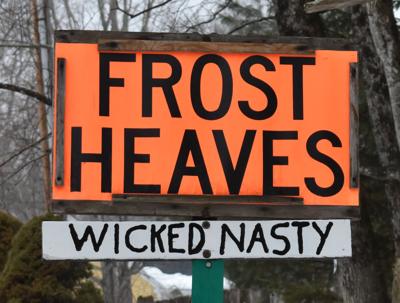
With temperatures warming up, motorists know that means one thing — the season of frost heaves, potholes and axle-deep mud has returned.
With mud season comes weight restrictions for some local roads throughout the region, as public works officials try to temper the damage.
Last year’s wet fall and temperatures in January that fluctuated wildly have some local public works directors concerned that local streets and roads could take an especially hard pounding this spring.
Laconia Public Works Director Wes Anderson said some city streets are already in terrible shape, singling out Clay Street and the lower part of Garfield Street — both in the South End.
“They look like a B-52 bombing mission hit them,” he said.
When frozen roads begin to thaw from the surface downward, melting snow and ice saturate the softened ground. During the spring thaw, the roadbed softened by trapped moisture beneath the pavement makes it more susceptible to damage. That also contributes to pothole problems that driven by the winter's numerous freeze-and-thaw cycles.
Anderson and Craig Clairmont, Belmont’s Public Works director, said the wetter-than-normal fall means the water table is unusually high, which means roads are more susceptible to frost heaves this year.
Frost heaves are created when moisture in the soil under the pavement accumulates in a particular area and freezes. Because water expands when it freezes, the pavement above the concentration of frozen soil bulges, pushing the pavement up, explained Jo Sias, a professor in the Department of Civil and Environmental Engineering at the University of New Hampshire.
As the spring thaw progresses, snowmelt on the road begins to find its way through cracks in the pavement created by the frost heave. That moisture is drawn down into the roadway’s subsurface by capillary action — similar to a sponge soaking up water. And because some areas of a road thaw faster than others, that adds to the deterioration.
New Hampshire is particularly vulnerable to this kind of pavement damage because the silty soil found beneath many streets and roads can hold lots of water, Sias said.
Frost heaves could be largely eliminated if that silty soil was removed and replaced with more-porous material, such as gravel. But, Sias pointed out, that solution would be cost-prohibitive for communities.
“It would more than double or triple the cost compared to what they do now,” Sias said.
Clairmont agreed. “To bring town roads up to the level of state highways would be cost-prohibitive,” he said.
While it's not feasible for cities and towns to create the kind of road base that exists for interstates and other major highways, improving drainage on streets and roads helps keep them in better condition.
“Better drainage helps to keep the water out from under the road,” said Sias. “It provides a better place for the water to go.”
Clairmont said the good drainage on many Belmont roads is a tremendous advantage.
One step cities and towns take in an effort to minimize the damage to secondary streets during the spring thaw is restricting heavy vehicles from traveling over the roads until the base is more solid.
Weight limits vary depending on the community. For example, in Belmont, vehicles weighing more than 6 tons are not allowed on posted roads. In Laconia and Gilford the limit is 10 tons. The limits in Gilford took effect a week ago, while the limits in Laconia and Belmont took effect this week.
Anderson and Clairmont try to be as accommodating with the weight restrictions as conditions permit.
If the forecast is for a cool morning with temperatures below freezing, they will let heavier vehicles make early deliveries. They also request businesses like waste haulers and fuel services to reduce their load weights to the extent possible.
Sias said communities can expect that the havoc spring thaw raises on the roads to get worse in coming years.
“Because of the way the climate is changing, we’re seeing more freezing-and-warming cycles. Things are going to get worse, and more prevalent, and will last longer,” she said.


(0) comments
Welcome to the discussion.
Log In
Keep it Clean. Please avoid obscene, vulgar, lewd, racist or sexually-oriented language.
PLEASE TURN OFF YOUR CAPS LOCK.
Don't Threaten. Threats of harming another person will not be tolerated.
Be Truthful. Don't knowingly lie about anyone or anything.
Be Nice. No racism, sexism or any sort of -ism that is degrading to another person.
Be Proactive. Use the 'Report' link on each comment to let us know of abusive posts.
Share with Us. We'd love to hear eyewitness accounts, the history behind an article.