


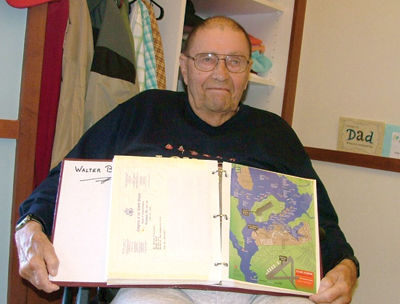
Pearl Harbor survivor Walter Borchert holds a scrapbook with a map which shows the location of American warships during the Japanese attack on Pearl Harbor. (Roger Amsden/for The Laconia Daily Sun)
By ROGER AMSDEN, for THE LACONIA DAILY SUN
BELMONT — Walter Borchert is one of the last remaining survivors of the Japanese attack on Pearl Harbor. What he saw that day is still vividly alive in his memory, even though it took place 75 years ago.
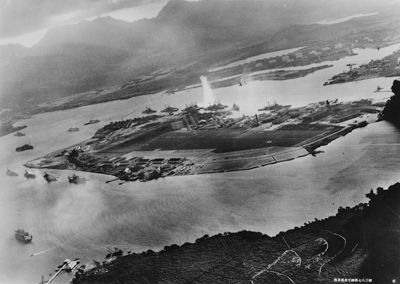
"You never forget something like that," said Borchert. "I can still see the battleship Arizona lifting partly out of the water after it got hit by a bomb that ended up going into its powder magazine. Over 1,100 sailors died when that happened. It didn't come completely out of the water, but lifted up and then sank back into the water," he said, motioning with his hands as he described the scene.
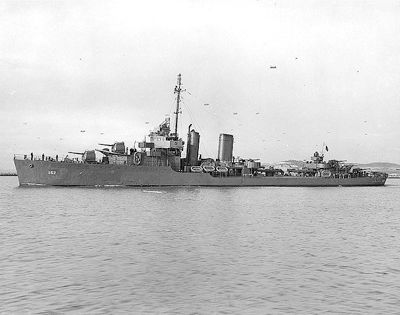
Borchert, now a resident of the New Hampshire Soldiers Home in Tilton, said Dec. 7, 1941, was a bright, sunny Sunday morning and there was a lot traffic around his ship, the 341-foot long USS Worden, one of four destroyers anchored near a destroyer tender at the entrance to Pearl Harbor.
The USS Worden
Boatswain Borchert, then 21, who had grown up in Brooklyn and signed up for a six-year tour of duty with the U.S. Navy in 1939, recalls that sailors were going ashore for chapel services while others were coming back to the ship from shore leave, or "liberty" as it was then known.
"I was just sitting down with a big egg sandwich and a big mug of coffee around eight o'clock when a guy named Yvonovich came running down the landing yelling 'The Japs are attacking!' I ran up onto the top deck and looked down the harbor to Battleship Row. The first thing I saw was the Arizona get hit," Borchert said.
Soon his ship would come under fire.
"We were constantly under bombing and strafing and had to keep ducking for cover," he said, recalling that although no bombs were dropped on the destroyers, the low-flying Japanese aircraft strafed them as each wave passed by. "They had virtually wiped us out in the first wave. We thought it was over then, but they hit us with a second wave. It went on for well over two hours. We had some .50-caliber machine guns, but couldn't use them to defend ourselves because the destroyers were so close together that you'd have shot the smokestacks off the other ships if you'd try to shoot at the airplanes."
One of the bombs hit 50 yards behind the Worden, exploding with such force that Borchert was slammed into the ship's torpedo racks.
"I banged up a knee, but I didn't know it because I didn't feel any pain until the adrenaline wore off'' he recalled.
He remembers going to a small arms locker on the port side of the ship where he pulled out a long-barreled .32-caliber pistol and the sailor beside him grabbed a .44-caliber pistol that they fired at the attacking aircraft.
"I don't think we hit any of them,'' said Borchert, who especially remembers one Japanese pilot who was flying so low that the sailors could see his face with each pass he made.
"He was grinning at us and firing his guns. There was an officer's locker on the ship's fantail that was filled with potatoes and onions. Some guys opened it up and started throwing them at him when he came by us," Borchert remembers.
The destroyers were eventually able to build up a head of steam and find enough separation so that they could fire back at the attackers. One of Borchert's shipmates, Quartermaster 3d Class Raymond H. Brubaker, trained a .50-caliber Browning machine gun on a low-flying dive bomber and sent it splashing into the water nearby.
"I just hope it was that guy who kept smiling at us. It was nice to know that we got at least one of them after all the damage they'd done to us. It was horrible. So many guys died that day," he said.
He says that within two hours of the start of the attack, the Worden was underway and headed out to sea.
"We spotted a sub shortly after noon and dropped seven depth charges. They were sitting out there trying to pick off ships as they came out of the harbor,'' he recalled.
Over the next 13 months, the Worden was involved in six other major naval operations in the South Pacific, including Coral Sea, Midway and Guadalcanal, frequently serving as part of the screening force for aircraft carriers like the Lexington, Saratoga and Yorktown.
"We were there ready to take a torpedo if we saw one headed toward a carrier and as the outer defense against Japanese airplanes. I spent a lot of time in what we called a gun tub, strapped in a harness and firing 20- and 40-millimeter guns when we were a screening ship for the Saratoga," Borchert recalled.
In October, the Worden returned to the West Coast of the United States, where it underwent some repairs and two days after Christmas 1942, sailed from San Francisco to support the occupation of Amchitka Island in the Aleutians, where disaster struck on Jan. 12, 1943.
The destroyer was guarding the transport Arthur Middleton as that ship put the preliminary Army security unit on the shores of Constantine Harbor, Amchitka Island. As they headed out, a strong current swept the Worden onto a rocky pinnacle that tore into her hull beneath her engine room and caused a complete loss of power.
An effort by the destroyer Dewey to tow the ship free failed when the cable broke and heavy seas started to push Worden toward the rocky shore. The ship broached and began breaking up and the crew was ordered to abandon ship.
"The water was 36 degrees. I didn't know if I was going to make it," said Borchert, who was finally pulled into one of the rescue boats of the Middleton.
"I got wet twice that day, because the Middleton ran aground, too,'' said Borchert.
He was later taken by a British gunboat to Papua, New Guinea, and got a ride on an Army transport ship which took him back to the states. He recalls that while on the British ship he would receive a daily ration of rum and was frequently pestered by the British sailors, who said that they'd be glad drink his rum if he didn't want it.
"But I always drank it!" he said.
When he returned stateside, he was assigned to Long Island City in New York, not far from his boyhood home in Brooklyn. Borchert worked as a security guard for the remainder of the war and met for the first time his future wife, a woman from New York who had been sending him letters through her church group while he was stationed in Hawaii.
He and Gloria, a school teacher, enjoyed their free time at places like Coney Island and at a Queens bar and restaurant, where the proprietor, Karl Vollmerding, always gave Borchert free drinks.
Vollmerding would later move to New Hampshire and build Karl's Steakhouse and Hofbrau Lounge near the Weirs Beach bridge, which Borchert and his wife would frequent after they moved to New Hampshire.
When the war ended, Borchert worked briefly for the Red Cross and for a company servicing vending machines before becoming a short-haul truck driver
"I remember driving through Brooklyn and honking my horn every time I saw Roy Campanella (Brooklyn Dodgers catcher) in front of his liquor store," said Borchert, who later became a New York City building inspector. A lifelong Dodger fan, Borchert said he gave up on them and his heart was broken after the team moved to California in 1958.
He and his wife bought a summer camp on Sachem Cove in Meredith in 1954 and spent many summers in the Lakes Region before moving to Meredith after they retired in 1977.
They most recently lived at Briarcrest Estates in Belmont, before Gloria moved into Golden View Health Care in Meredith and Walter moved to the Veterans Home.
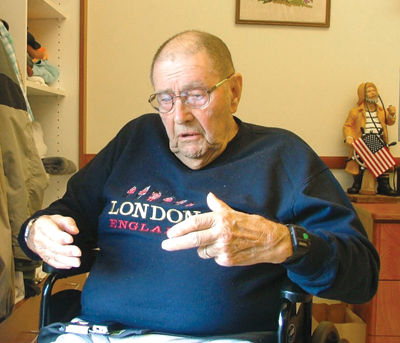
Pearl Harbor survivor Walter Borchert describes what it looked like when the Arizona exploded after its powder magazine was hit by a Japanese bomb. (Roger Amsden/for The Laconia Daily Sun)


(0) comments
Welcome to the discussion.
Log In
Keep it Clean. Please avoid obscene, vulgar, lewd, racist or sexually-oriented language.
PLEASE TURN OFF YOUR CAPS LOCK.
Don't Threaten. Threats of harming another person will not be tolerated.
Be Truthful. Don't knowingly lie about anyone or anything.
Be Nice. No racism, sexism or any sort of -ism that is degrading to another person.
Be Proactive. Use the 'Report' link on each comment to let us know of abusive posts.
Share with Us. We'd love to hear eyewitness accounts, the history behind an article.