


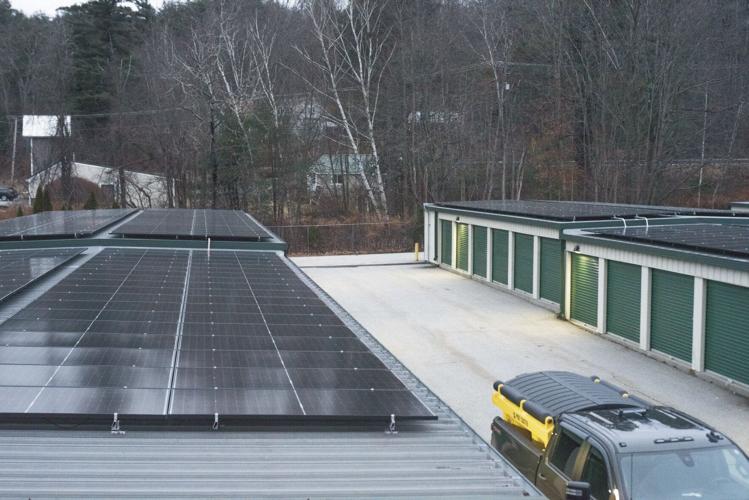
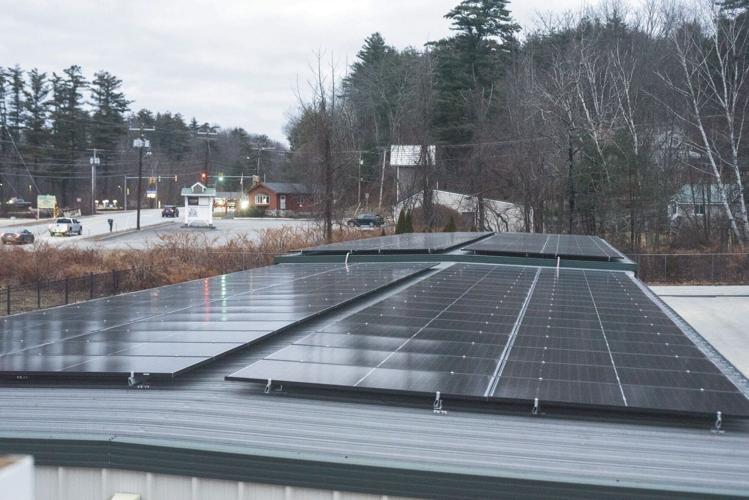
BELMONT — A storage facility seems like the perfect place to install solar panels with lots of flat, open space on the roof. Lawrence Wiley, owner of Winnisquam Storage, agreed, and installed 302 solar panels on top of the facility.
Wiley also owns three additional storage facilities, as well as 41 Wendy’s restaurants. One of his facilities in Epsom has already been using solar panels for a year. While the solar panels are installed at Winnisquam Storage, very little of that energy goes to that facility; most is used to power his Tilton and Gilford Wendy’s restaurants through the power grid.
Wiley originally invested in solar energy to make his businesses more sustainable, but found economic benefits, too. The federal government provides incentives for using solar energy, including tax credits.
“The federal government allows a 30% investment tax credit on these kinds of projects,” Wiley said.
Another benefit to Wiley is his business getting paid for all excess electricity produced by the solar panels that is sent to the electrical grid through a practice called net metering. Eversource will pay for the additional electricity, which goes toward the cost of the solar panels and creates a net-positive investment.
The panels at Winnisquam Storage will produce 160,206 kilowatt hours of electricity a year. For comparison, the average family home consumes 10,791 kWh, an average of about 889 kWh per month, according to the U.S. Energy Information Administration. Matt Smith, storage and facilities manager at Winnisquam Storage, could also attest to this.
“It'll produce enough power for all the electrical needs here, which is a lot more than the storage facility needs,” Smith said. “Regular residential or storage, we wouldn't use anything close to that. We're shipping the power right directly back in the grid.”
Wiley also received a grant from The Rural Energy for America Program that provides grants and loans to rural businesses interested in making energy efficiency improvements. But the grants can take a while to receive. It can take months to hear a decision about acceptance or denial, and ordering and receiving the panels can take months as well.
Solar panels can also be expensive. The panels cost Wiley over $300,000. Wiley expects the investment to pay for itself within three years of use. Solar energy is not something Wiley believes just anyone can do. They need the money to invest into a project like this.
“The thing about solar is you have to have the cash to be able to fund it upfront,” he said. “I wouldn't want to borrow money to do these solar facilities because the timeline is too uncertain. It takes a long time.”
In recent years, Wiley has also grown more concerned about climate change. He began looking into solar energy due to its environmentally friendly way of producing electricity. Wiley is making his contribution to fighting climate change through renewable energy and believes everyone should be trying to make change.
“It's a morally responsible thing to do,” he said. “There's less snow and less cold weather in New England than there used to be. My wife and I are concerned about it. We stumbled upon this idea of generating power in a green and environmentally friendly way, and we're very excited about it. That's why we're doing it.”


(0) comments
Welcome to the discussion.
Log In
Keep it Clean. Please avoid obscene, vulgar, lewd, racist or sexually-oriented language.
PLEASE TURN OFF YOUR CAPS LOCK.
Don't Threaten. Threats of harming another person will not be tolerated.
Be Truthful. Don't knowingly lie about anyone or anything.
Be Nice. No racism, sexism or any sort of -ism that is degrading to another person.
Be Proactive. Use the 'Report' link on each comment to let us know of abusive posts.
Share with Us. We'd love to hear eyewitness accounts, the history behind an article.