


LACONIA — A new housing development recently finished construction on the shores of Paugus Bay. Now, it’s waiting for new residents, though probably not the kind you’re imagining.
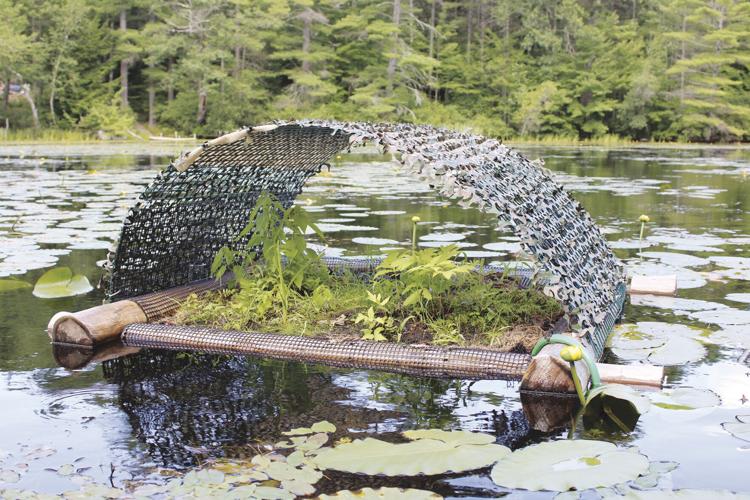
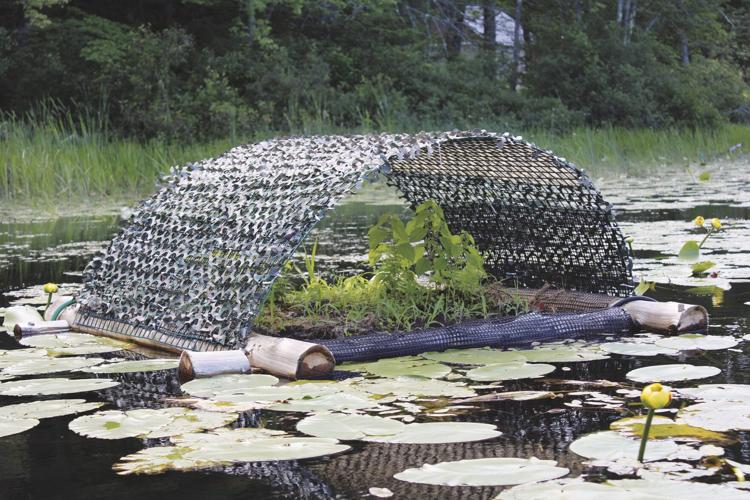
With the help of local volunteers, biologists from the Loon Preservation Committee, a nonprofit in Moultonborough, placed a loon nest raft in Paugus Bay. Since then, residents have spotted loons near the raft, and members of the committee hope they might soon move in.
In New Hampshire’s lakes, nest rafts serve as alternative nesting sites for loons that have been displaced from their preferred natural sites, which include marshes, small islands and pieces of sheltered shoreline. The rafts mimic small islands and are usually placed in calm waters with little boat traffic.
Biologists floated the state’s first nest raft on Squam Lake in the 1970s amid concerns about the declining loon population. Since then, rafts have become an important tool for loon conservation in the Lakes Region. Each year, about a quarter of the state’s newborn chicks hatch in rafts, according to Caroline Hughes, volunteer and outreach biologist at LPC.
Mike and Sandy Bravo, self-described “nature fans” who have lived on the lake for over a decade, were the first to suggest placing a nest raft in Paugus Bay. Last summer, a pair of loons nested on a precarious outcropping in the Weirs Channel. After the loons lost two eggs at that turbulent spot, the Bravos wondered if they could help the loons find a more suitable nesting location.
The Bravos called LPC to ask about the nest raft. After some investigating, LPC biologists determined that Paugus Bay was a good candidate for a nest raft.
“We had childlike giddy setting up the raft,” Sandy said. “We were all so excited, like kids at Christmas.”
Hughes said nest rafts are not a catch-all solution for loon preservation. They are most effective when a pair of loons has chosen a poor natural site and has lost multiple eggs. Since the pair in the Weirs Channel met both of these criteria, placing a nest in Paugus Bay made sense.
Within a few weeks, the Bravos were helping LPC biologists find a spot for the raft. They worked with nearby residents to find a spot that doesn’t obstruct docks, beaches or water access.
“We are trying to let local folks know and work with them to find the best spots for our rafts,” Hughes said. “We want people to be on the side of the loons and in support of the rafts.”
They settled on a quiet spot along Paugus Bay’s western shore. Unlike the Weirs Channel, this spot was calm and “not a boat parade,” Mike said.
As the team of biologists and volunteers covered the raft with muck and aquatic plants, blending it into the environment, they heard a loon in the distance.
The nest raft in Paugus Bay is LPC’s newest of 21 floating in Lake Winnipesaukee and about 60 floating in the Lakes Region. As well as on large lakes like Winnipesaukee and Squam, the rafts float in smaller bodies of water, including lakes Waukewan, Kanasatka and Winona, and Wakondah Pond.
The rafts are one of many tools LPC is using to stabilize and grow the loon population. The organization also runs a buyback program for lead sinkers, which are the greatest threat to adult loons and account for nearly 40% of loon deaths annually, Hughes said. Thanks to the work of LPC and other conservation groups, the number of breeding pairs statewide has more than tripled since the 1970s.
Now that the Paugus Bay raft is in place, all that's left to do is wait. Though the Bravos have seen loons investigating the raft, it still sits vacant. This is normal, Hughes said, especially for the time of year. Loons nest from mid-May to late June and are not usually looking for a nest later in the summer.
“The rafts are often a lesson in patience, both for us and for the folks excitedly watching it,” she said.
Sometimes, years pass before loons move into a raft. Some of LPC’s rafts have sat vacant for almost 10 years, and only about half have seen loon activity. Despite the waiting, LPC will keep floating rafts until loons in the area find a suitable nesting place, whether in one of the rafts or at a natural site, Hughes said.
The Bravos have promised to take care of the raft. They will pull it from the water in September and store it for the winter. Right after ice-out, they will float the raft again, readying it for next summer’s nesting season.
Even if loons never move into the nest, the Bravos are glad they have played a role in helping preserve the bird population.
“The ecosystem is like a tapestry. If you keep pulling threads out, eventually it’s all going to fall apart,” Sandy said. “We need to make sure we do as much as we can to help the environment.”





(0) comments
Welcome to the discussion.
Log In
Keep it Clean. Please avoid obscene, vulgar, lewd, racist or sexually-oriented language.
PLEASE TURN OFF YOUR CAPS LOCK.
Don't Threaten. Threats of harming another person will not be tolerated.
Be Truthful. Don't knowingly lie about anyone or anything.
Be Nice. No racism, sexism or any sort of -ism that is degrading to another person.
Be Proactive. Use the 'Report' link on each comment to let us know of abusive posts.
Share with Us. We'd love to hear eyewitness accounts, the history behind an article.