


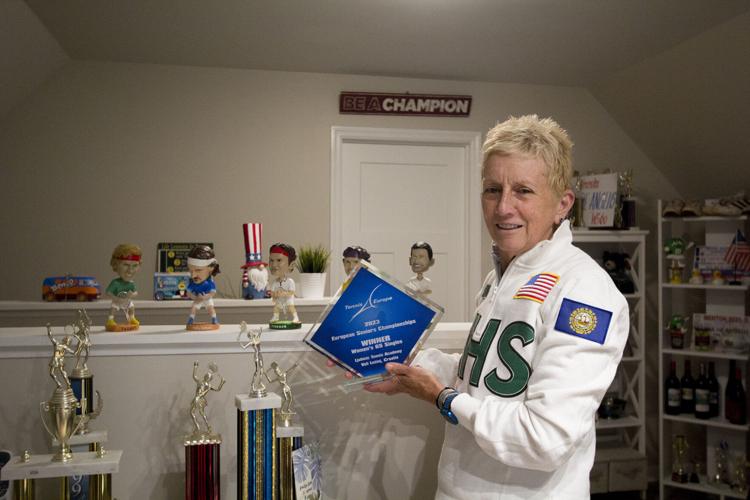
NEW HAMPTON — From the courts of New Hampton School to the sun-drenched clay of Lošinj Island, Croatia, Veronica “Vee” Lima-DeAngelis isn't just teaching tennis; she's living it, and her recent victory at the Tennis Europe European Seniors Championships just added another chapter to her storied career.
Lima-DeAngelis took first place in the women's 65 singles category championships, making her the eighth-best 65- to 70-year-old female player in the world.
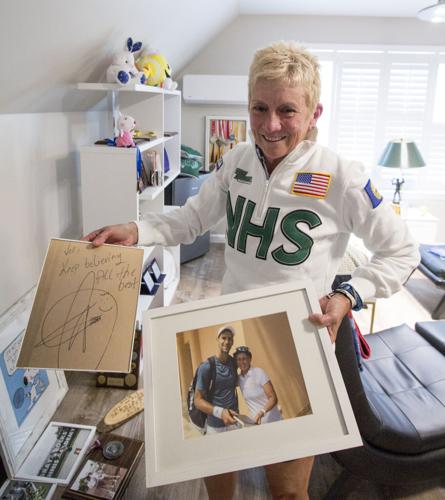
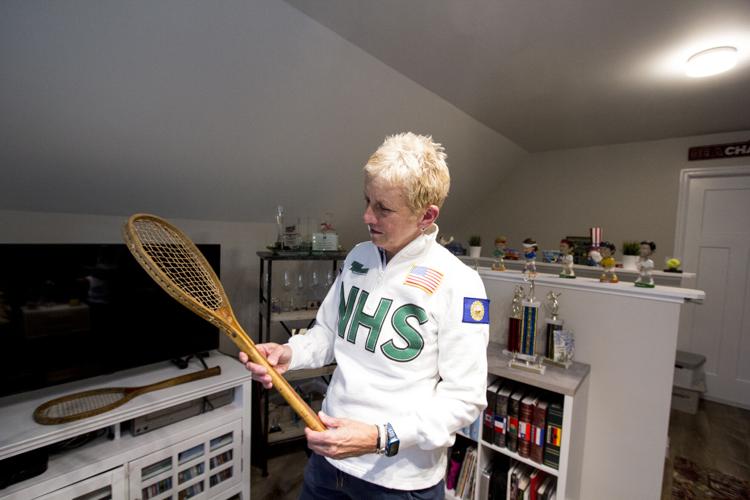
“I’ve been playing all my life,” Lima-DeAngelis said, surrounded by six decades' worth of trophies, photo albums and tennis memorabilia. “I only stopped when I had my kids and when I had surgery on my rotator cuff and wrist.”
Lima-DeAngelis recalled her final match during the tournament — held in June — in great detail during an interview.
“The lady was from Spain,” Lima-DeAngelis. “She was much easier than my semifinals, but that’s how tennis is. It happens a lot.”
Lima-DeAngelis beat her opponent in the first set, and had a lead of 5-0 in the second set.
“I just lost a little bit of my mind, because I was trying to control my emotions,” Lima-DeAngelis said. “I would be lying to you and myself if I went to the finals not having butterflies, because this is huge.”
Lima-DeAngelis stepped onto the court, repeated her inner mantra dictating that she must maintain her focus and control, as well as analyzing her opponent for any weakness.
“When I had 5-0, I really wanted to bagel her, which is 6-0, but the excitement inside took over, and she won that game. And then I said, ‘This is it.’”
After anther mental regrouping, Lima-DeAngelis said she became more aggressive and pushed more toward the net, despite her exhaustion.
“I closed 6-1,” Lima-DeAngelis said. “That’s how it is. You have to adjust and adjust and adjust every second. You gotta be in the zone.”
When she’s not competing in world-class tournaments, the Lakes Region resident shares her expertise with and mentors young players at New Hampton School. While abroad, Lima-DeAngelis arms herself with a pen and visits other clubs to take notes on how tennis is taught around the world.
“I am fortunate enough that I can go to Croatia, Slovenia, Spain and Italy, I mean everywhere,” Lima-DeAngelis said. “I try to bring it back to New Hampton, especially to the team, the best techniques, the best philosophy of tennis that I see, because every country has something new to learn.”
Lima-DeAngelis herself is an amalgamation of cultures and philosophies. She is the daughter of a Portuguese mother and a German father, and holds dual citizenship in the U.S. and Brazil. Her father’s line of work in international law took her around the world, but tennis was her constant companion.
“I had tennis, I had my lessons, I had piano, I had everything to keep you busy. Then at a certain time, I decided to focus on tennis,” Lima-DeAngelis recalled.
When asked what made her choose tennis out of all her pursuits, and what kept her in the game after so long, Lima-DeAngelis cited the high level of agency the sport imparts on her.
“I think it clicks with me because I have to make my own decisions on the court, I have to do the strategies by myself,” Lima-DeAngelis said. “When I’m coaching my kids in New Hampton, I tell my kids, ‘Everyone has issues in life,’ but when you jump on the tennis court the first thing you should do is enjoy the game, have fun, and leave everything else off of the tennis court.”
Lima-DeAngelis has practiced this philosophy, and used the game’s gift of compartmentalization extensively.
“I think it was 1998, my father had to have heart surgery and he said to my husband, 'I know she has to play a tournament in Massachusetts, let her go and play the tournament,'” Lima-DeAngelis said. “I went to Massachusetts, knowing that my father was not well. He went into surgery and I said to myself, ‘OK, I’m gonna go on the court, I’m gonna do this for my dad, I’m gonna win this tournament for my dad and I’m going to totally forget about that he’s in the hospital.'”
Lima-DeAngelis’ father has since died, but she still carries his lessons and those of her coach forward to share with own students.
“When I compete, if my opponent has attitude — which happens a lot, that a lot of women have attitude — the more attitude they have, the more strength I get,” explained Lima-DeAngelis. “When I was a little girl, I had a very good coach, and he used to say, ‘If you crack your racquet just once, you’re going to take time off.'
“I’m 67 this Saturday, I never cracked a racquet in my life, never. And my father used to say, 'If you misbehave like that, we’re gonna take the racquets away and you’re gonna stay without tennis a week or a month.' So my mental toughness is extremely good, and that’s what I transfer to my New Hampton kids as much as I can.”
As a coach, Lima-DeAngelis encourages her students to be the same person on the court as they are off it: no attitude, no tantrums and level-headed. The philosophy of personal toughness was also passed down to her children. Her son, she says, is now a member of the U.S. Army Rangers, a special forces unit.
Finding students who are able to master self-discipline and harness the will that tennis demands can be difficult. Many young athletes, Lima-DeAngelis says, do not seek the agency and independence that individual sports like tennis demand.
“I think it’s because the kids want to play team sports,” Lima-DeAngelis said about why there were fewer American tennis players when compared to Europeans. “They don’t want to be on the court by themselves making the decisions, which is tough.”
Lima-DeAngelis contrasted American interest in the sport with that of Spain. “If you got to the Polo Country Club in Barcelona at 10 in the morning during summer time, they have 65 tennis courts of red clay, and you see at least 300, 400 kids playing tennis. And that’s why there’s so many Spanish in the top 50 and top 100.”
As for the lack of toughness and drive in young American athletes? Lima-DeAngelis cited smartphones and the glut of modern conveniences.
“You have to strategize, and that comes so hard for the kids today, and I think it’s difficult for the kids to visualize a strategy because today that is doing everything,” Lima-DeAngelis said, gesturing toward the smartphone recording her interview. “It’s a reality of life, and it’s not just here, it’s everywhere. The whole world is like that. I see kids in France, in Spain, in Croatia. It’s just the way the world is right now.”
With any rule, there are exceptions. In Lima-DeAngelis’s case, those are her students who stick with her and keep trying. She teaches beginners, intermediate and varsity students, and even mixes her strongest female students in with the boys varsity team.
“The kids that are serious about tennis, they play in the fall with me,” Lima-DeAngelis said. “In the winter, they are doing strength training, and then comes the spring, that’s when I go to the varsity guys. Because I’m tennis director, I have another person that coaches the girls, but if I get a girl at New Hampton School that is really powerful and a big time player like I had the year before, then she comes to train with the guys.”
Then summer rolls around again, teaching time ends, and Lima-DeAngelis jumps right back into competition, maintaining her ranking and gathering more knowledge to bring back to her students in New England the next fall.





(0) comments
Welcome to the discussion.
Log In
Keep it Clean. Please avoid obscene, vulgar, lewd, racist or sexually-oriented language.
PLEASE TURN OFF YOUR CAPS LOCK.
Don't Threaten. Threats of harming another person will not be tolerated.
Be Truthful. Don't knowingly lie about anyone or anything.
Be Nice. No racism, sexism or any sort of -ism that is degrading to another person.
Be Proactive. Use the 'Report' link on each comment to let us know of abusive posts.
Share with Us. We'd love to hear eyewitness accounts, the history behind an article.