


LACONIA — Municipal representatives are working against legislation that would bring greater transparency to City Council real estate purchases like those that have cost local taxpayers more than $1 million.
Advocates for openness in government favor the bill.
One thing those for and against the measure agree on: Local government leaders should tell the public when they decide to use public funds to buy private property.
The advice runs counter to recent practice in Laconia, where city officials — acting outside the public eye — decided to spend $1.14 million last year to acquire the St. Joseph Church rectory and Catholic school.
Under the acquisition, the city gets more than 80 downtown parking spots and the Diocese of Manchester gains a greater ability to save the 92-year-old church, which was under threat of demolition.
Previously, city leaders agreed in private to spend $342,000 on land near Pickerel Pond for a canoe launching area.
Committee testimony
Rep. Gregg Hough told the House Judiciary Committee he learned on the campaign trail that city residents didn’t appreciate being kept in the dark about the church deal.
He read the committee the preamble to the state’s Right to Know Law:
“Openness in the conduct of public business is essential to a democratic society. The purpose of this chapter is to ensure both the greatest possible public access to the actions, discussions and records of all public bodies, and their accountability to the people.”
His House Bill 232 would require city councils to hold a public session for general discussion about buying property or proceeding with an acquisition. Price discussions could be held in private.
Currently, the Right to Know Law has an open meeting exemption that allows non-public sessions for discussion of property purchases. The provision is intended to prevent a third party from bidding up a property’s price.
Hough was asked during the committee hearing whether the actions of the Laconia City Council represented enough of a problem to change the state’s Right to Know law.
“I think $1.2 million in Laconia is enough,” he said. “When one person or group can figure out the law can be circumvented, then others will follow.”
Bidding war
Hough disputed the notion that discussion of property purchases would drive up prices.
“The reality is in real estate it’s an agreement between two people,” he said. “If a seller puts out a property, or says it’s available, a buyer can offer.
“The seller can always say, ‘I want more.’ The buyer can say, ‘OK, or I’m not going to pay it.’
“It’s a mutual thing. It’s the free market.”
Derry Town Administrator Dave Caron and Cordell Johnston, governmental affairs counsel at the New Hampshire Municipal Association, spoke against the bill in the committee hearing.
The association, which advocates on behalf of municipalities, collects more than $1 million in dues annually from member cities and towns across the state, including about $16,000 from Laconia.
Objection to transparency
Caron said he would support requiring local governing agencies to decide in public whether to purchase property, which is standard practice in Derry and many municipalities.
But Caron objects to Hough’s bill because he feels it could be interpreted as requiring an initial discussion in public that could drive up the price of a property.
“This interpretation is fraught with risk in our opinion,” Caron said.
“First, the mere discussion along with the attendant benefits of acquisition often result in a higher asking price, which is contrary to the public good. Second, during the public discussion, the seller could better understand the motives of the buyer, which if not considered previously by the seller, again potentially could lead to higher costs.”
Johnston also said the bill goes too far, but, like Caron, would support a requirement that city councils make the actual decision on property purchases in public session.
“If an entire discussion and transaction from beginning to end happens entirely outside public session, then I think there is a problem there,” he said. “I don’t want to comment on a situation where I’m not familiar with the facts, but certainly the final decision to purchase property ought to be at least documented in a public session, not in a non-public session.”
He also said in an interview that it’s common in most cities to tell the public when decisions are made to spend public money on private property.
Right to Know
David Saad, president of Right to Know New Hampshire, said in an interview that his organization supports Hough’s bill.
“The openness aspect of the Right to Know law says that we as citizens have a right to this information and we need this information in order to hold representatives and public officials accountable on our behalf,” he said.
Saad does not approve of the public being out of the loop when a city council decides to spend significant public money on real estate.
“Some public bodies choose to live up to the letter of the law, but certainly don't live up to the spirit of the law,” he said.
Keeping a secret
In Laconia, city leaders went to great lengths to keep the church deal under wraps.
Acting in non-public sessions, city leaders finalized a letter of intent to buy the property.
They concealed $700,000 of the money for the purchase by listing it only as “XYZ” on the bonded debt portion of the budget the City Council considered in a public meeting on June 29.
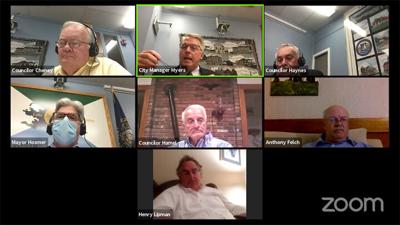
In an email, City Manager Scott Myers had warned councilors not to discuss this budget entry.
Over two and a-half hours, Myers and the City Council went over the budget in detail without mentioning the mysterious “XYZ” entry.
At the end of the City Council meeting, Myers said councilors did not need to vote on bonds.
"At this point we don't believe we need to hold any public hearings or have a full vote of the council because we are not issuing new debt and we're not increasing payments," he said.
Myers responded Monday to an email asking how this statement jibes with the additional $700,000 in debt embodied in the “XYZ” entry.
"The bond was included in the proposed budget which had a duly noticed public hearing," he said. "When the budget was approved, the bond was approved."
Two months after the council meeting, city and church officials disclosed the deal in a joint news release.
Mayor Andrew Hosmer and Myers said the maneuvers to keep the church deal confidential were legal.
Funding for the purchase was included in the budget as is required, even though it was listed only as “XYZ” and never discussed in the open.
The Judiciary Committee has yet to vote on Hough’s bill. It will meet in private session on Feb. 16 to consider committee recommendations.


(0) comments
Welcome to the discussion.
Log In
Keep it Clean. Please avoid obscene, vulgar, lewd, racist or sexually-oriented language.
PLEASE TURN OFF YOUR CAPS LOCK.
Don't Threaten. Threats of harming another person will not be tolerated.
Be Truthful. Don't knowingly lie about anyone or anything.
Be Nice. No racism, sexism or any sort of -ism that is degrading to another person.
Be Proactive. Use the 'Report' link on each comment to let us know of abusive posts.
Share with Us. We'd love to hear eyewitness accounts, the history behind an article.