


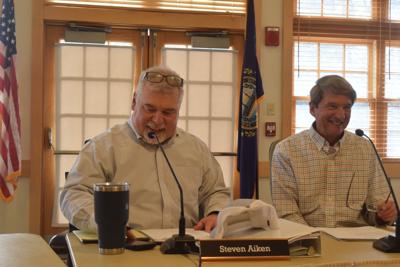
MEREDITH — The results of two petitioned warrant articles, both advisory, which voters affirmed, will be sent to the state Legislature, as instructed, within 30 days of Town Meeting.
The selectboard discussed the matter on March 30, when Town Manager Judie Milner asked if they would like the language of the articles and their votes sent to the Legislature.
The articles, drafted by resident Rick DeMark, were supported by a group of residents who distributed materials at the deliberative session and Town Meeting.
Article 21 calls on the Legislature to protect local taxpayers by ensuring adequate state revenues for essential services, and also avoiding policies that put the cost on local taxpayers.
The petitioned article was created due to state budget cuts and eliminated revenue sources, which lead to property taxes increasing, according to information provided at Town Meeting.
Proponents of the article said voting “yes” sends a clear message the town expects the state to pay its fair share, adding a fair state budget leads to stronger communities.
The other petitioned measure, Article 22, asked voters if they believe school budget decisions should remain with local voters, instead of being restricted by statewide, one-size-fits-all spending caps.
Information about the article was distributed by petitioners before the meeting, saying it intended to protect local control of school budgets.
The petitioners said the issue matters now, because of proposed legislation that would impose state-mandated spending caps on school budgets. While the state pays less than 30% of education costs, the cap would apply to all district budgets.
Those in favor say it would reduce flexibility to respond to enrollment changes, facility and staffing needs, and costs for health insurances, transportation, and special education.
A “yes” vote protects local voter control over school budgets, as well as preventing the one-size mandate. It also allows for meeting real-world costs, and defends educational quality, local accountability, and home values.
DeMark told voters at Town Meeting that House Bill 1300 was being voted on the following day in the House, and if passed there would be a vote every two years for a local tax cap. The bill passed in the House 177-160, and has moved to the Senate’s Election Law and Municipal Affairs Committee.
Both articles passed with a card vote at Town Meeting.
Milner asked if the board if they would like the results to be sent, as it isn’t necessary. Selectboard member Jim Gregoire said, “this board member would like to see that done.”
Member Jeanie Forrester felt the same, and said the language of the articles asked for that action to be taken. Milner agreed that was the case; the articles asked for the results to be sent within 30 days.
“If they’ve asked, and it was in the affirmative, I think we should,” Forrester said.
Milner said waiting until the next meeting would put them over the 30 day mark, so the selectboard asked her to take the initiative to send along the necessary information.




(0) comments
Welcome to the discussion.
Log In
Keep it Clean. Please avoid obscene, vulgar, lewd, racist or sexually-oriented language.
PLEASE TURN OFF YOUR CAPS LOCK.
Don't Threaten. Threats of harming another person will not be tolerated.
Be Truthful. Don't knowingly lie about anyone or anything.
Be Nice. No racism, sexism or any sort of -ism that is degrading to another person.
Be Proactive. Use the 'Report' link on each comment to let us know of abusive posts.
Share with Us. We'd love to hear eyewitness accounts, the history behind an article.