


By ADAM DRAPCHO, LACONIA DAILY SUN
LACONIA — "Since it was established, the story of LRCC is about people. It is about the outstanding students that have come to the college over the years to take coursework to advance their dream and the dedicated faculty and staff that work with them to achieve their goals," said Tom Goulette.
Goulette, who began teaching graphic arts at the college in 1976, rose to the position of vice president of academic affairs before he officially retired in September of 2015. Goulette, who continues to teach courses in graphics and leadership, is compiling a history of Lakes Region Community College in honor of its 50th anniversary. He is currently collecting information from former students – remembrances such as special teachers, athletic teams or social gatherings, or how the college helped in someone's career. Anyone who would like to share their story can contact Goulette at tgoulette@ccsnh.edu.
Goulette's research so far shows a half-century filled with changes.
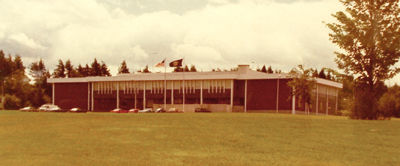
The college began as the New Hampshire Vocational Technical College – Laconia, which opened at its current Route 106 location, near the Belmont town line, in the fall of 1968. The original 47,000-square-foot building still contains the college's main entrance, library and some of its current academic classrooms.
In 1980, the first of several expansions was completed. The Robert H. Turner addition provided 28,000 additional square feet, and provided space for a cafeteria and kitchen.
With plans to move the entire school to the Laconia State School property, located off of Parade Road on the Meredith side of the city, the graphic arts and electrical programs were relocated to the State School's Powell Building in the summer of 1995. That plan was scuttled when the State School was instead used to create the now-closed prison, called the Lakes Region Correctional Facility. However, the graphic arts and electrical programs continued to be held there for a decade.
The college's nursing program was established in 2003, owing its existence to the cooperation of LRGHealthcare and its president at the time, Tom Clairmont. Also in 2003, the college earned accreditation under the Higher Education Commission of the New England Association of Schools and Colleges. Goulette said this was a "critical step" toward LRCC's new mission, which was expanded beyond the vocational programs.
"Because of achieving this status, students now have expanded opportunities to realize their education goals in either one of our traditional career programs, and/or to earn credits toward transfer to a four-year college or university. The quality of our programs, and the credits attained by our students, are now recognized and welcomed by an ever-growing number of four-year college partners," said Goulette.
2005 saw the opening of the first phase of a two-phase project that would significantly expand the LRCC campus. The Center for Arts and Technology building added 35,000 square feet of classroom and laboratory space. This allowed the graphic arts and electrical programs to return to the main campus.
Again with the support of LRGHealthcare, LRCC introduced the Summer Scholars Program in 2007, which brings local high schoolers to the college in the summer, so that they can further their interest in a health care profession by taking the college's Anatomy and Physiology class.
2013 was a year of many changes for LRCC. The second phase of the construction project begun in 2005 was completed, adding yet another 35,000 square feet of space. Known as the Health Science addition, the space contains the nursing program, the fire science classrooms, and a large room known as the Academic Commons, which holds 120 people and is the nearest thing on the campus to an auditorium.
In the same year, the Culinary Arts program moved from the Belmont Mill to the Canterbury Shaker Village, where it is still found today. Also in 2013, the college began offering classes in the Advanced Manufacturing Degree Program. Manufacturing programs and come and gone many times over the college's history, Goulette said, as student interest as piqued and declined. The most recent iteration has remained, though, thanks to strong support from more than 20 local companies.
LRCC's Automotive program has had a partnership with General Motors for 25 years, which attracts students from across Northern New England. In 2015, the program got its own building, when the Automotive Technology Building opened. In September of this year, the automotive program will mark the beginning of a partnership with Toyota. The college also offers generic automotive courses.
Overseeing all of this change has been a long list of presidents. Robert Turner was the founding president, which earned him the honor of having the first addition christened in his name. Others who have occupied the president's office include George Strout, Burt Mills, Robert Moulton, Jane Kilcoyne, Larry Keller, Will Reed, Alex Easton, Karen Sue Grosz, Kathy Enneguess, Mark Edelstein and, most recently, Scott Kalicki.
The college has also gone through a string of names. It started as the New Hampshire Vocational-Technical College–Laconia, then the New Hampshire Technical College–Laconia, the New Hampshire Community-Technical College–Laconia, and, finally, the Lakes Region Community College.
Kalicki, whose six-year tenure as president will conclude later this month, said that the final name change was one that he sees as one of the college's important moments.
"The name change to Lakes Region Community College – while many locals still refer to us as the 'Tech,' the name appropriately defines us more broadly. While we still have important 'technical' vocational programs, we are much more than that in terms of educational opportunities." Many of the college's current students are there to earn a liberal arts degree and transfer their credits to a four-year school, he said.
Kalicki's list of important moments in the college's history also includes the expansion of the school to four buildings, which provides a campus environment, and the addition of the nursing and automotive programs. While the effect has yet to fully materialize, he expects that the recent addition of student housing will soon be seen as a critical step for the college.
Over its history, Kalicki thinks that LRCC has also changed the recent history of the region around it.
"I think we've made post-high school education a reality for many who, without the college being in their community, may not have given it a thought or worked to get a higher education. I think we've brought many talented faculty and staff to the region who ... have made a positive impact on the community; and I believe we've strengthened the local workforce and helped new business come to life, created by our graduates. And, finally, I think we've added a further sense of pride in the community by a wonderful college-community relationship that show it values education and the opportunities it can provide to anyone."
Throughout all of its 50 years, LRCC's overall goal hasn't changed.
Said Kalicki, "Our mission has remained the same – serve all students seeking a high quality education emphasizing active learning and personal attention ... we prepare students to meet their personal goals as well as the needs of business, industry and the community."


(0) comments
Welcome to the discussion.
Log In
Keep it Clean. Please avoid obscene, vulgar, lewd, racist or sexually-oriented language.
PLEASE TURN OFF YOUR CAPS LOCK.
Don't Threaten. Threats of harming another person will not be tolerated.
Be Truthful. Don't knowingly lie about anyone or anything.
Be Nice. No racism, sexism or any sort of -ism that is degrading to another person.
Be Proactive. Use the 'Report' link on each comment to let us know of abusive posts.
Share with Us. We'd love to hear eyewitness accounts, the history behind an article.