


As egg supplies and prices fluctuate nationwide during a bird flu outbreak, Lakes Region locals are looking for alternatives to paying high prices at the grocery store.
Kathy Sorell of Restoration Acres Farm said there has been increased demand for her eggs. She previously used a sign to attract people to her egg stand, but people were taking them faster than her chickens could produce them.
“We used to put an egg sign out, and then we just stopped doing it because the minute we put it out, the eggs were gone,” she said.
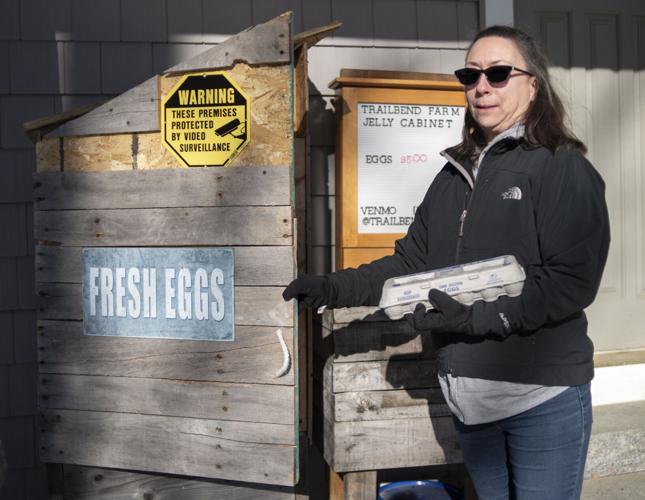
Because Restoration Acres Farm is a nonprofit serving community members in need, Sorell sells eggs by donation. She only sells five or six dozen eggs each week. But Trailbend Farm in Belmont has roughly 3,000 chickens. In addition to commercials sales like restaurants and catering companies, the farm sells 25 dozen large eggs each week at $5. Even with higher volume egg production, Karen Wright, who helps run the farm, is noticing an increase in demand.
“It's very rare that I have eggs go more than two days out there,” Wright said.
The price of eggs
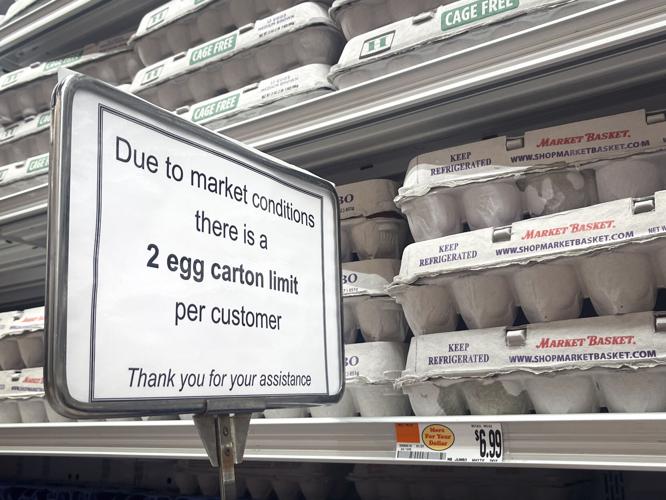
The U.S. Department of Agriculture Egg Markets Overview, released Feb. 21, said large, white eggs are currently $8.07 per dozen nationally. As of Tuesday afternoon, Lakes Region grocery stores are less expensive. The Hannaford website shows large white-shell eggs starting at $7.99 per dozen, and large brown-shell eggs as low as $4.59 per dozen. Shaw’s website has both brown and white eggs at $5.49 per dozen; Vista Foods is selling large, white eggs at $5.59 per dozen, and $6.19 per dozen for brown eggs; and a call to Market Basket shows $6.99 a dozen for large eggs.
Calls to each grocery store for comment were not returned by press time.
The Consumer Price Index for January 2025 shows in one month, egg prices increased 15.2%, while the index for food purchased for consumption at home more broadly increased 0.5%. The CPI also indicated over the last 12 months since the report, the egg price index increased by 53%, and at-home food increased by 1.9%.
With the recent noticeable increase in egg prices, prices at Lakes Region’s local egg producers have become more competitive with large-scale commercial suppliers.
“If I could be a chicken and lay eggs, I think I'd make more money than my job,” Sorell said.
Buying local
Nationwide, the highly pathogenic avian influenza, or HPAI, was found in 86 commercial flocks, and 51 backyard flocks, affecting 18.97 million birds, according to the USDA. So far, no infections have been found in New Hampshire.
Wright thinks there are other reasons to shop local, in addition to price. She said grocery store eggs are not as fresh.
“You're supporting your local farmer, which helps your local economy,” she said. “You're getting super fresh eggs.”
Annie Bridgeman, owner of Annie’s Cafe & Catering in Laconia, sources her eggs from Trailbend. The eggs are used to make everything from cookies and muffins, to quiches, and egg sandwiches. Bridgeman has been using Trailbend the eggs for a year. She said she knew after tasting the eggs they were exactly what she wanted.
“I'm very fussy. I like to have very good, fresh local products like that in my food,” she said. “And once I had them, I realized, 'We got to carry these. These are fantastic.'”
For those concerned with egg prices, Sorell said Restoration Acres Farm won't raise their prices.
“Typically, we ask $3 or $4 a dozen. And I know that's super low, considering what everybody else is doing, but because our focus is food insecurity, we're not letting that change our price,” Sorell said.
Sorell is also making a list of local egg producers in the area, and will post it to the farm's Facebook page, facebook.com/kathysrusticbread.
The demand has prompted some bad behavior. Both Trailbend and Restoration Acres use a money box honor system. Wright said some people have been taking eggs without paying, which prompted an increase in security measures.
“We have a money box out there. And unfortunately, because of this, you know, the way the world is at this point, I've had to put a camera out there,” she said. “But that's new, only about two weeks new. We've always been on the honor system.”
Wild bird infections
Despite no chicken flock infections to date in New Hampshire, the avian flu has been detected in wild birds. The avian influenza virus has been detected over 1,000 times in the state, according to the USDA. AIV can mutate into HPAI, which is more contagious and has a higher mortality rate. There are currently 122 HPAI detections in the Granite State. This is compared to over 26,000 detections of AIV nationwide, and over 5,000 HPAI detections.
Jessica Carloni, a NH Fish and Game wildlife biologist, assists in monitoring the bird flu. She helps establish banding sites to swab ducks and geese for the infection. Carloni said there are positives in every county in the state, but unlike chickens, wild birds can live with the virus and be relatively unaffected. More severe cases can come with symptoms.
“Geese sort of flop their head down. Their neck just kind of looks limp, and almost looks like they have a broken neck,” Carloni said. “Or they swim in circles, or walk in circles.”
If anyone sees these symptoms in wild birds, they can report them to the wildlife department at 603-271-2461.
Carloni also said there is no cause for panic, and offered advice to those with their own flocks.
“A lot of our ducks in New Hampshire could be carrying that virus, so they want to be cognizant of that,” Carloni said. “If they have backyard chickens, or ducks, not to let them co-mingle with wild ducks.”
A representative of the New Hampshire Department of Health and Human Services confirmed the majority of people in other states who have been diagnosed with bird flu had direct contact with infected farm animals. There is no evidence of human-to-human spread of the virus.
The representative also confirmed cooking eggs and chicken to safe internal temperatures gets rid of bacteria and viruses, like bird flu.
Wright said her birds are in big buildings, and don’t have contact with wild flocks. The farm also takes all the necessary sanitization procedures to ensure they don’t bring any germs between flocks, or back into the home with them. The bird flu doesn’t worry her. And with the right precautions, other egg producers will be fine, too.
“It doesn't keep us up at night, because we know we're doing everything we possibly can to keep our girls safe,” she said.


(0) comments
Welcome to the discussion.
Log In
Keep it Clean. Please avoid obscene, vulgar, lewd, racist or sexually-oriented language.
PLEASE TURN OFF YOUR CAPS LOCK.
Don't Threaten. Threats of harming another person will not be tolerated.
Be Truthful. Don't knowingly lie about anyone or anything.
Be Nice. No racism, sexism or any sort of -ism that is degrading to another person.
Be Proactive. Use the 'Report' link on each comment to let us know of abusive posts.
Share with Us. We'd love to hear eyewitness accounts, the history behind an article.