


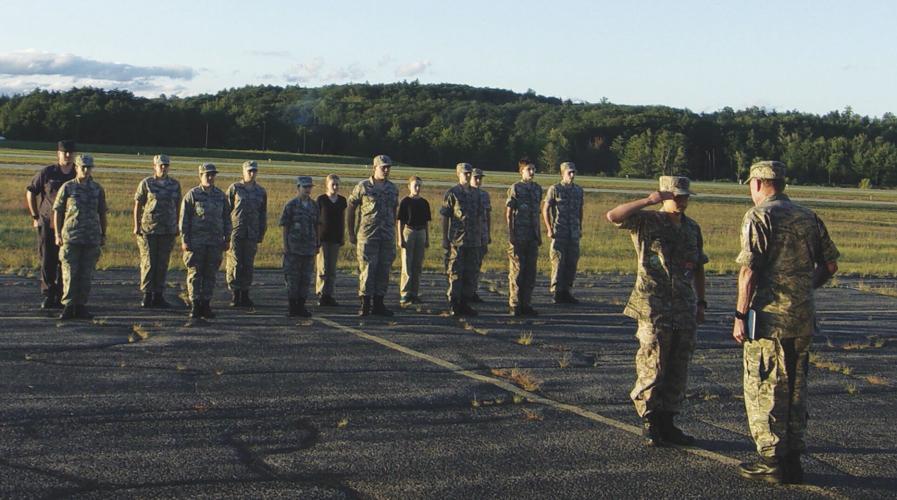
In uniform and impeccably attentive for opening formation, a group of teenagers gather on the tarmac before an open hangar at Laconia Municipal Airport on a September evening. The 15 young men and women are members of the Hawk Composite Squadron, a cadet program of the Civil Air Patrol. Greeting the cadets is Col. Bill Moran, who has been squadron commander for the past 23 years.
“It is so satisfying watching young teenagers whose behavior is thoughtful and kind,” Moran says. “Teamwork and giving of oneself raises all to new levels of leadership, friendship and camaraderie.”
The program Moran has led since his retirement after a 26-year career in the U.S. Air Force is available to anyone between the ages of 12 and 21. Cadets in the program meet every Thursday from 6:30 to 8:30 p.m., with each session focusing on one of the program’s four main goals: character development, aerospace education, physical training and leadership.
Included in leadership and character development are reading assignments for discussion, including Lauren Hillenbrand’s "Unbroken" and "The Wisdom of the Bullfrog" by William McRaven, ninth commander of U.S. Special Operations Command. Fitness training could find cadets navigating a ropes course or working together during a winter survival challenge at the Upper Valley Stewardship Center in Pike.
The Thursday evening in question is devoted to aerospace education, so following opening formation, cadets gather inside the hangar for a slide presentation by Capt. Mark Donovan concerning the operation of commercial and recreational drones, one of the numerous activities available to cadets.
Indeed, Moran is quick to highlight the many opportunities offered by the cadet program. In addition to weekly meetings, cadets are given 10 orientation flights: five in a powered aircraft and five in a glider. They also have the chance to attend a weeklong summer camp at Norwich University focusing on the program’s four goals. Upon completion, cadets may then apply for national cadet special activities, including weeklong sessions at academies focused on such disciplines as civil engineering, powered aircraft, gliders and robotics.
“A 15-year-old kid could have the opportunity to go out to Colorado Springs for a week and work robotics at the Air Force Academy,” Moran enthuses.
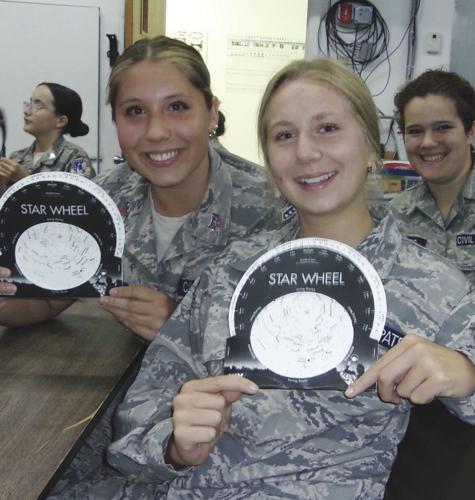
Donovan’s drone presentation on Sept. 14 gives way to a discussion by Capt. Julie Sicks-Panus on the night sky and identifying stars using a device the cadets themselves assemble. Sicks-Panus has worked as a science, technology engineering and math teacher from kindergarten through eighth grade at Plymouth Elementary School for 25 years, where she developed one of the few elementary engineering programs at a New Hampshire public school.
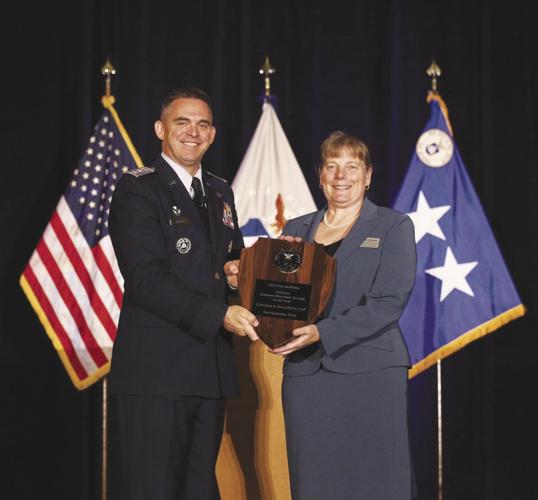
Sicks-Panus' dedication to her work was honored in August when she won the National Aerospace Teacher of the Year Award. The award acknowledges Sicks-Panus' excellence in teaching, but she’s also pursued her passion during eight years of volunteering for the cadet program and as the director of aerospace education for the New Hampshire Wing of CAP since 2022.
“I’ve always been interested in aviation,” Sicks-Panus explains. “Aerospace is an exciting way to teach a lot of different concepts. You can teach physics, math, engineering. All kids seem to get excited about aerospace and aviation, it doesn’t matter what age they are.”
With twilight getting progressively darker, the cadets venture out into the cool evening and soon several are excitedly pointing to stars they’ve identified. Sicks-Panus notes that the star wheel she had the cadets put together is a somewhat different activity from what she generally does.
“I usually try to wrap some piece of engineering into an activity: design it, build it, improve it,” Sicks-Panus says. A model rocketry badge on one cadet’s uniform is indicative of one of the activities she brings to the program. Like Moran, Sicks-Panus draws attention to the cadets’ many opportunities, as well as the organization that is ultimately responsible for putting it all together.
“They say the Civil Air Patrol is America’s best kept secret,” says Sicks-Panus. “We’d like to change that.”
It’s safe to say many people may be unfamiliar with CAP, or the fact that it actually predates the U.S. Air Force by almost six years. Founded on Dec. 1, 1941, just before the attack on Pearl Harbor, one of its earliest missions was flying coastal patrols to search for German U-boats. CAP became a civilian auxiliary of the U.S. Air Force when the latter was established in September 1947. It is a federally funded nonprofit corporation active in 1,400 communities nationwide, thanks to the efforts of volunteer professionals.
In addition to running the cadet program, CAP is tasked with conducting emergency services, such as search and rescue operations. It’s also responsible for promoting aerospace education, which includes the publication of aerospace curricula for kindergarten to college-level classes, and helping facilitate national conferences on the topic.
Regarding emergency services, Moran explains that in recent years, CAP has been more focused on documenting the effects of disasters, both man-made and natural, from the Deepwater Horizon explosion in 2010 to the Hurricane Sandy superstorm in 2012.
“Our main mission has become aerial photography,” Moran says. “With Superstorm Sandy, FEMA asked us to photograph 1 mile out into the ocean and 9 miles inland, from Cape Cod, Massachusetts, to Cape May, New Jersey. Over a month period, we uploaded 157,000 photographs.”
Most recently, two New Hampshire CAP aircrews joined efforts to document damage on the Maine coastline from Hurricane Lee.
With 50 years of safe flying under his belt, Moran is slated next month to receive the Federal Aviation Administration’s Wright Brothers Master Pilot Award. Yet as CAP’s focus on aerial photography shows, the work connected to aerospace can be more varied than what people imagine.
“There are so many careers connected to aviation,” confirms Sicks-Panus. “There’s a statistic that for every pilot that flies there are about 25 occupations needed to get that pilot in the air: mechanics, airport designer, air traffic control ... the list goes on.”
Sicks-Panus goes on to explain how her involvement with the cadet program started when her son was himself a cadet.
“One of the first things he did was a practice search and rescue exercise, in communication with aircraft to verify what the ground team found. Later, at 14 years old, he applied for a staff position at summer camp where he faced the application process, the interview, and was eventually put in charge of 19 cadets. These are real-world experiences,” Sicks-Panus affirms. “Even if you don’t end up going into aviation or the military, these are real world skills.”
Those interested in learning more about CAP’s cadet program are encouraged to visit gocivilairpatrol.com.


(0) comments
Welcome to the discussion.
Log In
Keep it Clean. Please avoid obscene, vulgar, lewd, racist or sexually-oriented language.
PLEASE TURN OFF YOUR CAPS LOCK.
Don't Threaten. Threats of harming another person will not be tolerated.
Be Truthful. Don't knowingly lie about anyone or anything.
Be Nice. No racism, sexism or any sort of -ism that is degrading to another person.
Be Proactive. Use the 'Report' link on each comment to let us know of abusive posts.
Share with Us. We'd love to hear eyewitness accounts, the history behind an article.