


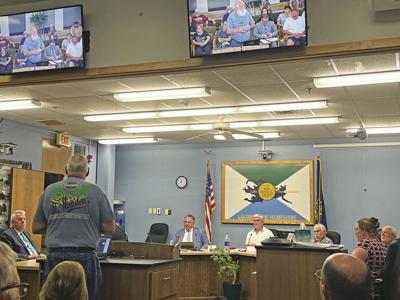
LACONIA — The city will move to an automated waste collection system starting next spring, after a vote by the city council at its Aug. 8 meeting.
The council voted 5-1, with Councilor Henry Lipman in dissent, to sign a contract with Casella for an automated collection system. The city weighed the costs of automatic and manual collection for both contracted and in-house options. Casella was the only company that, during multiple calls for bids, made an offer to the city. Overall, manual programs were found to be more expensive than automated, with in-house being more expensive than contracted in each category.
The Department of Public Works recommended that the city switch to automated collection. Councilors voting in favor cited the savings and the decreasing viability of manual services.
With Casella, continuing the city status quo of manual services would be $270,000 more expensive per year than changing to automatic. Costs for either option have risen considerably since the city last signed a waste contract due to changes in the labor market, gas prices and inflation, among others.
In automatic collection, a robotic arm lifts standard size containers to empty them into the truck. The city would be responsible for purchasing and providing these containers for residents, which City Manager Scott Myers said would cost between $70,000 and $80,000. Given the known costs associated with automatic collection, that program would still save the city about $200,000 per year.
The price of manual services is anticipated to accelerate as the labor market remains strapped, especially for waste collection — a field involving dangerous, labor intensive work.
Lipman, who voted against the change, said that he did not find the savings for automated services, when spread across the city, sufficient to compensate for the “hassle factor” that changing collection methods would put on residents.
“People have been through enough,” Lipman said. “It may not be feasible for some people to maintain this kind of structure.”
Lipman said he is not against automated collection as a concept, but did not think it was worth it for Laconia to change. “If we were talking about a much bigger number, I’d feel differently about it.”
Councilor Mark Haynes acknowledged that making the change might be difficult for some residents, but disagreed that the savings were not worth it. The city would likely have to make this change soon either way, and doing so sooner would increase its savings, according to Haynes.
“I find it hard to tell my constituents that we’re going to spend $300,000 on a situation that a year from now or two years from now may not even exist,” Haynes said. “What happens when Casella comes back and says ‘Sorry guys, we don’t have any help anymore and so we can’t pick it up manually.’ We’re going to be right back where we are.”
Haynes added that the savings, when applied to specific needs across the city like road repair, or parks and recreation equipment and updates, could make a felt and noticeable difference for some residents. “We don’t ever seem to have enough money to afford these things,” he said. Lipman reiterated that the net savings to the city would be about $200,000, not $300,000.
Soucy, who voted in favor of automated collection, expressed concerns for senior citizens’ ability to move the containers, and emphasized the importance of all community members being educationally equipped and physically accommodated under a new system.
During citizen comment earlier in the meeting, property owners largely, though not unanimously, favored manual collection — the traditional and current system — citing concerns that automated systems would be unable to handle unforeseen obstacles or imperfect compliance to collection procedure.
Rep. Harry Bean, a state representative from Gilford whose family owns more than 80 apartments throughout the city, argued that the inflexibility of automated collection would, in practice, end up costing the city more in both money and headache than manual, which can adapt to varying situations at each pick up site.
If a car parked by the street were blocking a can, Bean said, the automated machine would not be able to pick up the garbage. If residents are only able to dispose of a set volume each week, missing a week would lead to garbage build up for a full household.
“What do you do with that garbage next week?” Bean asked. Bean added that such obstacles were more likely to impact lower income neighborhoods.
Scott McWilliam stated that there weren’t many options available to the city and he agreed with Public Works’ recommendation to approve the change. He also said that the standard containers used in automated collection were of far better quality than what he perceived a lot of residents to be currently using and would lead to less spillage and mess.
Sheri and Timothy Minor each shared concerns similar to those of Bean, that obstacles such as snow banks would impede collection and create a greater mess for the city.
Sheri shared concerns about locations that don’t have a homeowner on-site at all times to be attentive that trash does not get knocked onto others’ properties. The result, she said, would be that the city will have to clean up the trash that gets knocked over and not collected.
“It’s too much of a burden to pick up all of the trash that’s going to be left over,” Sheri said, “from the days where it gets blocked and they can’t get to it.”
Councilor Robert Hamel said other cities similar to Laconia in climate and demographics had adopted this program without major issues. Franklin and Rochester, among other New England communities, have automated waste collection.
“Franklin has snow; Franklin has senior citizens. So does Rochester,” Hamel said. “And they seem to manage.” Hamel added that he had an 88-year-old friend in Rochester for whom automated collection works smoothly.
Hamel echoed Haynes’ point that a switch to automated collection would be “inevitable” either way, and that making the change sooner would increase what the city stands to gain.
“I know it won’t be popular. It’s a change, nobody likes change,” Hamel said. “But if I can save the taxpayers $300,000 this year, that’s a lot of money.”
“To maintain what we’re doing when the industry doesn’t want to do it... Let’s not push that can down the road,” Hamel said. Though he was “not thrilled” about the change, “the accounting makes sense,” he said.
Laconia’s current waste collection contract with Casella expires at the end of September, a contract which has already been extended, and Myers impressed upon the councilors the urgency of deciding the matter at Monday’s meeting.
Automated waste collection will begin in Laconia no earlier than April of next year. In an interview, Mayor Andrew Hosmer acknowledged that there are challenges posed by switching to automated, but echoed Hamel’s and Haynes’ point about the accelerating costs and inevitable disappearance of manual collection.
Hosmer said the city is working on ways for automated collection to have a minimum impact on senior citizens, multifamily houses, and those with disabilities.


(1) comment
It seems to me that Councilor Henry Lipman is the only one who is pay attention to the residents of Laconia, and the rest like Councilor Hamel don't care what they say, he's made up his mind he knows better than everyone else.
Every problem that residents and apartment owners express are very much the issue, and I as a resident this these councilor's who voted for the automated system should be on a call list for when the garbage is not picked up properly or cans knocked over and left due to inclement weather, they should be called to clean up the mess.
I do know that Casella has large trucks that do both, pick up automated and also have a space to throw in manually; which should be something to solve the problem while the residents transition to larger harder to handle containers, that will not be able to handle the overflow of trash that typically happens on holiday weekends or summer vacationers.
What is maddening about this short-term solution is the cost differential was not all that much more to cause this inconvenience, and in speaking about a small town like Franklin is no comparison to a larger city with many more multiple family dwellings and out of state visitors to vacation homes which leave containers for a few days before pickup when they leave for their home out of state.
Welcome to the discussion.
Log In
Keep it Clean. Please avoid obscene, vulgar, lewd, racist or sexually-oriented language.
PLEASE TURN OFF YOUR CAPS LOCK.
Don't Threaten. Threats of harming another person will not be tolerated.
Be Truthful. Don't knowingly lie about anyone or anything.
Be Nice. No racism, sexism or any sort of -ism that is degrading to another person.
Be Proactive. Use the 'Report' link on each comment to let us know of abusive posts.
Share with Us. We'd love to hear eyewitness accounts, the history behind an article.