


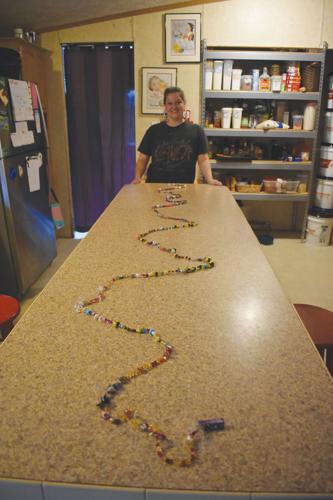
MOULTONBOROUGH — Shelby Boudreau has a string of beads, in which each bead represents a particular step in her daughter’s health journey. There’s a bead for her first ambulance ride to Boston, one for her first Fourth of July spent in the hospital, and many, many beads for each time she’s had a platelet infusion. The Boudreaus have a kitchen island that is about 8 feet long, and the string of beads is so long it has to zig-zag in order to fit on the island.
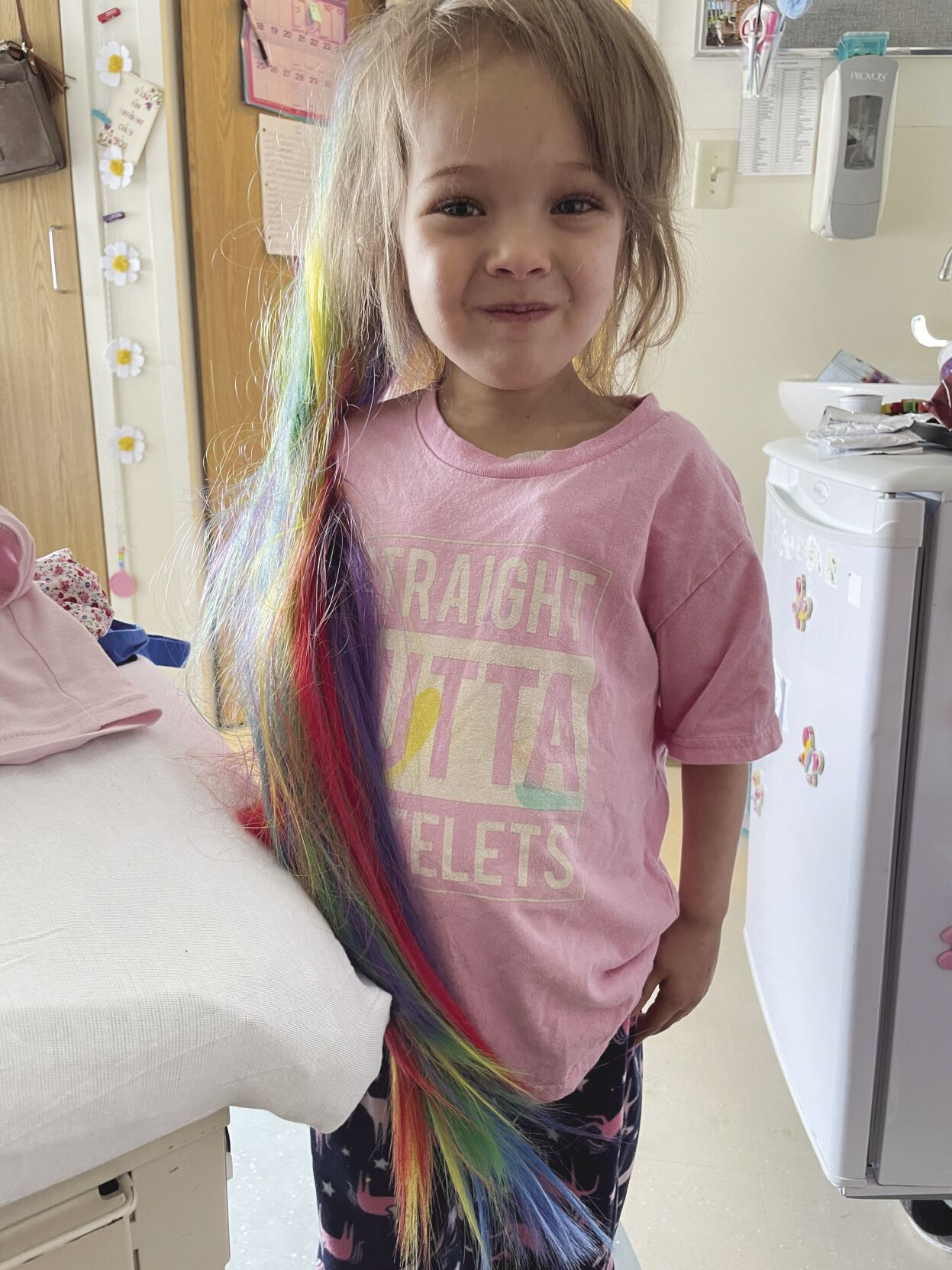
Boudreau’s daughter, Juniper, though only a kindergartener, has already spent more time in hospitals than most adults have, and her journey is far from over. She has a rare condition that is treatable and rarely fatal, but her disease caused so much damage that she requires a liver transplant. The family, which has been supported by the community through a GoFundMe campaign, is now asking people to register as possible donors so that Juniper can have hope of a normal childhood.
The happiest baby
The Boudreaus’ first child was born prematurely, and by comparison, Juniper, their second, was an easy infant.
“She was just the happiest baby,” Shelby said. Her daughter was born healthy, and progressed on schedule, meeting all of her milestones. But in February of 2019, she got her first cold.
“She got a sniffle, and just never got better. She kept getting sicker,” Shelby said.
Working with Wolfeboro Pediatrics, the Boudreaus explored all of the more common explanations for Juniper’s symptoms. Then, one morning, Shelby saw that Juniper was bleeding from her scalp.
“I broke down, and said, ‘I don’t know what’s going on,’” Shelby recounted. She praised Juniper’s pediatrician, Dr. Michael Matos, for always taking her concerns seriously, and this time he ordered a round of blood tests that finally put them on the path to a diagnosis. Chemicals indicating liver trouble were “through the roof,” she said, and Matos advised her to expect a call from Dartmouth-Hitchcock Medical Center, which has a children’s hospital, likely the next day.
“As soon as I hung up the phone, Dartmouth called and asked if we could come in tomorrow,” Shelby said. Actually, they asked if Juniper could come in first thing, before the office’s normal hours. When they arrived, she was told that they had already booked a room for Juniper at Children’s Hospital at Dartmouth, and they should head over there immediately.
Shelby said the trip to CHaD was “the scariest ride ever,” because she was beginning to presume the worst. There was not yet any certainty about the cause of Juniper’s illness, so a parade of specialists came through to see if her disease was in their field of expertise. Finally, after three days of constant testing, a sample of Juniper’s scalp was taken for testing, which gave them a name for her disease: Langerhans cell histiocytosis.
Langerhans cell histiocytosis is a disease that affects about 1 in every 200,000 children. Every healthy person has Langerhans cells in their body, which are part of the body’s immune response. The disease occurs when the body produces too many of the cells, which can result in cancer-like symptoms, usually in the skin and bones, though it can affect many other organs.
When it occurs, it can range in severity. Some cases are so mild that they don’t require treatment. In cases where treatment is necessary, chemotherapy drugs usually do the trick, and the disease can be cured. Thanks to modern treatment strategies, it is no longer considered a fatal disease, though there can be lasting damage.
Juniper’s case proved to be an outlier in its severity. She did one round of chemotherapy, receiving doses of medicine weekly for 11 weeks. The disease returned, so they did another round. When a third round was necessary, they reached out to specialists in the disease in hospitals across the country, and learned about a mutation of the disease, which they confirmed Juniper has, and gave her a third round of chemo, with a heavier-hitting drug, which took fighting with her insurance company “like crazy,” Shelby said, because it was a new medication and wasn’t even manufactured in a child’s dose. Once approved, they had to reach across the state’s borders to find a pharmacy that would compound the prescription for them.
The new medication worked, and things were looking up for Juniper. But her liver was paying the toll for the weight of the disease.
“LCH can be in multiple systems in your body, and Juniper had it in all her systems,” Shelby said. “But her liver had it the worst.”
If Juniper makes it onto the list of liver donation recipients, the family will enter a new phase. They will have to live in a constant state of readiness, as they will have a very short window of time to make it to the hospital in Boston once a liver, from a suitable deceased person, becomes available. Then, the parents will have to navigate a world in which their daughter was able to live, only because someone else died, and their daughter’s need for the organ meant that another deserving person didn’t get it.
For those reasons, the Boudreaus are pushing a campaign to see if they could find a living donor. The liver is one of the organs that a human can donate without compromising their own health, as Juniper would receive just one lobe of the liver, and the donor’s liver will regenerate back to its original size within six to eight weeks, according to a page on the Johns Hopkins website. It is considered a safe procedure, though it carries risks as any major surgery would, and the recovery period can take up to eight weeks.
The medical odyssey has already caused financial hardship for the family, as Shelby has had to leave her position as a paraprofessional, and her husband, a carpenter, has also had to miss time on occasion. The medical team advises against looking first to family members as donors, because the burden of having two family members recovering from transplant surgery would be undesirable.
The Boudreaus are asking people to go to lahey-livingdonor.org to take a questionnaire that is the first round in determining whether a person might be a suitable candidate.
In the meantime, the Boudreaus are trying to give Juniper as normal of a childhood as they can, including by having her attend kindergarten, which she is repeating because she missed so much school last year.
Shelby said she prides herself on always being prepared and organized in her life, but “this pulled the rug out from under me.”
She’s learned some important lessons throughout the process:
“Always ask a million questions,” and, “When you know something’s wrong with your kid, you know something’s wrong with your kid. Don’t let it go. We were persistent because we needed to be, we weren’t going to let it go.”
They’ve had some close calls with Juniper, some panicked rides to the hospital, and she said she deals with those past experiences by focusing on keeping her kids happy.
“We want to do it all, we don’t want to keep them from anything,” Shelby said. “At least right now, she’s in school, she’s with her friends, she’s doing what she should be at her age.”
•••
The Sunshine Effect is a new series in The Laconia Daily Sun highlighting the people and organizations working to improve our communities through volunteering and fundraising. We believe that telling their stories will encourage others to support their work, and launch new charitable efforts of their own. Have a suggestion for someone making a difference we should feature? Share it with us at laconiadailysun.com/sunshineeffecttip.


(0) comments
Welcome to the discussion.
Log In
Keep it Clean. Please avoid obscene, vulgar, lewd, racist or sexually-oriented language.
PLEASE TURN OFF YOUR CAPS LOCK.
Don't Threaten. Threats of harming another person will not be tolerated.
Be Truthful. Don't knowingly lie about anyone or anything.
Be Nice. No racism, sexism or any sort of -ism that is degrading to another person.
Be Proactive. Use the 'Report' link on each comment to let us know of abusive posts.
Share with Us. We'd love to hear eyewitness accounts, the history behind an article.