


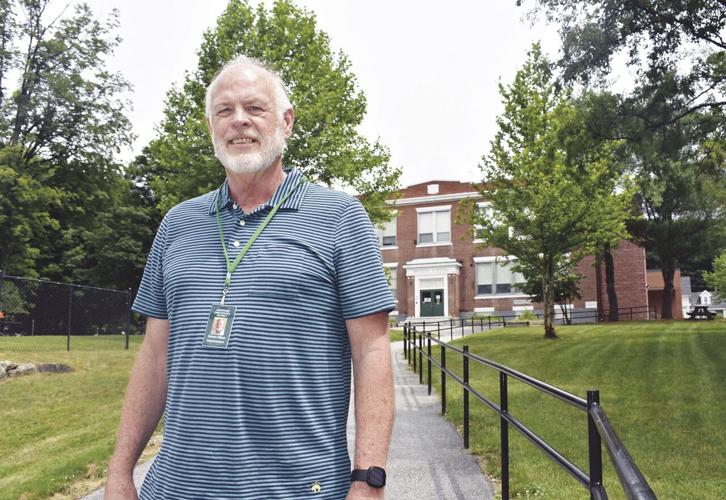
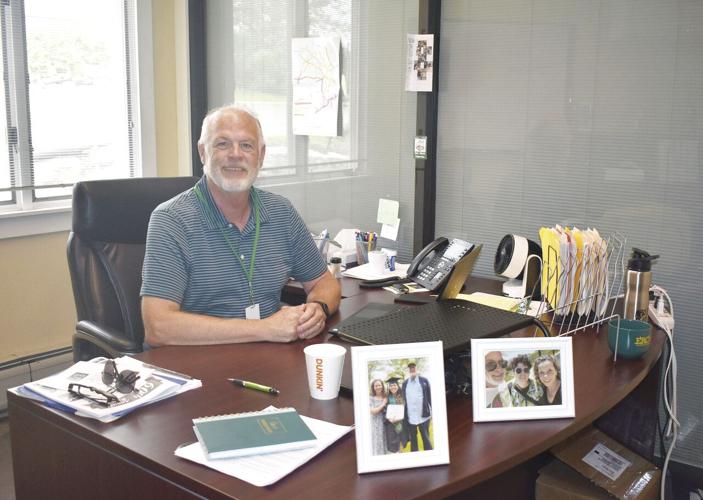
BRISTOL — One week into his new job, Steven Nilhas, interim superintendent for School Administrative Unit 4, said the one thing that has not changed, regardless of where he has worked, is a common thread: “the kids.”
“No matter what, they look to us for guidance and look to us for understanding,” he said, adding, “Relationships are the key to everything we do in this business, I think, and the humanistic leadership, whether it’s at the classroom level or this level, I think is really, really important.”
Speaking of his diverse background, Nilhas said, “The past experience that defines who I am is growing up on a farm, so I’ll start right there. ... It definitely shapes a lot about how I think and how I look at the world, and probably gave me some perspectives that have helped me in this business.”
Among those lessons were the value of perseverance and the recognition that some things are beyond one’s control.
Nilhas grew up in western Kansas. He taught English, serving as director of staff development and curriculum in Hays, Kansas. He later served as high and middle school principal and athletic director in Grainfield, Kansas; as superintendent of schools in Hill City, Kansas; and as high school principal in Lawrence, Kansas. He then went to South America, serving as high school principal at the American School of Asuncion in Paraguay and as middle-high principal at Colegio Jorge Washington in Cartagena, Colombia. Returning to the United States, he and his wife Elena moved to Littleton, where he was director of curriculum and instruction for the school district until accepting the interim superintendent’s job for the Newfound Area School District. Elena continues to teach kindergarten at Lakeway Elementary School in Littleton.
Nilhas’ career has put him in schools of 90 students and schools with 1,300 students, and in districts with as many as 10,000 students.
“Wherever I’ve been, I’ve had really good people to work with,” he said. “I’ve been so fortunate to have good people right by my side almost from day one of those places, that really helped me, supported me, and got me off to a good start. And Sue [Cross, SAU 4 administrative assistant] has already done that here.”
South America, he said, was a totally different environment from what he experienced in Kansas, but his farm background came in handy because the country is very agricultural.
“I remember visiting a farm out in the countryside and it was the height of summer, which is December. And I remember walking into this field of soybeans, and the soybeans are like mid-thigh and the greenest green I’ve ever seen in my life ... but that’s what happens when you have that kind of soil and it rains every week, and it’s 110 degrees.”
Cartagena, by contrast, was in the Caribbean, a tourist destination with everything that comes with it. Interestingly, he said of a place known for drug trafficking, alcohol was the drug of choice, but he did not see a lot of substance abuse among the students in his school.
Coming to New Hampshire, “I’d never lived in a place that had the opportunities — I call it a sportsman’s paradise, New Hampshire in general but the North Country in particular — because you can go fishing, you can go hunting, you can snowmobile ... all those things in that rural life. Yet you’re not too far away from Montreal and Boston.”
He said living in Littleton since 2016 has been another life-changing experience, and “seven years later, we’re still here.”
When he met the Newfound Area School Board in June, he hinted he is considering the job as more than an interim position, and he confirmed that during his interview in July.
“It’s not my decision,” Nilhas acknowledged. “I said I didn’t want to get ahead of myself here, but I don’t know how to think as an interim [superintendent] ... I’m just gonna do what I’ve always done and work really hard and hopefully earn an opportunity.
"There are situations where someone says, ‘I’ll come in and help you for a year and I’ll get this transition but I don’t intend to be here any longer than that.’ And I want to be upfront with people that that’s not how I see it from my perspective. Certainly I would like to stay beyond one year, but, you know, there’s a lot that has to happen before then.”
The big issue confronting the Newfound Area School District is the possibility of three towns withdrawing and forming a new district.
“That’s on everybody’s mind,” Nilhas said. “It’s not a done deal, but that potential is there.
"It’s fairly complex and I’m just kind of trying to peel the onion a little bit.”
The district also is looking into building additions on its existing elementary schools or building a new elementary school, and Nilhas already has met with the building committee to discuss where things stand.
“I haven’t talked to anybody here that says all the elementary schools are fine,” he said. “It’s very [early] and I’ll have a lot more clarity on quite a few of these — or at least some more clarity on some of these wishes, including obviously the state of the facilities and buildings.”
He said the committee discussed what a reasonable timeline would be. “I know there was a desire at one point to get things moving pretty quick. We’ll see if we’re actually able to adhere to that. Again, just looking at the options, looking at the best way to engage with the communities, the taxpayers, and come up with some solutions.
“I think that, in an ideal world, we want kids to have the same opportunities and the same learning environments and so on, so I was really happy to see that being the whole goal.”
The community has “tremendous resources” to enhance education, Nilhas observed, with the Tapply-Thompson Community Center playing a major role.
“That’s the kind of relationships I think are smart,” Nilhas said. “They’re fiscally smart, a good use of resources, and I was really happy to see the level of collaboration there.”
Right now, he is learning what is here, who is here, and what support there is for students.
“I think schools need to engage their communities,” he said. “I’ve seen schools that sort of thought they lived in a bubble and weren’t responsive or even accountable in some cases to their communities and families they serve, and that’s not a good practice.
“I think it’s like anything else. You have your few loud voices, that can be very overwhelming, and sometimes you have to realize that not everybody feels that way, or not even a majority of people feel a certain way. I’m available to anybody. I’m an idea-oriented person. I’m more than happy to entertain ideas — not all ideas, by the way, but most ideas. If they get over into certain phobias and racism and that kind of stuff, I don’t have a lot of time for that, but I’ll certainly talk about educational philosophies and I do think there’s obviously a place for parents and communities to have a voice.”
He added that open communication is important. “I say I’m everybody’s superintendent. It doesn’t matter if you’re a taxpayer with no kids or an employee, or most importantly, a student, I think that availability [is important]. We have tools at our disposal that we didn’t always have in the past. We have video access to school board meetings. I do think one of the big challenges, though, is how do we really reach people that aren’t necessarily going to watch a YouTube video, or social media, because social media is a very powerful way to communicate, also.”
He hopes to establish transparent procedures and operating principles to provide the means to show the community how decisions are made, which assists the district in evaluating the efficacy of those decisions.
Discussing a recent choice that alarmed the staff by requiring they remove all personal items from their classrooms, Nilhas said he has addressed that, because building a culture of trust is important.
“Obviously, we need to do everything we can to support teachers and give them the tools that they need to teach. And then we have some rules we all have to follow that we just need to work through.
"I’ve been in education for a while and my wife’s a teacher, and teachers put a fair amount of their own money into supplies and this, that, and the other. I think we need to recognize that and understand that, too. Work with people and make sure it’s clear that there’s certain things we just can’t bring in from outside because we get into some issues with safety.
“At the end of the day, what determines students’ success is the quality of instruction they receive from the classroom teacher and the quality of the relationship they establish with a classroom teacher or teachers.”


(0) comments
Welcome to the discussion.
Log In
Keep it Clean. Please avoid obscene, vulgar, lewd, racist or sexually-oriented language.
PLEASE TURN OFF YOUR CAPS LOCK.
Don't Threaten. Threats of harming another person will not be tolerated.
Be Truthful. Don't knowingly lie about anyone or anything.
Be Nice. No racism, sexism or any sort of -ism that is degrading to another person.
Be Proactive. Use the 'Report' link on each comment to let us know of abusive posts.
Share with Us. We'd love to hear eyewitness accounts, the history behind an article.