


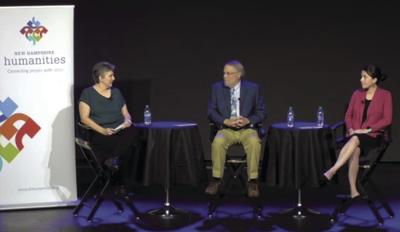
MANCHESTER — News organizations across the state, faced with a diminished number of reporters amid shrinking revenues and competition from social media, are addressing the need for accurate local news coverage by sharing their stories, observed Mike Pride, a former editor of the Concord Monitor, and Daniela Allee, the Spanish news managing editor of New Hampshire Public Radio.
The two news veterans shared their views on the state of journalism today and what the future may hold on Nov. 2 during a panel discussion sponsored by New Hampshire Humanities at the Rex Theatre in Manchester.
“We don’t have a reporter in every corner of the state,” Allee said, “so it’s really nice where we can share our stories together [through the Granite State News Collaborative]. People can publish and you can say, ‘Oh, this is what The Laconia Daily Sun has put out, and it’s like, great, we know a reporter in that area that is following that story.’”
Pride cited nonprofit news organizations such as InDepthNH.org and the New Hampshire Bulletin, both of which publish stories online, as valuable contributors to accurate news coverage.
Moderator Kimberly Lauffer, a journalism teacher at Keene State University, traced the history of news coverage before asking the panelists to help make sense of what “news” is today.
Newspapers in the 18th and 19th centuries were very different from what they became in the 20th century, Lauffer said.
“The press was very partisan. Political parties supported and ran the newspapers and pamphlets and the magazines,” she said. “And because those publications were subsidized by political parties, people knew what perspective they were coming from. And people knew that it was a good idea to consult more than one source of information.”
The idea of objective news coverage did not come until Adolph Ochs bought The New York Times in the 1890s, declaring, “We’re going to cover the news impartially, without fear or favor,” according to Lauffer, who said, “that sort of entered or ushered in a new era.”
The rise of the penny press made newspapers available to more people, leading to the realization that publishers could use their circulation numbers to build an advertising base that would subsidize the dissemination of news.
“As Ochs said, ‘without fear or favor’ meant that they could reach a broader advertising base as well, because they wouldn’t upset advertisers if they weren’t taking an opinion one way or another,” Lauffer said.
Pride said the “three-legged stool” of classified advertising, display advertising and subscriptions supported newspapers during the “golden age of journalism,” which continued through most of his career.
However, radio, television and satellite gradually cut into the mass audience that newspaper had enjoyed, and as circulation dropped, the media increasingly focused how to attract and retain readers and viewers.
“As the audiences started splintering, the ratings began to shrink, and people started doing more and more extreme things to draw more eyeballs,” Lauffer said, adding social media algorithms now drive what news people see there.
“It doesn’t matter if you like something or you dislike something, if you respond to it in any way with a comment or an emoji, it’s considered engagement, and you’ll see more of it and it will rise to a level of more importance for other people, as well,” she said.
Pride, describing himself as a “dinosaur,” observed that the golden age when the financing worked for newspapers, and the goal was to help create an informed public, has vanished.
“My thought, 14 years after I retired, is that that world is just gone,” Pride said. “The internet just killed that and then, almost in instant, it took away every single one of those legs of the stool.”
He noted that the Union Leader once had a correspondent in every town, “so the paper was just full of news about New Hampshire. … And if you bought the Concord Monitor, you could find out what’s going on in 30 towns around Concord.”
Today, the Monitor, which had 45 reporters when Pride retired, has 10 reporters.
Allee said that what it means today is that reporters have to provide the broader context for what is happening.
“If something seems to be a problem, what is that problem?” she said. “And then also like, what solutions do exist to solve it, how other towns looked at it or other regions in the state looking at that problem in a different way.”
She said, “A lot of it comes down to thinking about the communities that we interact with. … I think what’s important is to be able to know what your neighbor’s doing, or to be able to understand a town issue … and why and how to get involved.”
Observing that much of the news is nationalized today, she said, “there’s a lot to parse through as a journalist these days.”
Pride observed the national focus on the upcoming elections, saying, “It’s very, very difficult to find information about the local candidates. It’s very difficult to find the sort of critical coverage of the U.S. Senate race, critical coverage of the governor’s race. It’s just not available to people anymore in any medium. … You’re left with the ads, and that’s where you’re getting your information, and what I would tell you about the ads and about most things … even many things on the internet, is don’t trust anything, or at least question everything.
“You have to question the source of the information. It’s just so easy to put up things that are false.”
Pride took issue with his former paper on its coverage of the double homicides in Concord. Before police had released much information about the killing of the couple found on a walking trail in the city, and at a time when there were no suspects, the Monitor quoted an “expert” as saying that, usually in similar cases, it is someone in the family or someone who knew them, so the public need not worry very much.
“I said, ‘How in the world did they let that go?’” Pride said. “They just don’t have enough information to know. They’re basically telling the public, ‘Go ahead and walk that trail.’”
Allee cited NHPR’s Spanish language news initiative that she spearheaded as a way of building public trust. During the height of the pandemic, the station turned to WhatsApp to provide COVID information on a platform that “a lot of Spanish speakers and frankly people around the world use.” She described it as a community-media partnership.
“I think a lot of those things have to happen kind of at a small scale,” Allee said.


(0) comments
Welcome to the discussion.
Log In
Keep it Clean. Please avoid obscene, vulgar, lewd, racist or sexually-oriented language.
PLEASE TURN OFF YOUR CAPS LOCK.
Don't Threaten. Threats of harming another person will not be tolerated.
Be Truthful. Don't knowingly lie about anyone or anything.
Be Nice. No racism, sexism or any sort of -ism that is degrading to another person.
Be Proactive. Use the 'Report' link on each comment to let us know of abusive posts.
Share with Us. We'd love to hear eyewitness accounts, the history behind an article.