


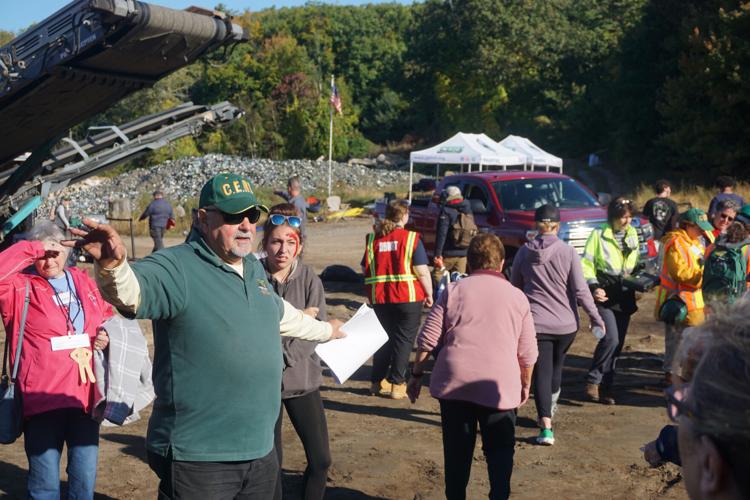
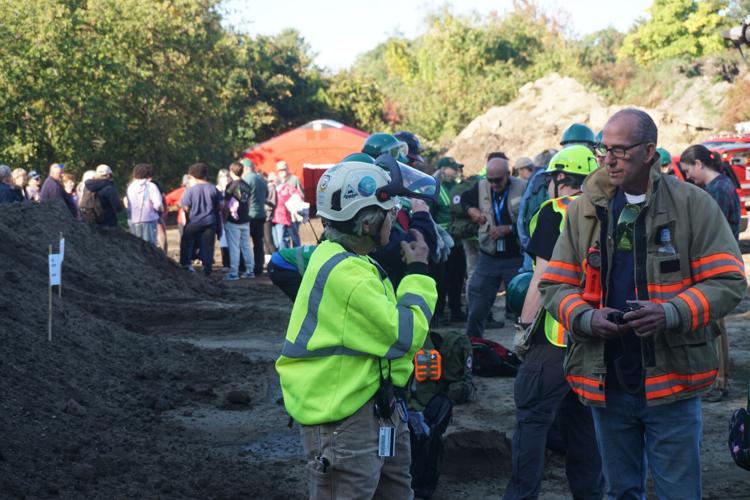
GILFORD — Emergency response volunteers from all over New Hampshire met at the Gilford Fire-Rescue Training Center Saturday morning for a neighborhood tornado disaster simulation. The scenario helped volunteers work out a response in the aftermath of a real-world event. They discovered the environment would be stressful and chaotic, and communication would be paramount.
The simulation brought together community emergency response teams, Medical Reserve Corps teams, the disaster behavioral response team and disaster animal response teams from the Lakes Region, south-central New Hampshire, the North Country, the Capital Area, greater Nashua, greater Manchester and the Upper Valley for a day of training and education.
The event was coordinated and led by John Beland, director of emergency preparedness and response for the Partnership for Public Health and a former fire chief. Laconia Fire Chief Tim Joubert assisted Beland in facilitating the training exercise.
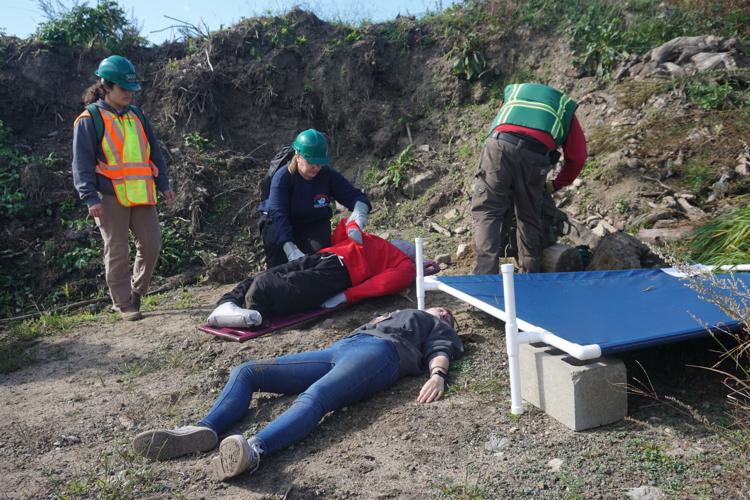
Emergency response volunteers, numbering over 80 individuals, interacted with groups of actors who portrayed victims of a hypothetical tornado disaster, including wellness providers, disaster medical operations triage providers, land-based search and rescue teams, rescue and extrication teams and civilian fire responders.
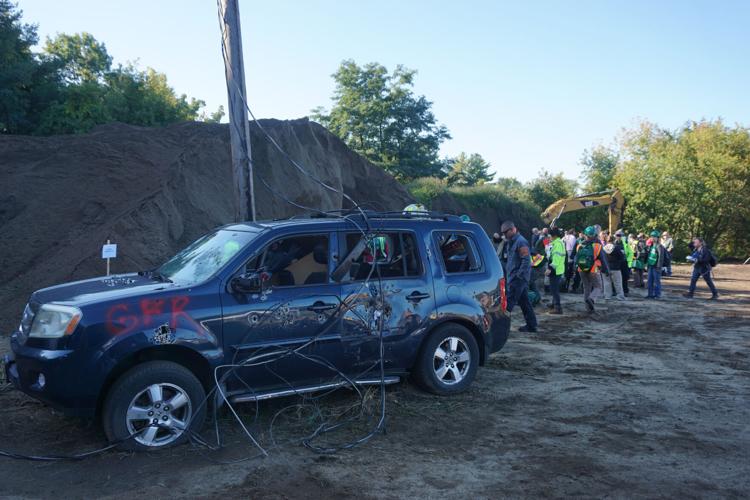
Through the morning, the groups worked to locate, identify and treat injured victims, rescue trapped victims, identify dangerous areas and environmental threats, rescue lost pets, avoid electrical wires and coordinate with each other to facilitate the safe execution of those tasks.
“Do not fight the exercise, just go with the flow,” Beland said.
Communication proved the most difficult aspect for volunteers and professional first responders alike — amongst the chaos and confusion of a real-world emergency, first responders would have to communicate clearly and concisely in order to keep each other and victims safe, and volunteers were instructed to train with their respective groups on their radio communication skills.
“There’s nothing nice and neat about the whole process — it’s a disaster area,” Leland said.
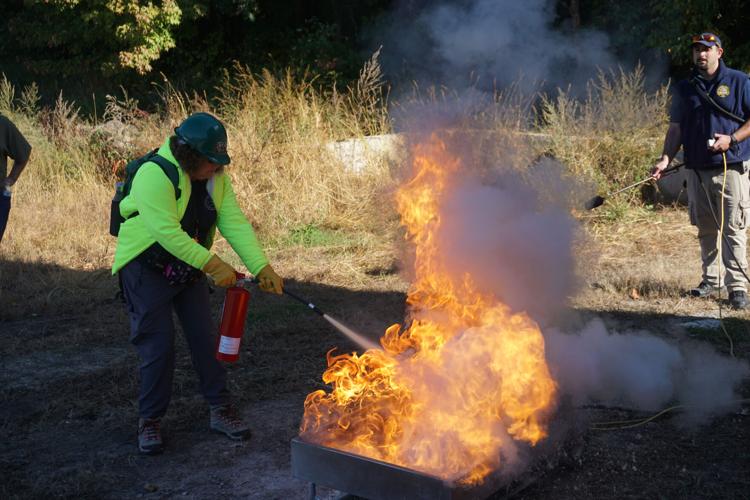
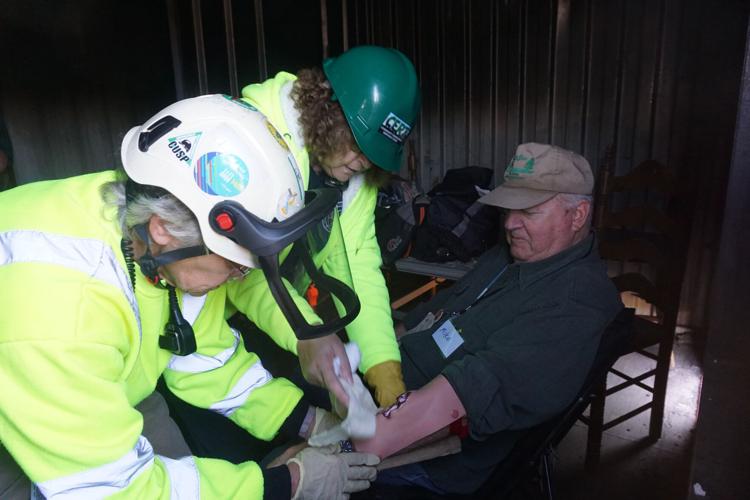
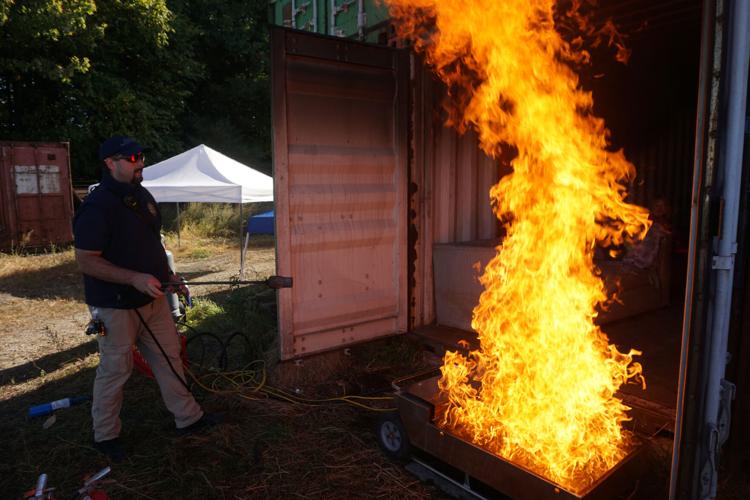
During one training scenario, Mike Stanley of Hill, who was assigned the task of portraying a victim with a broken foot and severe damage to his forearm, sat in a chair inside a training building constructed out of metal shipping containers while Craig Cote lit a controlled fire outside another entrance. Civilian fire response volunteers worked to locate and treat Stanley’s injuries and radio in his location so other volunteers could remove him from the building as they worked to locate and treat other potential victims of a catastrophic tornado.
“I was supposed to wait for extraction, but it never came through, so I limped out on my own,” Stanley said following the training.
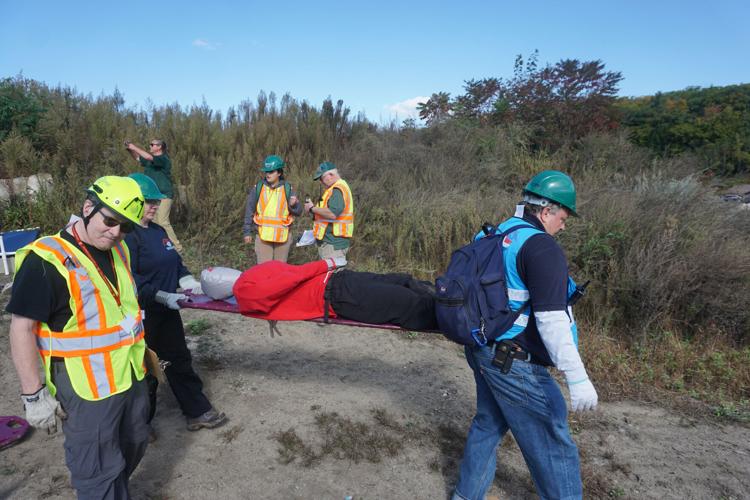
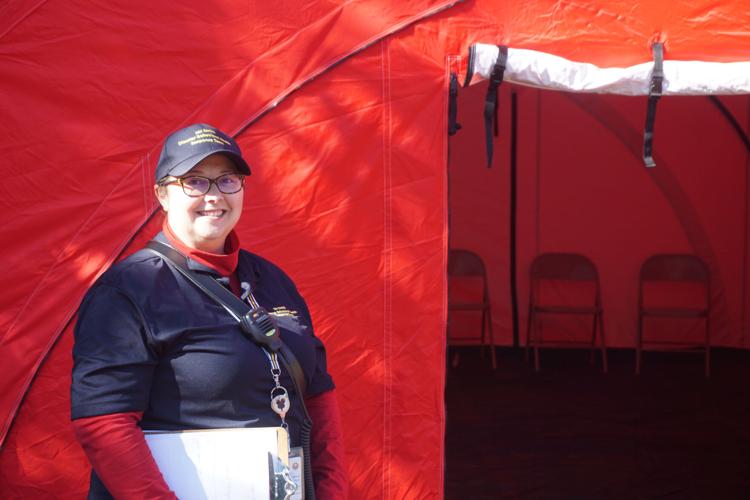
As emergency response volunteers located victims, they were transported to an onsite triage location for medical attention. Those without injuries were herded into a large red tent, which housed disaster behavioral health services provided to victims and first responders alike.
Cassie McNelly of the Bureau of Emergency Preparedness Response and Recovery, state Department of Health and Human Services, said the tent is meant to provide a respite for victims and first responders to deal with the emotional or psychological toll caused by being involved in a genuine disaster — such assets have been employed in real-world situations, such as during the shooting attack at the State Hospital in Concord — and can include emotional support dogs. Those providers worked around the clock for five days.
“It is new to get out there,” McNelly said of “psychological first aid.”
“We do that during immediate disasters and trauma.”
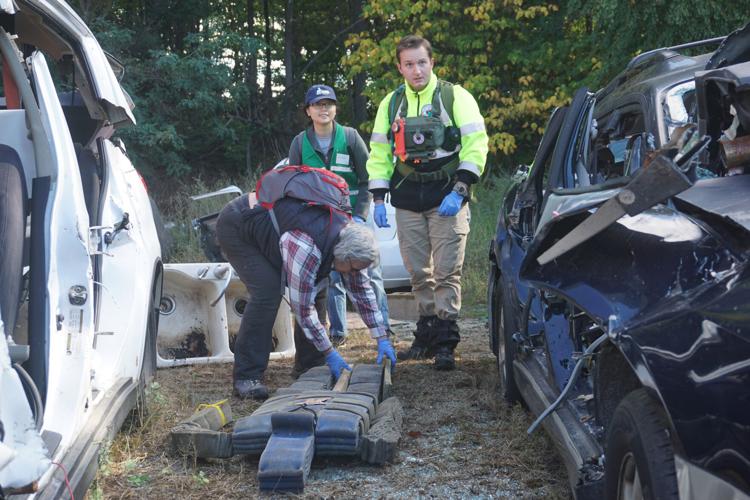
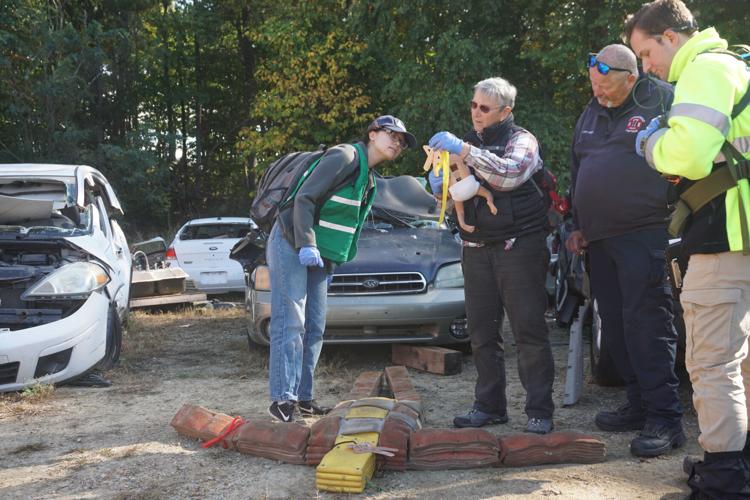
Elsewhere on the property, teams worked to free human dummies fashioned out of firehose from destroyed vehicles, determine if they were alive and transport them to the appropriate location. The fire hoses, riveted together into the rough shape of a human being, appeared heavy, and were loaded onto spine boards for transportation.
This was the first statewide exercise of its kind, according to its organizers.
Lessons learned
“We’re still waiting for two — one’s hanging on by a thread,” said an emergency response volunteer as heard over a handheld radio operated by Chief Joubert.
Following the training, Beland told participants the goal is to simulate the chaotic nature of a real emergency.
“The objective is to make everybody feel overwhelmed,” he said, noting problems could and certainly would arise as the situation progressed.
“Radio communications [are] never perfect, there’s always some kind of glitch,” he said. “It’s something we always have to deal with.”
Noting training should be an ongoing process, Beland implored volunteers to practice their radio communication skills regularly, outside of their exercise.
“It’s a learning thing and then just a practice thing, with the radios,” he said.
Emergency response volunteers, in a real-world scenario, would likely be working in unfamiliar environments. Beland told participants to relax and fall into a rhythm, not biting off more than they can chew.
“For the first 5, 10 minutes, it feels like chaos,” he said. “It takes a minute to get set and get into your battle rhythm.”
Communication aside, participants themselves identified aspects of their response which should be improved: getting medical triage into the field faster could prove lifesaving, being better-able to delegate responsibilities among volunteers could make their response more efficient and accepting nothing will go perfectly will set their minds at ease.
“These people have just experienced, probably, the worst day in their lives,” Beland said. “All you’re doing is trying to make it a little better.”
Joubert, who himself has spent a career responding to such emergencies as a firefighter, said time seems to slow down in the heat of the moment.
“In reality, a 5-minute wait time feels like you’ve been waiting 15 minutes,” he said. “It does take time and it can be frustrating.”
Joubert said communications can be a struggle, but applauded the effort put forward by volunteer participants and offered them a piece of advice.
“When you’re communicating with command, just keep it short and sweet,” Joubert said.
“Overall, I thought the effort was fantastic.”


(0) comments
Welcome to the discussion.
Log In
Keep it Clean. Please avoid obscene, vulgar, lewd, racist or sexually-oriented language.
PLEASE TURN OFF YOUR CAPS LOCK.
Don't Threaten. Threats of harming another person will not be tolerated.
Be Truthful. Don't knowingly lie about anyone or anything.
Be Nice. No racism, sexism or any sort of -ism that is degrading to another person.
Be Proactive. Use the 'Report' link on each comment to let us know of abusive posts.
Share with Us. We'd love to hear eyewitness accounts, the history behind an article.