


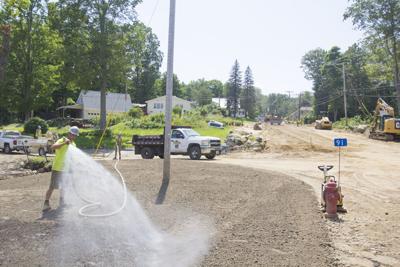
The Lakes Region was unlucky to get a taste of the heavy rains that have battered Vermont and the northwestern portions of the Granite State on July 16. In Alton, a chunk of Route 140 was destroyed by a storm washout. The next day, as crews went to work to clear the debris, Julie White and her vacationing family strolled by the devastation. They had driven over that patch of highway just 30 minutes before its destruction. During an interview with The Sun, White called the destruction “a once-in-a-lifetime event.”
That couldn’t be further from the truth, according to climate scientists.
Events like the torrential storms earlier this month, smoke from ever-intensifying wildfires and shorter winters are becoming increasingly common across the globe. These are the loudest signs the state’s climate is rapidly changing, and not necessarily for the better. While the situation teeters on the brink of dire, climatologists like Mary Stampone say there is still some time to mitigate the damage done so far, but it must be soon.
“We will also have to adapt to what changes we’ve had and changes that are coming, plus mitigating the most extreme changes,” said Stampone, an associate geography professor at the University of New Hampshire. “We have a few decades to do that. Whether or not we will is a different story.”
As the climate continues to warm, nearly every aspect of New Hampshire’s ecosystem and by extension, economy, is affected.
“We’re going to see more hot days during summer, days in the 90s,” Stampone said, when asked to paint a picture of the local climate just a few decades down the road. “More heatwaves, more of these extreme heat events, which will require more resources for cooling. If you have a heating and air company, it’ll be a good time for you."
Stampone added that overall, the northeastern U.S. will become wetter, but that moisture will not be evenly distributed across the four seasons. Instead, Stampone said Granite Staters will face more instances of dense rains coupled with drought in the summer months. At a glance, especially for those less familiar with how the climate works, these two patterns seem contradictory.
“The rain is going to come into bigger events, but much more spaced apart,” explained Stampone, referencing last summer’s dry spell. “That dry period is going to get drier, but those rain events are going to get bigger.”
With more intense rainstorms comes a particular threat to the Lakes Region: cyanobacteria and algae blooms, which can sicken or kill humans and dogs, as well as damage to aquatic ecosystems.
“With heavier precipitation, you get more runoff,” Stampone said. “That increases our risk of flooding. Also that water will carry soil fertilizers, whatever is put on the ground, all of that is going to be carried into lakes and streams.”
Those fertilizers contribute directly to cyanobacteria blooms, due to the sudden rush of nutrients like nitrogen and phosphorus rapidly introduced into the water.
On an ecological scale, Stampone said warmer temperatures are contributing to a boom in tick and mosquito populations, threatening both humans and animals with disease.
“The warming of the winter is a problem all year long, so we’re getting snow later in the season. That 1-inch snow cover is important for controlling tick populations,” Stampone said. “We need that hard freeze in the winter to kill off a lot of the bugs we see in the summer. We’re having an increase in tick populations, Lyme disease and other vector-borne disease.”
Stampone pointed out that New Hampshire’s forests are adapted for cold, harsh winters, and as those periods get shorter and warmer, invasive species such as the emerald ash borer are able to thrive longer, and therefore wreak greater devastation in forests.
“Our economy is based on tourism,” Stampone said. “Warmer lakes lead to beach closures, less snow impacts ski resorts [and] things like snowmobiling, snowshoeing, cross-country skiing. If there's no snow, there’s no snow. People see that. People are seeing the changes here.”
Despite the visible and tangible signs and science, some people remain skeptical of the existence of climate change along political lines. One former self-described skeptic said he changed his tune once the dark predictions of the '90s started coming into fruition in the 2000s.
“At first I was somewhat of a denier, because I thought it’s almost arrogant to think mankind could change the atmosphere in such dramatic ways,” said Tommy Vazzano, a retired meteorologist from Sandwich.
“As time went on and I saw more and more of it, and I saw this difference in the rain right here in Sandwich, my percentage of how much of this is human-made kept going up and up in my head,” Vazzano continued. “The past 20 years I've been on board. It’s true most meteorologists were not on board initially, because we're the ones that thrive on death and destruction in the weather.”
Climate skepticism is not uncommon in the Northeast, where certain changes such as heavy rains and shorter winters are far less noticeable than events such as Canada’s wildfires or India and Arizona’s lethal heatwaves.
“When I was in college in the '90s, it was, ‘We can expect these changes, that’s scary.’ Now those things are happening, we’re seeing it,” Stampone said. “It's not hyperbole, it’s actually happening. We are not OK.”
“Look at what’s happening this summer, the heat dome,” Vazzano said. “Phoenix, Arizona’s reading for the months of July, the high temperature was 110 on their coolest day. It’s happening more elsewhere. When I see these letters in the paper by some conservatives about climate change, it makes me wince.”
Politics are involved
Climate change denial and Republican politics seem to go hand in hand now, but it wasn’t always this way.
As recently as the early 2000s, Republicans and Democrats alike pushed for environmental protection, and in some cases, regulation. The late senator and Republican presidential candidate John McCain introduced the Climate Stewardship Act, an emissions-capping bill meant to reduce the effects of acid rain in 2003. Even then, McCain was quoted as saying, “Climate change is real.”
As Stampone pointed out, the Environmental Protection Agency was started by none other than Republican President Richard Nixon.
Things seemed to take a shift in the 2010s, after the Citizens United decision allowed fossil fuel companies to pour nearly unlimited money into American politics, where candidates could be swayed in exchange for campaign contributions. Democrats like Al Gore started championing environmental causes while traveling by private jet.
“Anytime you have money involved, you have potential for it to be politicized,” Vazzano said. “It’s kind of like how COVID got politicized. Anytime someone tries to inhibit business because of a potential scientific problem, someone’s going to step up and say, 'No, we have too many regulations, we would rather regulate than deregulate.' I think that’s how it must have evolved. Now it’s gotten to the point where there’s so much misinformation.”
Wharton Sinkler, a chapter leader for the Citizens Climate Lobby's Lakes Region chapter, which seeks bipartisan solutions to climate change, pointed to signs of dissent in Republican ranks when it comes to the issue.
“We’ve gotten ourselves into a rut in the sense, where the left is perceived as pro-climate and the right perceived as anti-climate,” Sinkler said, citing efforts of Congressman John Curtis (R-Utah), who leads the recently created Conservative Climate Caucus, which now boasts 81 members. Curtis did not immediately respond to a request for comment on this story.
At times, Democrats have used climate legislation as a vehicle for other agenda-driven items, fostering even less cooperation from their Republican counterparts.
Sinkler cited the Inflation Reduction Act as an example.
“It was a climate bill that was passed in reconciliation,” Sinkler said, explaining that reconciliation bills can only affect the budget.
“If that’s the case, it can be passed in the Senate with only a bare majority. They didn’t have it filibuster-proof, which would be 60%,” said Sinkler. “They can only do two reconciliation bills per session. One was the Inflation Reduction Act. It was passed on purely partisan lines, and that always leaves a bitter taste in the mouths of Republicans because they weren’t involved in it.”
Polarization blocking progress on solving problems is far from a new phenomenon, but now the stakes are higher than ever.
"Instead of being a problem that we all need to work to solve together, it’s political football and one team wants to put the ball in the other team’s end zone and score points,” Sinkler said. “So really it would be helpful to remove it from that 'I win you lose, you win I lose' framing and reframe it as ‘We have a problem, what do you think we should do?’”
How to make a difference
Just because politicians seem deadlocked when it comes to effectively and actively addressing the climate crisis, Stampone said this doesn’t mean that individuals are helpless.
“Look at things that can mitigate emissions but also increase your adaptation capacity,” Stampone said. “A great example on an individual level is putting solar panels on your house. They reduce your need for the grid electric, which is usually produced by fossil fuels, and they’re an extra source of power. With solar panels you can keep some things running. That’s a combination of mitigation and adaptation.”
On a local community scale, Stampone emphasized the importance of protecting and restoring areas like wetlands and marshes.
“Those areas absorb coastal flooding during a storm,” Stampone said. “They also absorb a lot of carbon from the atmosphere and store it, and they also curb flooding.”
Other actions such as reporting and eliminating invasive species, or planting a bee-friendly pollinator garden can help.
New Hampshire Fish and Game has extensive information on how climate change is affecting the local ecosystem, as well as guides for identifying invasive plant and animal species. To access those resources, visit wildlife.state.nh.us.
On the political front, Sinkler says voters should engage with their representatives on climate change.
“If you reach out to them and tell them this issue is important to you, it’s going to make an impact,” Sinkler said.
“We can’t undo [the damage so far], but we can level things off,” Stampone said. “In our lifetimes we can mitigate the worst of it and cap it where it is now, if we can stabilize emissions by 2050.”


(0) comments
Welcome to the discussion.
Log In
Keep it Clean. Please avoid obscene, vulgar, lewd, racist or sexually-oriented language.
PLEASE TURN OFF YOUR CAPS LOCK.
Don't Threaten. Threats of harming another person will not be tolerated.
Be Truthful. Don't knowingly lie about anyone or anything.
Be Nice. No racism, sexism or any sort of -ism that is degrading to another person.
Be Proactive. Use the 'Report' link on each comment to let us know of abusive posts.
Share with Us. We'd love to hear eyewitness accounts, the history behind an article.