


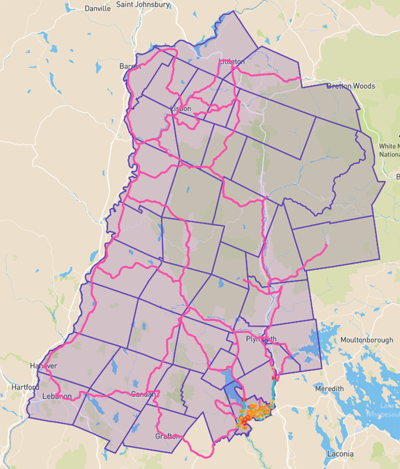
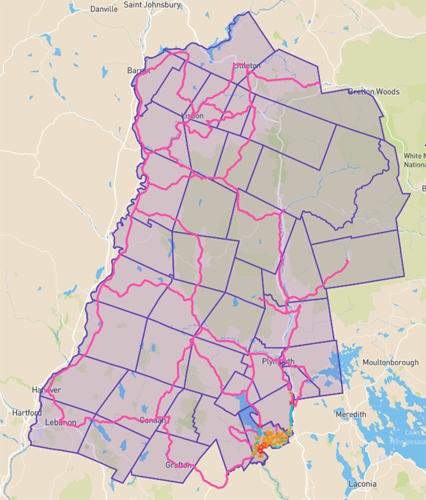
BRISTOL — A $3.7 million American Rescue Plan grant will allow the Grafton County Broadband Committee to proceed with engineering plans for the entire 39-town region, a significant step in its goal of assisting every town in the county in providing high-speed internet service.
The committee formed to apply the lessons from Bristol’s pilot program to other communities that are under-served by existing cable companies.
Bristol Town Administrator Nik Coates, who serves as chair of the Grafton County Broadband Committee, said the grant will allow eX² — the Nebraska-based company that built the town’s network — to prepare plans for both “middle-mile” and “last-mile” fiber work.
Middle-mile refers to a fiber network along major routes through the county: Interstate 93, routes 3 and 3-A, and other state-owned highways. Last-mile networks will extend the infrastructure backbone along town roads to reach homes off the main highways.
Bristol’s project, which has become a model for other communities, sought to solve the problem of extending broadband service to areas where cable companies could not justify the expense of such an investment. The Bristol Economic Development Committee led the initial effort after businesses expressed frustration with the lack of reliable internet in the town. The town’s topography, surrounded as it is by mountains, also resulted in spotty coverage from cellular towers.
Coates wanted to bridge the gap without asking taxpayers to foot the entire bill, so with the support of the selectboard, he was able to use $1.2 million in CARES Act funds to upgrade and extend the fiber system already in place within the Newfound Area School District. He also obtained a $260,000 grant from the Northern Border Regional Commission to get the broadband project underway, and voters supported the project with tax money, proving the additional fiber backbone to connect Bristol’s municipal, educational, and commercial buildings.
Last month, Hub 66, a fiber-to-home internet service, began connecting residential customers to the fiber network. The company, based in Acton, Massachusetts, utilized unused space at the Bristol Town Offices as temporary headquarters, and voters at this year’s town meeting agreed to extend a four-year lease to the company.
“No one ever built out Bristol because it just didn’t make sense to do it on their own,” Coates said. “Why would you spend millions upon millions of dollars getting from Manchester to Bristol, and then have only 2,000 customers? No business would do that.”
Coates said that, as word of Bristol’s success in overcoming that problem spread, he began getting calls and emails from around the country, including as far away as Arizona.
“What we developed in Bristol seems to be good model that could work for other towns, where it’s basically a public-private partnership. We got some grant money, and then we worked with a private company to kind of bring in additional dollars to build it out,” Coates said, “and we think we can grow that out across the country.”
He said that, in taking it to the county level, “we think it’s important to cover the entire county — we’re using taxpayer dollars. We’re not here to serve a certain customer base; we’re here to try and provide service to as many people as possible.”
Two-Track Approach
The $3.7 million represents a combination of middle-mile engineering to link communities, beginning with Bristol to Canaan and continuing around the county until the network returns to Bristol to complete the loop. The work includes preliminary route layouts and construction analysis to final route design. That portion of the work amounts to a little more than $397,000.
The final-mile design would define the network extension along town roads, including construction pricing estimates and permit applications. That work carries a $3.3 million price tag because of its more detailed work, including finalized specifications.
Coates said members of the committee will be visiting each of the towns to explain the plan, and those towns have the option of taking part or not. Lebanon, for instance, already has its own extensive fiber network.
“We’re going to sit down with [the towns] and say, ‘Look, here’s a couple of things.’ One, by November, we’ll have what’s called a high-level design — it’s basically lines drawn on a map of what it looks like and how much it’s going to cost,” Coates said. “And we’re going to bring a grant writer that we have on retainer, and she’s going to speak to basically, ‘As Community X, you’re eligible for this grant program, and we know that you have ARPA money that you have received already, so there’s some money that you can utilize for a match, and you may want to start thinking about getting yourself ready for town meeting if you don’t have enough.’”
He said communities may want to get together in applying for grants, and noted that the Northern Borders Regional Commission is “probably the biggest grant funder for broadband.”
However, communities will not be obligated to tie into the fiber infrastructure running through their towns if they do not feel it is needed, or if they want to use their ARPA funds for other projects.
“Okay, no problem,” Coates said. “We’re not here to force it down your throat.”
Meanwhile, the Broadband Committee is seeking a $26 million grant to continue the work.
“We thought it was really important to keep the project going,” Coates said, “so, as we wait for the $26 million grant, let’s keep moving forward with the engineering so that we can be ready for whatever next opportunity comes.”
They chose to start the project from Bristol because that portion is already done. A county grant provided $195,000 for the first 110 miles of final engineering for the middle mile, and the $3.7 million grant will allow the remainder of the engineering to be completed.
Beginning on April 8, the committee will be interviewing interested parties to handle the fiber-to-home-and-business aspect of the job. Hub 66, which handled that work in Bristol, is expected to bid, along with a dozen other service providers. They will have the opportunity to bid on the entire county or individual towns.
Existing franchise agreements do no prevent other companies from bidding for the work. In Bristol, for instance, Hub 66 was able to install fiber to homes where Breezeline already offered service.
“Our goal,” Coates said, “is not to do certain neighborhoods and certain towns; we want to serve everyone in the county. At the end of the day, if we don’t get these big grants, or we don’t secure private investment, it’s okay; we’ve advanced the ball, which no other county has done.”


(0) comments
Welcome to the discussion.
Log In
Keep it Clean. Please avoid obscene, vulgar, lewd, racist or sexually-oriented language.
PLEASE TURN OFF YOUR CAPS LOCK.
Don't Threaten. Threats of harming another person will not be tolerated.
Be Truthful. Don't knowingly lie about anyone or anything.
Be Nice. No racism, sexism or any sort of -ism that is degrading to another person.
Be Proactive. Use the 'Report' link on each comment to let us know of abusive posts.
Share with Us. We'd love to hear eyewitness accounts, the history behind an article.