




FRANKLIN — A moratorium on new natural gas connections, imposed by Liberty Utilities and which local communities learned about at the end of 2025, poses risks to further economic and housing development.
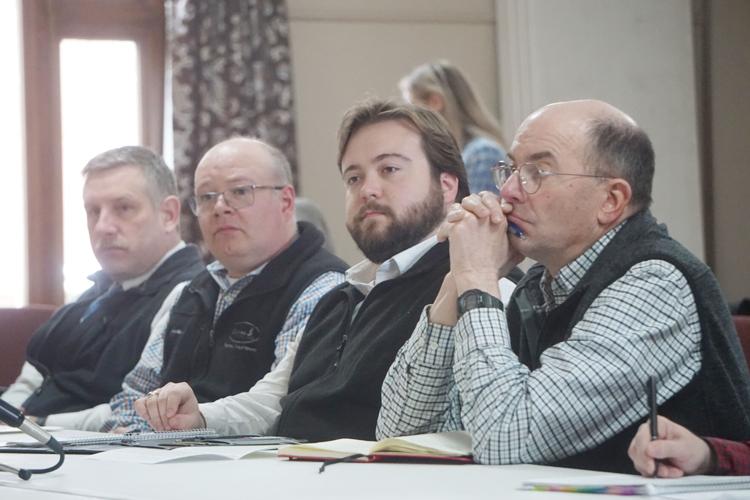
Rep. Maggie Goodlander (D-NH) met with local leaders and a representative of the utility at the public library on April 7, and the group left with more questions than answers.
Laconia City Manager Kirk Beattie informed councilors in January, that Liberty Utilities issued a moratorium on adding new addresses for natural gas service in the City of Laconia and surrounding communities, citing lack of capacity. In Franklin, leaders became aware at the end of 2025, when developers first encountered the issue themselves, and reached out to neighboring communities.
There are seven Lakes Region cities and towns affected by the moratorium, according to Liberty’s Carolyn O’Connor: Belmont, Franklin, Gilford, Laconia, Northfield, Sanbornton and Tilton.
And not being able to hook up to natural gas is causing headaches for real estate developers.
Tyler Carmichael, Laconia’s assistant planning director, told the group a developer in the city working to convert a commercial building to residential planned to use natural gas, but was denied their request to connect. Now, the developer will consider switching to electric, which adds costs late in the game.
“We’re seeing such a huge increase in development in Laconia,” Laconia Planning Director Rob Mora said. “How is this going to affect us long-term, economically?”
“It’s definitely not a positive to run out of natural gas.”
At the former Laconia State School property along Parade Road, Pillsbury Realty Development is under contract to purchase the massive lot by the end of the summer, and intends to construct a multi-use community with more than 2,000 units of housing. Sans natural gas, Pillsbury must consider alternatives, like propane.
“It could sour people from wanting to build,” Beattie said. “If they have the natural gas line running in front of their property, and they can’t tap into it, I could see someone going, ‘Well, maybe we’re going somewhere else.’”
“If we wait five years to start talking about this, we’re just five years behind."
Community leaders were taken by surprise upon learning about the moratorium, and were confused as to why Liberty hadn’t communicated their plans to impose such in the Lakes Region. But O’Connor told the group Liberty had informed regulators in 2024 that they foresaw a lack of capacity for service in the area, though she also said she wasn’t aware of any public announcement regarding the notice.
“I’m not aware of any public disclosure,” O’Connor said.
“It was a surprise to us, what was going on,” Beattie said.
“I don’t know how a secret that big got kept that well,” said Mitch Kloewer, Franklin’s city manager.
When pressed for details, like the scope of the moratorium and how communities were selected for inclusion, or solutions to the problem, O’Connor was tight-lipped. She said she’d have to bring those questions back to her superiors, and added the company was investigating expanding capacity in the region.
Donald Kreis, the Granite State consumer advocate, said his office was aware of the notice to the Public Utilities Commission, but took no action, as it was primarily connected to commercial, not consumer, activity. Kreis told the group that in documents filed by the utility in 2022, Liberty communicated their intent to invest upward of $20 million on natural gas pipeline upgrades to the Lakes Region, though the project never materialized.
“It’s not the fault of Ms. O’Connor or anybody who works here in New Hampshire — this is a company with a Canadian parent company that is notoriously deprived of adequate capital when it comes to making necessary investments,” he said.
Kreis said the reason public utilities exist is because we rely on private capital to build infrastructure. Liberty, Kreis said, failed to deploy capital to meet its obligations, and regulators failed to keep the company in check — both the Public Utilities Commission and the New Hampshire Department of Energy have the authority to either investigate or sanction.
“There’s plenty of blame to go around here,” said Kreis. “I don't think the company deserves to be let off the hook — it has failed to deploy necessary capital in order to meet its public service obligations, but the regulators have failed to be vigilant in oversight of the company.”
Goodlander, dissatisfied with O’Connor’s apparent lack of candor, vowed to pursue answers.
“This shouldn’t be as opaque and complicated to navigate as it is.”


(0) comments
Welcome to the discussion.
Log In
Keep it Clean. Please avoid obscene, vulgar, lewd, racist or sexually-oriented language.
PLEASE TURN OFF YOUR CAPS LOCK.
Don't Threaten. Threats of harming another person will not be tolerated.
Be Truthful. Don't knowingly lie about anyone or anything.
Be Nice. No racism, sexism or any sort of -ism that is degrading to another person.
Be Proactive. Use the 'Report' link on each comment to let us know of abusive posts.
Share with Us. We'd love to hear eyewitness accounts, the history behind an article.