


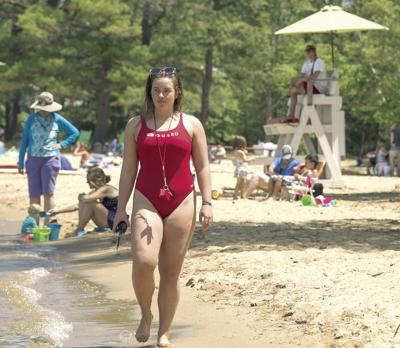
GILFORD — As Kelly Gallant looked out over the Gilford Town Beach on a sunny summer Friday, she took in a mix of excited kids, swimmers and people basking on the sand.
At age 23, this is her sixth – and likely last – season as a lifeguard.
She will miss it.
“I just love being outdoors,” said Gallant, who graduated from the University of New Hampshire in 2017 with a degree in kinesiology and then took some time off to travel.
“I’ve said for each of the last couple years this will be my last season as a lifeguard, but this is probably it. We shall see.”
When she does move on, Gilford Parks and Recreation Director Herb Greene is likely to have a hard time finding a replacement.
Like many of his colleagues in the region, he is having an increasingly difficult time attracting candidates for lifeguard positions, once a highly coveted job for young people.
“Right now we have 10 lifeguards plus our beach manager, but we still have four vacancies,” Greene said. “We’ve had to shrink our guarded area and reduce coverage of the beach.
“This is the biggest vacancy rate I’ve seen.”
A regional unemployment rate hovering around 3 percent means many employers are having a hard time finding summer help, but municipalities looking for lifeguards have special challenges.
One hurdle for potential lifeguard applicants is the $400 it costs to take the lifeguarding course required for American Red Cross certification.
Also, the strong swimming requirements are not easy. One must be able to swim 300 yards (12 laps), tread water for two minutes using legs only and recover a 10-pound object from the bottom of the pool.
The job of lifeguard comes with a lot of responsibility and the requirement of enforcing multiple rules, which at the Gilford Town Beach include prohibitions against smoking, glass, water guns, baseballs, bats, pets and skinny dipping.
Lifeguards there are likely to make several rescues, or “saves,” over the summer, often when young people struggle to make it to an offshore floating dock.
Lifeguards must avoid distraction and actively scan the water. No cell phones allowed.
Amy Lovisek, Laconia’s assistant recreation and facilities director, was able to hire only seven of the 13 lifeguards she sought this summer for Weirs, Bond and Opechee Point beaches. The job pays $11 an hour.
“Not being a 16-year-old, it’s hard to speculate why more don’t want to become lifeguards, but kids have so many options these days,” she said.
“They don’t need to spend the $400 to be trained as a lifeguard, and then have that responsibility and liability. Maybe even parents aren’t interested in kids taking on that role.”


(0) comments
Welcome to the discussion.
Log In
Keep it Clean. Please avoid obscene, vulgar, lewd, racist or sexually-oriented language.
PLEASE TURN OFF YOUR CAPS LOCK.
Don't Threaten. Threats of harming another person will not be tolerated.
Be Truthful. Don't knowingly lie about anyone or anything.
Be Nice. No racism, sexism or any sort of -ism that is degrading to another person.
Be Proactive. Use the 'Report' link on each comment to let us know of abusive posts.
Share with Us. We'd love to hear eyewitness accounts, the history behind an article.