



GILMANTON — June Zanes Garen of Gilmanton never imagined when she became a nurse that she would endanger her life.
She answered a deep, internal calling to help others, and worked in a hospital operating room for 30 years before switching to a new arena at the front lines of mental illness, anguish and despair. In 2017, at age 57, she took a job at New Hampshire Hospital.
As a newly minted psychiatric nurse practitioner at the state’s psychiatric hospital, she followed all the rules and regulations and cared about her patients and their outcomes. Two months after she started, while on an evening shift, she was assaulted by a patient she says tried to kill her by running at her, punching her stomach and toppling her, then repeatedly kicking her head, neck, chest and back. It’s unclear how many witnesses heard or saw it happening.
Garen suffered a fractured skull, bleeding between brain and bone, a traumatic brain injury and lasting, invisible wounds – including sleepless nights, bouts of rest plagued by nightmares and flashbacks of her attacker that brought back the same emotions and sensations, including paralyzing fear.
In the aftermath, Garen couldn’t go shopping because a stranger might stand behind her, a position of vulnerability she could no longer tolerate. She struggled with thoughts of wanting to die and had shifted from being a healer to a patient with post traumatic stress disorder.
“It takes an enormous amount of your brain to live when you don’t know how to do it,” said Garen, who remains unable to work in the health care field as a result of her injuries. “I was always trying to claw my way back up to a new normal.”
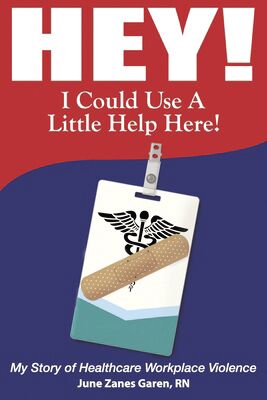
Now her journey has reached a new and optimistic milestone. Garen recently celebrated the release of her book chronicling her experience as a victim of workplace violence, what helped her recover, and her advice to others in health care – but especially to hospital administrators and legislators who can heal a broken system. Her book, HEY! I Could Use a Little Help!, published by Vermont-based Phoenix Books, is available through independent booksellers and the publisher, and can be ordered online from indiebound.org as well as amazon.com.
She hopes it will illuminate the silent epidemic of healthcare workplace violence and prompt changes in facilities she says do little to provide a safe place for physicians, nurses and staff to work.
“When your mind shifts to being a survivor instead of a victim, that’s empowering,” said Garen. In the book she includes accounts of other survivors, recipes for healing and prompts for self-reflection. She borrowed the title from what nurses say in situations they can’t handle. “After I was assaulted, I sure did need a little help.”
Silence among health care workers and reluctance among health care administrators to make costly safety changes or collect data has kept the problem alive, Garen said.
“We don’t heal what we don’t acknowledge. And we can’t heal when we’re shaming and blaming ourselves. I didn’t expect to be beaten at work. The shaming and blaming gets directed at the people who are the victims of violence,” who often retreat for fear of retribution. “A lot of people stop participating in trying to make changes because when they do, they end up being revictimized.”
According to the federal Occupational Safety and Health Administration, 75 percent of the roughly 25,000 workplace assaults recorded each year occur in the health care sector, but they represent the tip of a larger iceberg. The Joint Commission, a national accreditation organization of health care institutions, found that only 20 percent of assaults of health care workers are reported.
It’s a problem that is insidiously common and has been systematically ignored, said Garen – including in New Hampshire, where state workers are not protected by OSHA regulations, and many victims would rather stay quiet. In November 2019, the state legislature passed a bill creating a commission to study workplace violence against state employees, including those in health care and corrections, where assaults can be common.
“Women tend to be easy marks for a lot of people who are being aggressive," she said. "Nurses and physicians are at risk” especially in emergency rooms and in mental health units, particularly when patients have histories of violence that family members fail to disclose. In December, a security guard died after an assault at Frisbie Hospital in Rochester.
According to surveys by the American College of Emergency Physicians, over half of emergency department residents experience violence on the job and while in training. “For 90 percent of nurses, it’s a daily thing,” said Garen. “We’re not warriors. We’re healers. Verbal or physical violence, lateral or horizontal” from patients, superiors or co-workers, “It’s not OK. As a nurse, you can’t defend yourself." EMTs and first responders suffer similar abuse which brings on post-traumatic stress disorder and increased suicide risk.
When she was being attacked, Garen heard a cracking sound that she later learned was coming from her skull. She heard a patient scream, “He’s killing a nurse!”
When she regained consciousness, she found herself sprawled on the floor alone, and wondered if she had died. She eventually hobbled behind a nurses’ desk, then locked herself in a bathroom while the patient remained unrestrained.
A police officer dropped her off in front of Concord Hospital because she was unable to drive herself. She learned the extent of what happened from the police who came to the hospital to take photographs for evidence. “After I was knocked unconscious, he continued to kick me. He was trying to kill me,” she said.
She was released from the emergency room the next day and went home to being alone. “I was afraid to sleep at night because he might get lose again and come after me.” Shopping became impossible because she couldn’t tolerate crowds of strangers or anyone standing behind her. Anxiety reactions endure today. “Anybody running towards me, I’m done,” she said.
Her assailant eventually was indicted by a grand jury. The court found him “unrestored, but no longer dangerous” after he was placed on medication, according to an examining psychiatrist, Garen said. She was let go from her job at New Hampshire Hospital and collected worker’s compensation.
“All I ever wanted to do was to help people and take care of people and help them get better, and I still want to do that,” she said.
Garen hopes the pattern of "don’t ask, don’t tell" will end.
Congressman Joseph Courtney, D-Connecticut, has proposed federal legislation, HB 1159, to require health care, hospitals and social services facilities to have plans to make workplaces safer. Measures might include buzzers, cameras, and more requirements for minimum staffing, according to health care workers. The bill is now in the Senate Committee on Health, Education, Welfare and Pensions.
“As nurses, we’re supposed to be the most trustworthy profession, yet we’re just treated abominably,” Garen said. Workplace violence “is a silent epidemic, and we continue to blame the victims.”
Garen hopes her book will spark discussions and shift the culture and thinking to promote a safer and healthier workplace, not just for the staff, but for patients as well.


(0) comments
Welcome to the discussion.
Log In
Keep it Clean. Please avoid obscene, vulgar, lewd, racist or sexually-oriented language.
PLEASE TURN OFF YOUR CAPS LOCK.
Don't Threaten. Threats of harming another person will not be tolerated.
Be Truthful. Don't knowingly lie about anyone or anything.
Be Nice. No racism, sexism or any sort of -ism that is degrading to another person.
Be Proactive. Use the 'Report' link on each comment to let us know of abusive posts.
Share with Us. We'd love to hear eyewitness accounts, the history behind an article.